


JEE Advanced · Physics · 2. Units & Dimensions
A dimensionless quantity is constructed in terms of electronic charge \(e\), permittivity of free space \(\varepsilon_0\), Planck's constant \(h\) and speed of light \(c\). If the dimensionless quantity is written as \(e^\alpha \varepsilon_0^\beta h^\gamma c^\delta\) and \(n\) is a non-zero integer, then \((\alpha, \beta, \gamma, \delta)\) is given by
- A \((2 n,-n,-n,-n)\)
- B \((n,-n,-2 n,-n)\)
- C \((n,-n,-n,-2 n)\)
- D \((2 n,-n,-2 n,-2 n)\)
Answer & Solution
Correct Answer
(A) \((2 n,-n,-n,-n)\)
Step-by-step Solution
Detailed explanation
For the quantity to be dimensionless
\(\mathrm{e}^\alpha \varepsilon_0^\beta \mathrm{h}^\gamma \mathrm{c}^{\mathrm{d}}=\mathrm{M}^0 \mathrm{~L}^0 \mathrm{~T}^0 \mathrm{~A}^0 \)
\( \Rightarrow(\mathrm{AT})^\alpha\left(\mathrm{M}^{-1} \mathrm{~L}^{-3} \mathrm{~T}^4 \mathrm{~A}^2\right)^\beta\left(\mathrm{ML}^2 \mathrm{~T}^{-1}\right)^\gamma\)\(\left(\mathrm{LT}^{-1}\right)^\delta=\mathrm{A}^0 \mathrm{M}^0 \mathrm{~L}^0 \mathrm{~T}^0 \)
\( \therefore \alpha+2 \beta=0, \alpha+4 \beta-\gamma-\delta=0,-\beta+\gamma\) \(=0 ~\&~-3 \beta+2 \gamma+\delta=0 \)
\( \therefore \alpha=-2 \beta, \beta=\gamma ~\&~ \gamma=\delta\)
\(\therefore\) Option (1) satisfies the given condition
\(\mathrm{e}^\alpha \varepsilon_0^\beta \mathrm{h}^\gamma \mathrm{c}^{\mathrm{d}}=\mathrm{M}^0 \mathrm{~L}^0 \mathrm{~T}^0 \mathrm{~A}^0 \)
\( \Rightarrow(\mathrm{AT})^\alpha\left(\mathrm{M}^{-1} \mathrm{~L}^{-3} \mathrm{~T}^4 \mathrm{~A}^2\right)^\beta\left(\mathrm{ML}^2 \mathrm{~T}^{-1}\right)^\gamma\)\(\left(\mathrm{LT}^{-1}\right)^\delta=\mathrm{A}^0 \mathrm{M}^0 \mathrm{~L}^0 \mathrm{~T}^0 \)
\( \therefore \alpha+2 \beta=0, \alpha+4 \beta-\gamma-\delta=0,-\beta+\gamma\) \(=0 ~\&~-3 \beta+2 \gamma+\delta=0 \)
\( \therefore \alpha=-2 \beta, \beta=\gamma ~\&~ \gamma=\delta\)
\(\therefore\) Option (1) satisfies the given condition
See the Complete Solution
Get step-by-step explanations for this and 2.5 Lakh+ more JEE, NEET & CET questions.
- Unlock all solutions
- Practice the full chapter
- Track accuracy across PYQs
4.8 rated on Google Play · 14,000+ reviews
More questions from Physics
- An electric dipole is formed by two charges and located in -plane at and , respectively, as shown in the figure. The electric potential at point due to the dipole is . The charges and are then moved to the points and , respectively. What is the value of electric potential atJEE Advanced 2023 Medium
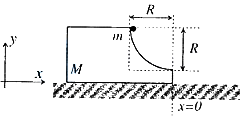
- A block of mass M has a circular cut with a frictionless surface as shown. The block rests on the horizontal frictionless surface of a fixed table. Initially the right edge of the block is at , in a coordinate system fixed to the table. A point mass m is released from rest at the topmost point of the path as shown and it slides down. When the mass loses contact with the block its position is x and velocity is v. At that instant which of the following options is correct?
 JEE Advanced 2017 Easy
 - Paragraph:
The figure shows a circular loop of radius \(a\) with two long parallel wires (numbered \(1\) and \(2\) ) all in the plane of the paper. The distance of each wire from the centre of the loop is \(d\). The loop and the wires are carrying the same current \(I\). The current in the loop is in the counterclockwise direction if seen from above.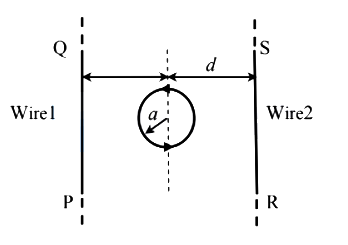
Question:
When \(d \approx a\) but wires are not touching the loop, it is found that the net magnetic field on the axis of the loop is zero at a height \(h\) above the loop. In that caseJEE Advanced 2014 Medium - Two balls, having linear momenta \(\overrightarrow{\mathbf{p}}_1=p \hat{\mathbf{i}}\) and \(\overrightarrow{\mathbf{p}}_2=-p \hat{\mathbf{i}}\), undergo a collision in free space. There is no external force acting on the balls. Let \(\overrightarrow{\mathbf{p}}_1^{\prime}\) and \(\overrightarrow{\mathbf{p}}_2^{\prime}\) be their final momenta. The following option(s) is/are NOT ALLOWED for any non-zero value of \(p, a_1, a_2, b_1, b_2, c_1\) and \(c_2\)JEE Advanced 2008 Easy
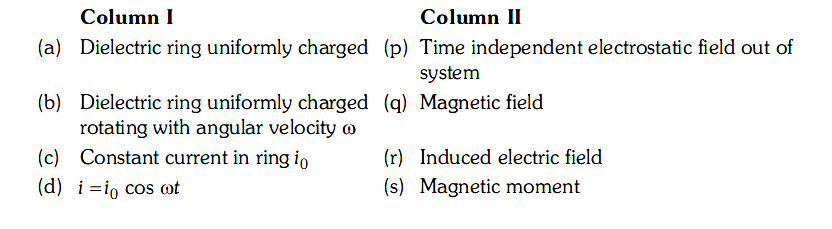
- Match the following columns
 JEE Advanced 2006 Hard
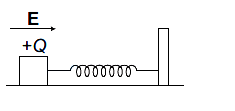
 - A wooden block performs SHM on a frictionless surface with frequency \(v_0\). The block carries a charge \(+Q\) on its surface. If now a uniform electric field \(\mathbf{E}\) is switched on as shown, then the SHM of the block will be
 JEE Advanced 2011 Easy
More PYQs from JEE Advanced
- Consider the lines and the planes Let be the equation of the plane passing through the point of intersection of L1 and L2, and perpendicular to planes P1 and P2.
Match List- I with List - II and select the correct answer using the code given below the lists :
List I List II A. a = P. 13 B. b = Q. -3 C. c = R. 1 D. d = S. -2 JEE Advanced 2013 Medium - A cylindrical container is to be made from certain solid material with the following constraints: It has a fixed inner volume of , has a 2 mm thick solid wall and is open at the top. The bottom of the container is a solid circular disc of thickness 2mm and is of radius equal to the outer radius of the container.
If the volume of the material used to make the container is minimum when the inner radius of the container is 10mm, then the value of isJEE Advanced 2015 Medium - The plot given below shows curves (where, is the pressure and is the temperature) for two solvents and and isomolal solutions of in these solvents. is completely dissociates in both the solvents.
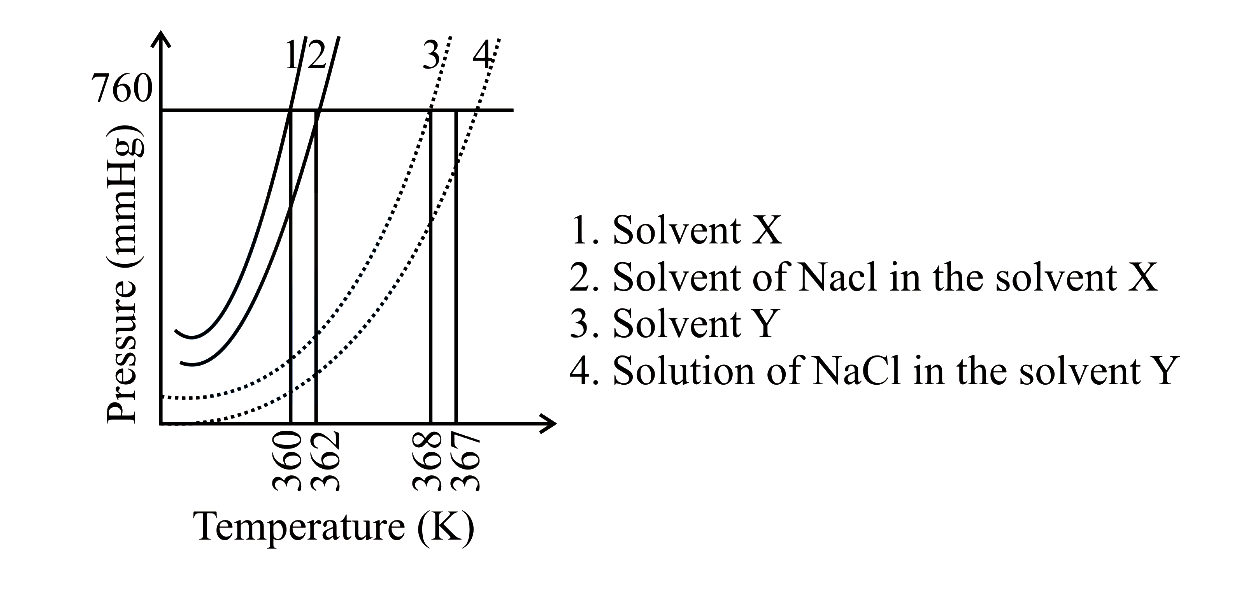
On the addition of equal number of moles of a non-volatile solute in equal amount (in ) of these solvents, the elevation of boiling point of solvent is three times that of solvent . The solute is known to undergo dimerization in these solvents. If the degree of dimerization is in the solvent , the degree of dimerization in the solvent is _______.JEE Advanced 2018 Hard - The difference in the oxidation numbers of the two types of sulphur atoms in \(\mathrm{Na}_2 \mathrm{~S}_4 \mathrm{O}_6\) isJEE Advanced 2011 Medium
- Paragraph:
The circle \(x^2+y^2-8 x=0\) and hyperbola \(\frac{x^2}{9}-\frac{y^2}{4}=1\) intersect at the points \(A\) and \(B\).Question:
Equation of the circle with \(A B\) as its diameter isJEE Advanced 2010 Easy - The locus of the orthocentre of the triangle formed by the lines \((1+p) x-p y+p(1+p)=0\), \((1+q) x-q y+q(1+q)=0\) and \(y=0\), where \(p \neq q\), isJEE Advanced 2009 Hard