


JEE Advanced · Physics · 15. Oscillations
Paragraph :
When a particle of mass \(m\) moves on the \(x\)-axis in a potential of the form \(V(x)=k x^2\), it performs simple harmonic motion.
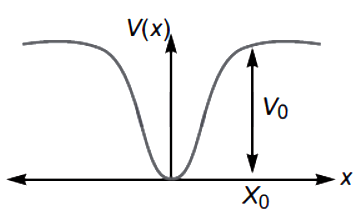
The corresponding time period is proportional to \(\sqrt{\frac{m}{k}}\), as can be seen easily using dimensional analysis. However, the motion of a particle can be periodic even when its potential energy increases on both sides of \(x=0\) in a way different from \(k x^2\) and its total energy is such that the particle does not escape to infinity. Consider a particle of mass \(\mathrm{m}\) moving on the \(x\)-axis. Its potential energy is \(V(x)=\alpha x^4(\alpha>0)\) for \(|x|\) near the origin and becomes a constant equal to \(V_0\) for \(|x| \geq X_0\) (see figure).
Question :
The acceleration of this particle for \(|x|>X_0\) is
- A proportional to \(V_0\)
- B proportional to \(\frac{V_0}{m X_0}\)
- C proportional to \(\sqrt{\frac{V_0}{m X_0}}\)
- D Zero
Answer & Solution
Correct Answer
(D) Zero
Step-by-step Solution
Detailed explanation
For \(|x|>X_0\), potential energy is constant. Hence, kinetic energy, speed or velocity will also remain constant.
\(\therefore\) Acceleration will be zero.
Hence, the correct option is (d).
\(\therefore\) Acceleration will be zero.
Hence, the correct option is (d).
See the Complete Solution
Get step-by-step explanations for this and 2.5 Lakh+ more JEE, NEET & CET questions.
- Unlock all solutions
- Practice the full chapter
- Track accuracy across PYQs
4.8 rated on Google Play · 14,000+ reviews
More questions from Physics
- The efficiency of a Carnot engine operating with a hot reservoir kept at a temperature of 1000 K is 0.4. It extracts 150 J of heat per cycle from the hot reservoir. The work extracted from this engine is being fully used to run a heat pump which has a coefficient of performance 10 . The hot reservoir of the heat pump is at a temperature of 300 K . Which of the following statements is/are correct:JEE Advanced 2025 Hard
- In an aluminum (Al) bar of square cross section, a square hole is drilled and is filled with iron (Fe) as shown in the figure. The electrical resistivities of Al and Fe are and , respectively. The electrical resistance between the two faces P and Q of the composite bar is
 JEE Advanced 2015 Medium
 - A soft plastic bottle, filled with water of density \(1 \mathrm{gm} / \mathrm{cc}\), carries an inverted glass test-tube with some air (ideal gas) trapped as shown in the figure. The test-tube has a mass of \(5 \mathrm{gm}\), and it is made of a thick glass of density \(2.5 \mathrm{gm} / \mathrm{cc}\). Initially the bottle is sealed at atmospheric pressure \(p_{0}=10^{5} \mathrm{~Pa}\) so that the volume of the trapped air is \(v_{0}=3.3 \mathrm{cc}\). When the bottle is squeezed from outside at constant temperature, the pressure inside rises and the volume of the trapped air reduces. It is found that the test tube begins to sink at pressure \(p_{0}+\Delta p\) without changing its orientation. At this pressure, the volume of the trapped air is \(v_{0}-\Delta v\).
Let \(\Delta v=X\) cc and \(\Delta p=Y \times 10^{3} \mathrm{~Pa}\).
The value of is ____.JEE Advanced 2021 Hard - In a particular system of units, a physical quantity can be expressed in terms of the electric charge , electron mass . Planck's constant , and Coulomb's constant , where is the permittivity of vacuum. In terms of these physical constants, the dimension of the magnetic field is . The value of is _______.JEE Advanced 2022 Medium
- Statement 1 For practical purposes, the earth is used as a reference at zero potential in electrical circuits.
and Statement 2 The electrical potential of a sphere of radius \(R\) with charge \(Q\) uniformly distributed on the surface is given by \(\frac{Q}{4 \pi \varepsilon_0 R}\).JEE Advanced 2008 Easy - A freshly prepared sample of a radioisotope of half-life 1386 s has activity \({10}^{3}\) disintegrations per second. Given that In 2 = 0.693, the fraction of the initial number of nuclei (expressed in nearest integer percentage) that will decay in the first 80 s after preparation of the sample isJEE Advanced 2013 Medium
More PYQs from JEE Advanced
- Paragraph:
Let \(A, B, C\) be three sets of complex numbers as defined below.
\(A=\{z ; \operatorname{lm} z \geq 1\} ; B=\{z:|z-2-i|=3\} ;\) \(C=\{z: \operatorname{Re}((1-i) z)=\sqrt{2}\}\).
Question:
Let \(z\) be any point in \(A \cap B \cap C\). The \(|z+1-i|^2+|z-5-i|^2\) lies betweenJEE Advanced 2008 Easy - Let and be the unit vectors along the three positive coordinate axes. Let be three vectors such that and Then, which of the following is/are TRUE?JEE Advanced 2022 Medium
- A student appears for a quiz consisting of only true-false type questions and answers all the questions. The student knows the answers of some questions and guesses the answers for the remaining questions. Whenever the student knows the answer of a question, he gives the correct answer. Assume that the probability of the student giving the correct answer for a question, given that he has guessed it, is \(\frac{1}{2}\). Also assume that the probability of the answer for a question being guessed, given that the student's answer is correct, is \(\frac{1}{6}\). Then the probability that the student knows the answer of a randomly chosen question isJEE Advanced 2024 Medium
- For any real numbers and , let , be the solution of the differential equation Let . Then which of the following functions belong(s) to the set ?JEE Advanced 2021 Hard
- The minimum value of the sum of real numbers \(a^{-5}, a^{-4}, 3 a^{-3}, 1, a^8\) and \(a^{10}\) with \(a>0\) isJEE Advanced 2011 Medium
- Let \(f:[-1,2] \rightarrow[0, \infty)\) be a continuous function such that \(f(x)=f(1-x)\) for all \(x \in[-1,2]\). Let \(R_1=\int_{-1}^2 x f(x) d x\) and \(R_2\) be the area of the region bounded by \(y=f(x), x=-1, x=2\) and the \(X\)-axis. Then,JEE Advanced 2011 Medium