


JEE Advanced · Physics · 27. Atomic Physics
Paragraph:
When a particle is restricted to move along \(x\)-axis between \(x=0\) and \(x=a\), where \(a\) is of nanometer dimension, its energy can take only certain specific values. The allowed energies of the particle moving in such a restricted region, correspond to the formation of standing waves with nodes at its ends \(x=0\) and \(x=a\). The wavelength of this standing wave is related to the liner momentum \(p\) of the particle according to the de Broglie relation. The energy of the particle of mass \(m\) is related to its linear momentum as \(E=\frac{p^2}{2 m}\). Thus, the energy of the particle can be denoted by a quantum number \(n\) taking values \(1,2,3, \ldots(n=1\), called the ground state) corresponding to the number of loops in the standing wave.
Use the model described above to answer the following three questions for a particle moving in the line \(x=0\) to \(x=a\) [Take \(h=6.6 \times 10^{-34} \mathrm{Js}\) and \(e=1.6 \times 10^{-19} \mathrm{C}\) ]
Question:
The speed of the particle that can take discrete values is proportional to
- A \(n^{-3 / 2}\)
- B \(n^{-1}\)
- C \(n^{1 / 2}\)
- D \(n\)
Answer & Solution
Correct Answer
(D) \(n\)
Step-by-step Solution
Detailed explanation
From Eq. (i)
See the Complete Solution
Get step-by-step explanations for this and 2.5 Lakh+ more JEE, NEET & CET questions.
- Unlock all solutions
- Practice the full chapter
- Track accuracy across PYQs
4.8 rated on Google Play · 14,000+ reviews
More questions from Physics
- An -particle (mass amu) and a singly charged Sulphur ion (mass amu) are initially at rest. They are accelerated through a potential and then allowed to pass into a region of uniform magnetic field which is normal to the velocities of the particles. Within this region, the -particle and the sulphur ion move in circular orbits of radii and , respectively. The ratio is __________ .JEE Advanced 2021 Easy
- The largest wavelength in the ultraviolet region of the hydrogen spectrum is \(122 \mathrm{~nm}\). The smallest wavelength in the infrared region of the hydrogen spectrum (to the nearest integer) isJEE Advanced 2007 Hard
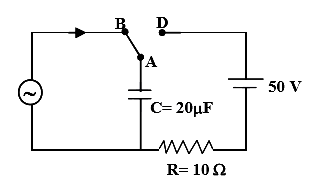
- At time t = 0, terminal A in the circuit shown in the figure is connected to B by a key and an alternating current , with and rad/s starts flowing in it with the initial direction shown in the figure. At , the key is switched from B to D. Now onwards only A and D are connected. A total charge Q flows from the battery to charge the capacitor fully. If and the battery is ideal with of 50V, identify the correct statement(s).
 JEE Advanced 2014 Medium
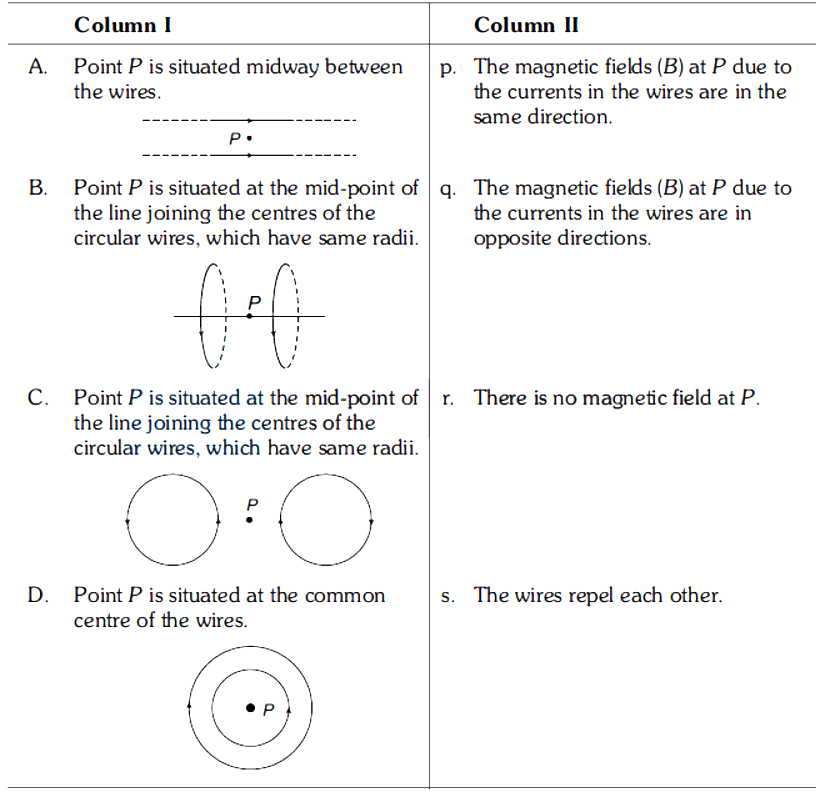
 - Two wires each carrying a steady current \(I\) are shown in four configurations in Column I. Some of the resulting effects are described in Column II. Match the statements in Column I with the statements in Column II and indicate your answer by darkening appropriate bubbles in the \(4 \times 4\) matrix given in the ORS.
 JEE Advanced 2007 Hard
 - The filament of a light bulb has surface area The filament can be considered as a black body at temperature emitting radiation like a point source when viewed from far. At night the light bulb is observed from a distance of . Assume the pupil of the eyes of the observer to be circular with radius . Then: (Take Stefan-Boltzmann constant Wiens' displacement constant , Planck's constant , speed of light in vacuum )JEE Advanced 2020 Hard
- Paragraph:
A small spherical monoatomic ideal gas bubble \(\left(\gamma=\frac{5}{3}\right)\) is trapped inside a liquid of density \(\rho_1\) (see figure). Assume that the bubble does not exchange any heat with the liquid. The bubble contains \(n\) moles of gas. The temperature of the gas when the bubble is at the bottom is \(T_0\), the height of the liquid is \(H\) and the atmospheric pressure is \(p_0\) (Neglect surface tension).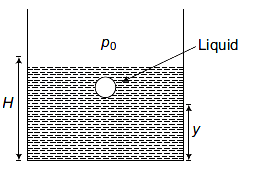
Question:
The buoyancy force acting on the gas bubble is (Assume \(R\) is the universal gas constant)JEE Advanced 2008 Hard
More PYQs from JEE Advanced
- The value of thenJEE Advanced 2017 Hard
- Two inductors (inductance , internal resistance ) and (inductance , internal resistance ), and a resistor (resistance ) are all connected in parallel across a battery. The circuit is switched on at time . The ratio of the maximum current drawn from the battery is:JEE Advanced 2016 Medium
- Paragraph:
Let \(a, r, s, t\) be nonzero real numbers. Let \(P\left(a t^{2}, 2 a t\right), Q, R\left(a r^{2}, 2 a r\right)\) and \(S\left(a s^{2}, 2 a s\right)\) be distinct points on the parabola \(y^{2}=4 a x\). Suppose that \(P Q\) is the focal chord and lines \(Q R\) and \(P K\) are parallel, where \(K\) is the point \((2 a, 0)\).
Question:
If \(s t=1\), then the tangent at \(P\) and the normal at \(S\) to the parabola meet at a point whose ordinate isJEE Advanced 2014 Medium - Paragraph:
Chemical reactions involve interaction of atoms and molecules. A large number of atoms/molecules (approximately \(6.023 \times 10^{23}\) ) are present in a few grams of any chemical compound varying with their atomic/molecular masses. To handle such large numbers conveniently, the mole concept was introduced. This concept has implications in diverse areas such as analytical chemistry, biochemistry, electrochemistry and radiochemistry. The following example illustrates a typical case, involving chemical/electrochemical reaction, which requires a clear understanding of the mole concept.
A \(4.0\) molar aqueous solution of \(\mathrm{NaCl}\) is prepared and \(500 \mathrm{~mL}\) of this solution is electrolysed. This leads to the evolution of chlorine gas at one of electrodes (atomic mass: \(\mathrm{Na}=23, \mathrm{Hg}=200 ; 1\) faraday \(=96500\) coulombs).
Question:
The total charge (coulombs) required for complete electrolysis isJEE Advanced 2007 Medium - A uniform circular disc of mass and radius is rotating with an angular velocity of about its own axis, which is vertical. Two uniform circular rings, each of mass and radius , are gently placed symmetrically on the disc in such a manner that they are touching each other along the axis of the disc and are horizontal. Assume that the friction is large enough such that the rings are at rest relative to the disc and the system rotates about the original axis. The new angular velocity of the system isJEE Advanced 2013 Medium
- Columns 1, 2 and 3 contain starting materials, reaction conditions and type of reactions respectively.
The only CORRECT combination in which the reaction proceeds through radical mechanism isColumn 1 Column 2 Column 3 (I) Toulene (i) \(NaOH\) \( /Br _2\) (P) Condensation (II) Acetophenone (ii) \(B r_2 / h v\) (Q) Carboxylation (III) Benzaldehyde (iii) \(\left( CH _3 CO \right)_2\) \(O / CH _3\) \(COOK\) (R) Substitution (IV) Phenol (iv) \(NaOH\) \(/CO _2\) (S) Haloform JEE Advanced 2017 Medium