


JEE Advanced · Physics · 27. Atomic Physics
Consider a hydrogen-like ionized atom with atomic number with a single electron. In the emission spectrum of this atom, the photon emitted in the transition has energy higher than the photon emitted in the transition. Given that the ionization energy of the hydrogen atom is , what is the value of ?
- A 3
- B 5
- C 7
- D 9
Answer & Solution
Correct Answer
(A) 3
Step-by-step Solution
Detailed explanation
See the Complete Solution
Get step-by-step explanations for this and 2.5 Lakh+ more JEE, NEET & CET questions.
- Unlock all solutions
- Practice the full chapter
- Track accuracy across PYQs
4.8 rated on Google Play · 14,000+ reviews
More questions from Physics
- In an experiment to determine the acceleration due to gravity g, the formula used for the time period of a periodic motion is The values of R and r are measured to be respectively. In five successive measurements, the time period is found to be 0.52s, 0.56s, 0.57s, 0.54s and 0.59s. The least count of the watch used for the measurement of time period is 0.01s. Which of the following statements (s) is (are) true?JEE Advanced 2016 Medium
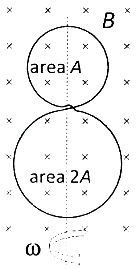
- A circular insulated copper wire loop is twisted to form two loops of area and as shown in the figure. At the point of crossing the wires remain electrically insulated from each other. The entire loop lies in the plane (of the paper). A uniform magnetic field points into the plane of the paper. At , the loop starts rotating about the common diameter as axis with a constant angular velocity in the magnetic field. Which of the following options is/are correct?
 JEE Advanced 2017 Hard
 - A binary star consists of two stars \(A\) (mass \(2.2 M_S\) ) and \(B\) (mass \(11 M_s\) ), where \(M_S\) is the mass of the sun. They are separated by distance \(d\) and are rotating about their centre of mass, which is stationary. The ratio of the total angular momentum of the binary star to the angular momentum of \(\operatorname{star} B\) about the centre of mass isJEE Advanced 2010 Medium
- Paragraph:
A point charge \(Q\) is moving in a circular orbit of radius \(R\) in the \(x-y\) plane with an angular velocity \(\omega .\) This can be considered as equivalent to a loop carrying a steady current \(\frac{Q \omega}{2 \pi}\). A uniform magnetic field along the positive \(z\)-axis is now switched on, which increases at a constant rate from 0 to \(B\) in one second. Assume that the radius of the orbit remains constant. The application of the magnetic field induces an emf in the orbit. The induced emf is defined as the work done by an induced electric field in moving a unit positive charge around a closed loop. It is known that, for an orbiting charge, the magnetic dipole moment is proportional to the angular momentum with a proportionality constant \(\gamma\).
Question:
The magnitude of the induced electric field in the orbit at any instant of time during the time interval of the magnetic field change isJEE Advanced 2013 Medium - A positive point charge of \(10^{-8} \mathrm{C}\) is kept at a distance of 20 cm from the center of a neutral conducting sphere of radius 10 cm . The sphere is then grounded and the charge on the sphere is measured. The grounding is then removed and subsequently the point charge is moved by a distance of 10 cm further away from the center of the sphere along the radial direction. Taking \(\frac{1}{4 \pi \epsilon_0}=9 \times 10^9 \mathrm{Nm}^2 / \mathrm{C}^2\) (where \(\epsilon_0\) is the permittivity of free space), which of the following
statements is/are correct: :JEE Advanced 2025 Medium - Paragraph :
A special metal \(S\) conducts electricity without any resistance. A closed wire loop, made of \(S\), does not allow any change in flux through itself by inducing a suitable current to generate a compensating flux. The induced current in the loop cannot decay due to its zero resistance. This current gives rise to a magnetic moment which in turn repels the source of magnetic field or flux. Consider such a loop, of radius \(a\), with its center at the origin. A magnetic dipole of moment \(m\) is brought along the axis of this loop from infinity to a point at distance \(r(\gg a)\) from the center of the loop with its north pole always facing the loop, as shown in the figure below.
The magnitude of magnetic field of a dipole \(m\), at a point on its axis at distance \(r\), is \(\frac{\mu_{0}}{2 \pi} \frac{m}{r^{3}}\), where \(\mu_{0}\) is the permeability of free space. The magnitude of the force between two magnetic dipoles with moments, \(m_{1}\) and \(m_{2}\), separated by a distance \(r\) on the common axis, with their north poles facing each other, is \(\frac{k m_{1} m_{2}}{r^{4}}\), where \(k\) is a constant of appropriate dimensions. The direction of this force is along the line joining the two dipoles.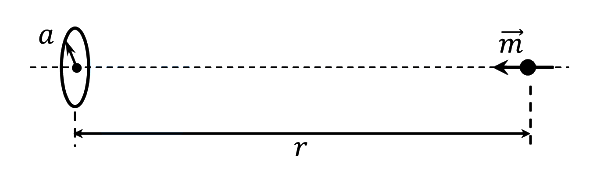
Question :
The work done in bringing the dipole from infinity to a distancefrom the centre of the loop by the given process is proportional to:JEE Advanced 2021 Hard
More PYQs from JEE Advanced
- Among the species given below, the total number of diamagnetic species is _____________.
\(H\) atom, \(N O_2\) monomer, \(O_2^{-}\)(superoxide), dimeric sulphur in vapour phase,
\(Mn_3 O_4, \left(NH_4\right)_2\left[FeCl_4\right], \left(NH_4\right)_2\left[NiCl_4\right],\) \(K_2 MnO_4, K_2 CrO_4\)JEE Advanced 2018 Easy - Let be the cube with the set of vertices . Let be the set of all twelve lines containing the diagonals of the six faces of the cube . Let be the set of all four lines containing the main diagonals of the cube ; for instance, the line passing through the vertices and is in . For lines and , let denote the shortest distance between them. Then the maximum value of , as varies over and varies over , isJEE Advanced 2023 Easy
- Among \(H_2, H e_2^{+}, L i_2, B e_2, B_2, C_2, N_2, O_2^{-}\), and \(F_2\), the number of diamagnetic species is -
(Atomic number : \(H=1, H e=2, L i=3, B e=4, B=5,\) \(C=6, N =7, O=8, F=9\) )JEE Advanced 2017 Easy - Consider a star of mass \(m_2 \mathrm{~kg}\) revolving in a circular orbit around another star of mass \(m_1 \mathrm{~kg}\) with \(m_1 \gg m_2\). The heavier star slowly acquires mass from the lighter star at a constant rate of \(\gamma \mathrm{kg} / \mathrm{s}\). In this transfer process, there is no other loss of mass. If the separation between the centers of the stars is \(r\), then its relative rate of change \(\frac{1}{r} \frac{\mathrm{~d} r}{\mathrm{~d} t}\left(\right.\) in s \(\left.^{-1}\right)\) is given by:
[Note: The original question was awarded bonus marks in the JEE Advanced 2025 exam. We have changed the options to make the question valid and solvable.]JEE Advanced 2025 Hard - Let be the minimum possible value of , where are real numbers for which . Let be the maximum possible value of , where are positive real numbers for which . Then the value of isJEE Advanced 2020 Medium
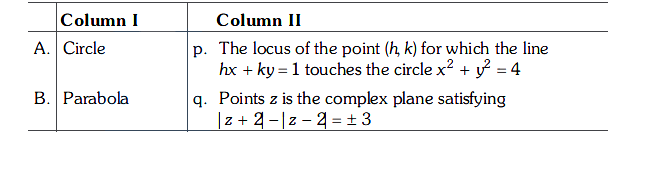
- \[
\text { Match the conics in Column I with the statements/expressions in Column II. }
\]
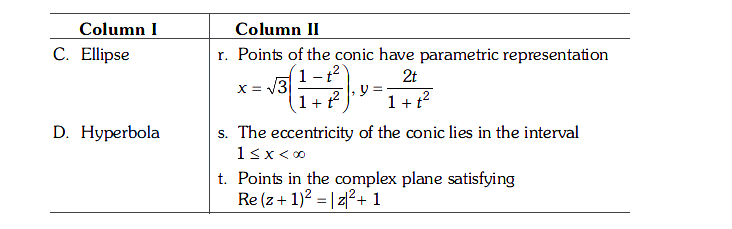 JEE Advanced 2009 Easy