


JEE Advanced · Mathematics · 19. Determinants
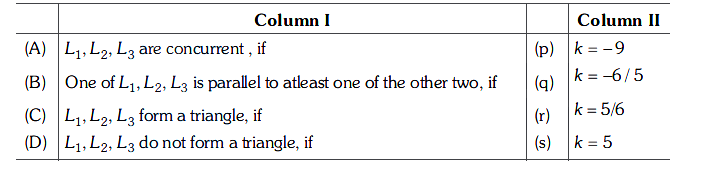
Consider the lines given by
\[
L_1: x+3 y-5=0, L_2: 3 x-k y-1=0, L_3: 5 x+2 y-12=0
\]
Match the Statements/Expressions in Column I with the Statements/Expressions in Column II.
- A
(A) r, (B) p,s, (C) s, (D) p,s
- B
(A) s, (B) p,q,r, (C) r, (D) p,q
- C
(A) s, (B) p,q, (C) r, (D) p,q,s
- D
(A) r, (B) p,q, (C) s, (D) p,q
Answer & Solution
Correct Answer
(C)
(A) s, (B) p,q, (C) r, (D) p,q,s
Step-by-step Solution
Detailed explanation
(A) Solving equations \(L_1\) and \(L_3\),
\[
\begin{aligned}
\frac{x}{-36+10} & =\frac{y}{+12-25}=\frac{1}{2-15} \\
x & =2, y=1
\end{aligned}
\]
\(L_1, L_2, L_3\) are concurrent, if point \((2,1)\) lies on \(L_2\).
\[
\therefore \quad 6-k-1=0 \Rightarrow k=5
\]
(B) Either \(L_1\) is parallel to \(L_2\), or \(L_3\) is parallel to \(L_2\), then
\[
\begin{aligned}
& \frac{1}{3}=\frac{3}{-k} \text { or } \frac{3}{5}=\frac{-k}{2} \\
& k=-9 \quad \text { or } \quad k=-\frac{6}{5}
\end{aligned}
\]
\[
\Rightarrow \quad k=-9 \text { or } k=-\frac{6}{5}
\]
(C) \(L_1, L_2, L_3\) form a triangle, if they are not concurrent, or not parallel.
\[
\therefore \quad k \neq 5,-9,-\frac{6}{5} \Rightarrow k=\frac{5}{6}
\]
(D) \(L_1, L_2, L_3\) do not form a triangle, if
\[
k=5,-9,-\frac{6}{5}
\]
\[
\begin{aligned}
\frac{x}{-36+10} & =\frac{y}{+12-25}=\frac{1}{2-15} \\
x & =2, y=1
\end{aligned}
\]
\(L_1, L_2, L_3\) are concurrent, if point \((2,1)\) lies on \(L_2\).
\[
\therefore \quad 6-k-1=0 \Rightarrow k=5
\]
(B) Either \(L_1\) is parallel to \(L_2\), or \(L_3\) is parallel to \(L_2\), then
\[
\begin{aligned}
& \frac{1}{3}=\frac{3}{-k} \text { or } \frac{3}{5}=\frac{-k}{2} \\
& k=-9 \quad \text { or } \quad k=-\frac{6}{5}
\end{aligned}
\]
\[
\Rightarrow \quad k=-9 \text { or } k=-\frac{6}{5}
\]
(C) \(L_1, L_2, L_3\) form a triangle, if they are not concurrent, or not parallel.
\[
\therefore \quad k \neq 5,-9,-\frac{6}{5} \Rightarrow k=\frac{5}{6}
\]
(D) \(L_1, L_2, L_3\) do not form a triangle, if
\[
k=5,-9,-\frac{6}{5}
\]
See the Complete Solution
Get step-by-step explanations for this and 2.5 Lakh+ more JEE, NEET & CET questions.
- Unlock all solutions
- Practice the full chapter
- Track accuracy across PYQs
4.8 rated on Google Play · 14,000+ reviews
More questions from Mathematics
- A computer producing factory has only two plants and . Plant produces and plant produces of the total computers produced. of computers produced in the factory turn out to be defective. It is known that, (computer turns out to be defective given that it is produced in plant ) (computer turns out to be defective given that it is produced in plant ). Where, denotes the probability of an event A computer produced in the factory is randomly selected and it does not turn out to be defective. Then the probability that it is produced in plant isJEE Advanced 2016 Medium
- If the normal of the parabola drawn at the end points of its latus rectum are tangents to the circle then the value of isJEE Advanced 2015 Easy
- Let be the ellipse . For any three distinct points and on , let be the mid-point of the line segment joining and , and be the mid-point of the line segment joining and . Then the maximum possible value of the distance between and , as and vary on , is _____.JEE Advanced 2021 Medium
- Let be the origin and and for some If then which of the following statements is (are) TRUE?JEE Advanced 2021 Medium
- Paragraph:
Consider the functions defined implicitly by the equation \(y^3-3 y+x=0\) on various intervals in the real line. If \(x \in(-\infty,-2) \cup(2, \infty)\), the equation implicitly defines a unique real valued differentiable function \(y=f(x)\). If \(x \in(-2,2)\), the equation implicitly defines a unique real valued differentiable function \(y=g(x)\), satisfying \(g(0)=0\).Question:
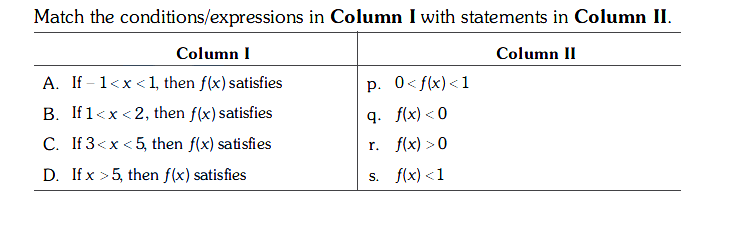
If \(f(-10 \sqrt{2})=2 \sqrt{2}\), then \(f^{\prime \prime}(-10 \sqrt{2})\) is equal toJEE Advanced 2008 Medium - Let \(f(x)=\frac{x^2-6 x+5}{x^2-5 x+6}\).
 JEE Advanced 2007 Hard
More PYQs from JEE Advanced
- A solution is prepared by mixing each of , and in \(100 \mathrm{~mL}\) of water. of the resulting solution is
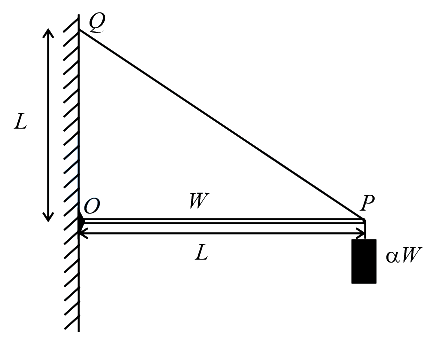
[Given: and of are and , respectively. ]JEE Advanced 2022 Medium - One end of a horizontal uniform beam of weight and length is hinged on a vertical wall at point and its other end is supported by a light inextensible rope. The other end of the rope is fixed at point , at a height above the hinge at point . A block of weight is attached at the point of the beam, as shown in the figure (not to scale). The rope can sustain a maximum tension of . Which of the following statement(s) is(are) correct?
 JEE Advanced 2021 Hard
 - Let be a differentiable function such that its derivative is continuous and . If is defined by and if , then the value of is_______JEE Advanced 2020 Medium
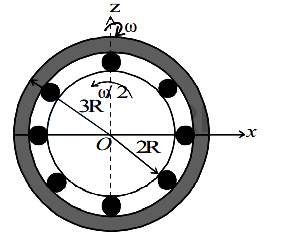
- The figure shows a system consisting of (i) a ring of outer radius \(3 R\) rolling clockwise without slipping on a horizontal surface with angular speed \(\omega\) and (ii) an inner disc of radius \(2 R\) rotating anti-clockwise with angular speed \(\omega / 2\). The ring and disc are separated by frictionless ball bearings. The point \(P\) on the inner disc is at a distance \(R\) from the origin, where \(O P\) makes an angle of \(30^{\circ}\) with the horizontal. Then with respect to the horizontal surface,
 JEE Advanced 2012 Medium
 - If the distance of the point \(P(1,-2,1)\) from the plane \(x+2 y-2 z=\alpha\), where \(\alpha>0\), is 5 , then the foot of the perpendicular from \(P\) to the plane isJEE Advanced 2010 Easy
- Three randomly chosen non negative integers are found to satisfy the equation . Then the probability that is even, is
JEE Advanced 2017 Medium