


JEE Advanced · Physics · 19. Current Electricity
Paragraph :
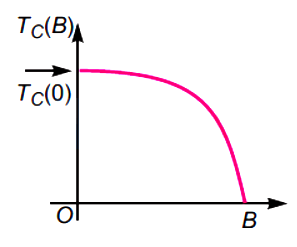
Electrical resistance of certain materials, known as superconductors, changes abruptly from a non-zero value to zero as their temperature is lowered below a critical temperature \(T_C(0)\). An interesting property of superconductors is that their critical temperature becomes smaller than \(T_C(0)\) if they are placed in a magnetic field i.e., the critical temperature \(T_C(B)\) is a function of the magnetic field strength \(B\). The dependence of \(T_C(B)\) on \(B\) is shown in the figure.
Question :
A superconductor has \(T_C(0)=100 \mathrm{~K}\). When a magnetic field of \(7.5\) Tesla is applied, its \(T_C\) decreases to \(75 \mathrm{~K}\). For this material one can definitely say that when (Note : \(\mathrm{T}\) = Tesla)
- A \(B=5 \mathrm{~T}, T_C(B)=80 \mathrm{~K}\)
- B \(B=5 \mathrm{~T}, 75 \mathrm{~K} < T_C(B) < 100 \mathrm{~K}\)
- C \(B=10 \mathrm{~T}, 75 \mathrm{~K} < T_C(B) < 100 \mathrm{~K}\)
- D \(B=10 \mathrm{~T}, T_C(B)=70 \mathrm{~K}\)
Answer & Solution
Correct Answer
(B) \(B=5 \mathrm{~T}, 75 \mathrm{~K} < T_C(B) < 100 \mathrm{~K}\)
Step-by-step Solution
Detailed explanation
With increase in temperature, \(T_C\) is decreasing.
\(
\begin{aligned}
T_C(0) & =100 \mathrm{~K} \\
T_C & =75 \mathrm{~K} \text { at } B=7.5 \mathrm{~T}
\end{aligned}
\)
Hence, at \(B=5 \mathrm{~T}, T_C\) should lie between \(75 \mathrm{~K}\) and \(100 \mathrm{~K}\). Hence, the correct option should be (b).
\(
\begin{aligned}
T_C(0) & =100 \mathrm{~K} \\
T_C & =75 \mathrm{~K} \text { at } B=7.5 \mathrm{~T}
\end{aligned}
\)
Hence, at \(B=5 \mathrm{~T}, T_C\) should lie between \(75 \mathrm{~K}\) and \(100 \mathrm{~K}\). Hence, the correct option should be (b).
See the Complete Solution
Get step-by-step explanations for this and 2.5 Lakh+ more JEE, NEET & CET questions.
- Unlock all solutions
- Practice the full chapter
- Track accuracy across PYQs
4.8 rated on Google Play · 14,000+ reviews
More questions from Physics
- The \(\beta\)-decay process, discovered around 1900 , is basically the decay of a neutron \((n)\). In the laboratory, a proton \((p)\) and an electron \(\left(e^{-}\right)\)are observed as the decay products of the neutron. Therefore, considering the decay of a neutron as a two-body decay process, it was predicted theoretically that the kinetic energy of the electron should be a constant. But experimentally, it was observed that the electron kinetic energy has continuous spectrum. Considering a three-body decay process, i.e.
\(n \rightarrow p+e^{-}+\bar{v}_{e}\), around 1930, Pauli explained the observed electron energy spectrum. Assuming the anti-neutrino \(\left(\bar{v}_{e}\right)\) to be massless and possessing negligible energy, and the neutron to be at rest, momentum and energy conservation principles are applied. From this calculation, the maximum kinetic energy of the electron is \(0.8 \times 10^{6} \mathrm{eV}\). The kinetic energy carried by the proton is only the recoil energy.
Question:
If the anti-neutrino had a mass of \(3 \mathrm{eV} / \mathrm{c}^{2}\) (where \(\mathrm{c}\) is the speed of light) instead of zero mass, what should be the range of the kinetic energy, \(K\), of the electron?JEE Advanced 2012 Hard - Two point charges \(-Q\) and \(+Q / \sqrt{3}\) are placed in the \(x y\)-plane at the origin \((0,0)\) and a point \((2,0)\), respectively, as shown in the figure. This results in an equipotential circle of radius \(R\) and potential \(V=0\) in the \(x y\)-plane with its center at \((b, 0)\). All lengths are measured in meters.
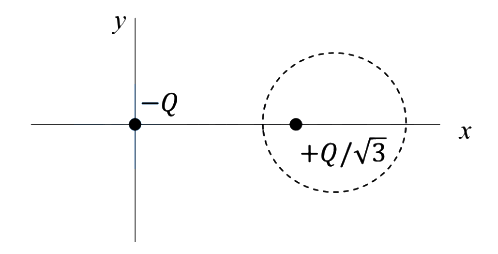
The value of is ________ meter.JEE Advanced 2021 Medium - A photoelectric material having work-function is illuminated with a light of wavelength . The fastest photoelectron has a de Broglie wavelength . A change in wavelength of the incident light by results in a change in . The ratio is proportional toJEE Advanced 2017 Hard
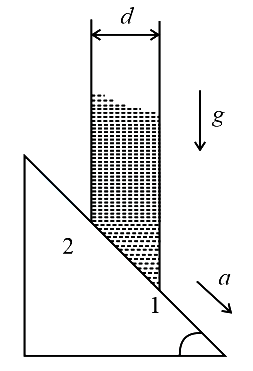
- A cylindrical tube, with its base as shown in the figure., is filled with water. It is moving down with a constant acceleration along a fixed inclined plane with angle . and are pressures at point and , respectively, located at the base of the tube. Let , where is density of water, is the inner diameter of the tube and is the acceleration due to gravity. Which of the following statement(s) is (are) correct?
 JEE Advanced 2021 Hard
 - A ray of light travelling in water is incident on its surface open to air. The angle of incidence is \(\theta\), which is less than the critical angle. Then there will beJEE Advanced 2007 Medium
- A table tennis ball has radius \((3 / 2) \times 10^{-2} \mathrm{~m}\) and mass \((22 / 7) \times 10^{-3} \mathrm{~kg}\). It is slowly pushed down into a swimming pool to a depth of \(d=0.7 \mathrm{~m}\) below the water surface and then released from rest. It emerges from the water surface at speed \(v\), without getting wet, and rises up to a height \(H\). Which of the following option(s) is(are) correct?
[Given: \(\pi=22 / 7, g=10 \mathrm{~m} \mathrm{~s}^{-2}\), density of water \(=1 \times 10^3 \mathrm{~kg} \mathrm{~m}^{-3}\), viscosity of water \(=1 \times 10^{-3} \mathrm{~Pa}\)-s.]JEE Advanced 2024 Hard
More PYQs from JEE Advanced
- A student is performing an experiment using a resonance column and a tuning fork of frequency \(244 s^{-1}\). He is told that the air in the tube has been replaced by another gas (assume that the column remains filled with the gas). If the minimum height at which resonance occurs is \((0.350 \pm 0.005) m\), the gas in the tube is (Useful information: \(\sqrt{167\text{ RT}}=640\text{ J}^{\frac{1}{2}}\text{ mol}^{-\frac{1}{2}} ;\) \(\sqrt{140\text{ RT}}=590\text{ J}^{\frac{1}{2}}\text{ mole}^{-\frac{1}{2}}\) . The molar masses M in grams are given in the options. Take the values of \(\sqrt{\frac{10}{\text M }}\) for each gas as given there.)JEE Advanced 2014 Easy
- Let be the function defined as if where . Let be a function such that for all . ThenJEE Advanced 2023 Hard
- Let \(\mathbb{R}\) denote the set of all real numbers. Let \(f: \mathbb{R} \rightarrow \mathbb{R}\) be defined by
\(f(x)= \begin{cases}\frac{6 x+\sin x}{2 x+\sin x} & \text { if } x \neq 0 \\ \frac{7}{3} & \text { if } x=0\end{cases}\)
Then which of the following statements is (are) TRUE?JEE Advanced 2025 Hard - The desired product X can be prepared by reacting the major product of the reactions in LIST-I with one or more appropriate reagents in LIST-II.
(given, order of migratory aptitude: aryl > alkyl hydrogen)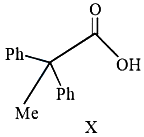
LIST-I LIST -II A) 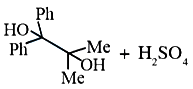
P) B) 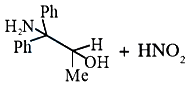
Q) C) 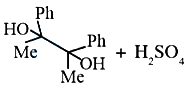
R) Fehling solution D) 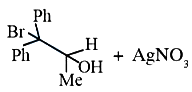
S) T) JEE Advanced 2018 Medium - Match the specified conditions in solids listed in Column I with their properties in Column II. Indicate your answer by darkening the appropriate bubbles of the \(4 \times 4\) matrix given in the ORS.
Column I Column II A. Simple cubic and face-centered cubic p. Have these cell parameters \(a=b=c \text { and } \alpha=\beta=\gamma\) B. Cubic and rhombohedral q. Are two crystal systems C. Cubic and tetragonal r. Have only two crystallographic angles of \(90^{\circ}\) D. Hexagonal and monoclinic s. Belong to same crystal system JEE Advanced 2007 Easy - Electrolysis of dilute aq. \(\mathrm{NaCl}\) solution was carried out by passing \(10 \mathrm{~mA}\) current. The time required to liberate \(0.01\) mole of \(\mathrm{H}_2\) gas at the cathode is (1 Faraday \(=96500 \mathrm{C} \mathrm{mol}^{-1}\) )JEE Advanced 2008 Hard