


JEE Advanced · Physics · 11. Properties of Fluids
A table tennis ball has radius \((3 / 2) \times 10^{-2} \mathrm{~m}\) and mass \((22 / 7) \times 10^{-3} \mathrm{~kg}\). It is slowly pushed down into a swimming pool to a depth of \(d=0.7 \mathrm{~m}\) below the water surface and then released from rest. It emerges from the water surface at speed \(v\), without getting wet, and rises up to a height \(H\). Which of the following option(s) is(are) correct?
[Given: \(\pi=22 / 7, g=10 \mathrm{~m} \mathrm{~s}^{-2}\), density of water \(=1 \times 10^3 \mathrm{~kg} \mathrm{~m}^{-3}\), viscosity of water \(=1 \times 10^{-3} \mathrm{~Pa}\)-s.]
- A The work done in pushing the ball to the depth \(d\) is \(0.077 \mathrm{~J}\).
- B If we neglect the viscous force in water, then the speed \(v=7 \mathrm{~m} / \mathrm{s}\).
- C If we neglect the viscous force in water, then the height \(H=1.4 \mathrm{~m}\).
- D The ratio of the magnitudes of the net force excluding the viscous force to the maximum viscous force in water is \(500 / 9\).
Answer & Solution
Correct Answer
(A) The work done in pushing the ball to the depth \(d\) is \(0.077 \mathrm{~J}\).
Step-by-step Solution
Detailed explanation
Work done in pushing the ball
\(
W=(v \rho g) d-(v \sigma g) d
\)
Where,
\(\rho \rightarrow\) Density of water
\(\sigma \rightarrow\) Density of ball
\(
\begin{aligned}
& \Rightarrow W=\frac{4}{3} \pi R^3 \times 10 \times 0.7\left[1000-\frac{3}{4} \times \frac{10^{-3}}{R^3}\right] \\
& W=0.077 \mathrm{~J}
\end{aligned}
\)
[1 is correct]
\(\Rightarrow\) When ball is released at bottom same work (i.e. \(0.077 \mathrm{~J}\) ) is done on ball.
\(
\begin{aligned}
& \therefore \frac{1}{2} m v^2=0.077 \\
& v=\sqrt{\frac{0.077 \times 2}{\frac{22}{7} \times 10^{-3}}} \\
& =7 \mathrm{~m} / \mathrm{s}
\end{aligned}
\)
[2 is correct]
\(
\Rightarrow \text { also, } H=\frac{v^2}{2 g}=\frac{7 \times 7}{2 \times 10}=2.45 \mathrm{~m}
\)
[3 is incorrect]
\(\Rightarrow\) Net force \(F_{\text {net }}=v \sigma g-v \sigma g=0.11 \mathrm{~N}\)
Also, viscous force is maximum when \(v=7 \mathrm{~m} / \mathrm{s}\)
\(
\begin{aligned}
& \therefore\left(F_v\right)_{\max }=6 \pi \eta r v \\
& =6 \times \frac{22}{7} \times 10^{-3}\left(\frac{3}{2} \times 10^{-2}\right) \times 7 \\
& =18 \times 11 \times 10^{-5} \mathrm{~N}
\end{aligned}
\)
Now,
\(
\frac{F_{\text {net }}}{\left(F_v\right)_{\max }}=\frac{500}{9}
\)
[4 is correct]
\(
W=(v \rho g) d-(v \sigma g) d
\)
Where,
\(\rho \rightarrow\) Density of water
\(\sigma \rightarrow\) Density of ball
\(
\begin{aligned}
& \Rightarrow W=\frac{4}{3} \pi R^3 \times 10 \times 0.7\left[1000-\frac{3}{4} \times \frac{10^{-3}}{R^3}\right] \\
& W=0.077 \mathrm{~J}
\end{aligned}
\)
[1 is correct]
\(\Rightarrow\) When ball is released at bottom same work (i.e. \(0.077 \mathrm{~J}\) ) is done on ball.
\(
\begin{aligned}
& \therefore \frac{1}{2} m v^2=0.077 \\
& v=\sqrt{\frac{0.077 \times 2}{\frac{22}{7} \times 10^{-3}}} \\
& =7 \mathrm{~m} / \mathrm{s}
\end{aligned}
\)
[2 is correct]
\(
\Rightarrow \text { also, } H=\frac{v^2}{2 g}=\frac{7 \times 7}{2 \times 10}=2.45 \mathrm{~m}
\)
[3 is incorrect]
\(\Rightarrow\) Net force \(F_{\text {net }}=v \sigma g-v \sigma g=0.11 \mathrm{~N}\)
Also, viscous force is maximum when \(v=7 \mathrm{~m} / \mathrm{s}\)
\(
\begin{aligned}
& \therefore\left(F_v\right)_{\max }=6 \pi \eta r v \\
& =6 \times \frac{22}{7} \times 10^{-3}\left(\frac{3}{2} \times 10^{-2}\right) \times 7 \\
& =18 \times 11 \times 10^{-5} \mathrm{~N}
\end{aligned}
\)
Now,
\(
\frac{F_{\text {net }}}{\left(F_v\right)_{\max }}=\frac{500}{9}
\)
[4 is correct]
See the Complete Solution
Get step-by-step explanations for this and 2.5 Lakh+ more JEE, NEET & CET questions.
- Unlock all solutions
- Practice the full chapter
- Track accuracy across PYQs
4.8 rated on Google Play · 14,000+ reviews
More questions from Physics
- A pendulum consists of a bob of mass \(m=0.1 \mathrm{~kg}\) and a massless inextensible string of length \(L=1.0 \mathrm{~m}\). It is suspended from a fixed point at height \(H=0.9 \mathrm{~m}\) above a frictionless horizontal floor. Initially, the bob of the pendulum is lying on the floor at rest vertically below the point of suspension. A horizontal impulse \(P=0.2 \mathrm{~kg}-\mathrm{m} / \mathrm{s}\) is imparted to the bob at some instant. After the bob slides for some distance, the string becomes taut and the bob lifts off the floor. The magnitude of the angular momentum of the pendulum about the point of suspension just before the bob lifts off is \(J \mathrm{~kg}-\mathrm{m}^{2} / \mathrm{s}\). The kinetic energy of the pendulum just after the liftoff is \(K\) Joules.
The value of is ____.JEE Advanced 2021 Hard - The \(\beta\)-decay process, discovered around 1900 , is basically the decay of a neutron \((n)\). In the laboratory, a proton \((p)\) and an electron \(\left(e^{-}\right)\)are observed as the decay products of the neutron. Therefore, considering the decay of a neutron as a two-body decay process, it was predicted theoretically that the kinetic energy of the electron should be a constant. But experimentally, it was observed that the electron kinetic energy has continuous spectrum. Considering a three-body decay process, i.e.
\(n \rightarrow p+e^{-}+\bar{v}_{e}\), around 1930, Pauli explained the observed electron energy spectrum. Assuming the anti-neutrino \(\left(\bar{v}_{e}\right)\) to be massless and possessing negligible energy, and the neutron to be at rest, momentum and energy conservation principles are applied. From this calculation, the maximum kinetic energy of the electron is \(0.8 \times 10^{6} \mathrm{eV}\). The kinetic energy carried by the proton is only the recoil energy.
Question:
What is the maximum energy of the anti-neutrino?JEE Advanced 2012 Medium - A glass beaker has a solid, plano-convex base of refractive index 1.60, as shown in the figure. The radius of curvature of the convex surface (SPU) is \(9 \mathrm{~cm}\), while the planar surface (STU) acts as a mirror. This beaker is filled with a liquid of refractive index \(n\) up to the level QPR. If the image of a point object \(\mathrm{O}\) at a height of \(h\) (OT in the figure) is formed onto itself, then, which of the following option(s) is(are) correct?
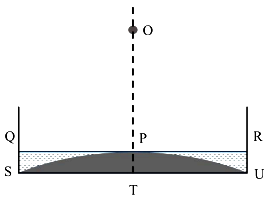 JEE Advanced 2024 Hard
 - A particle of mass \(m\) and charge \(q\), moving with velocity \(v\) enters Region II normal to the boundary as shown in the figure. Region II has a uniform magnetic field \(B\) perpendicular to the plane of the paper. The length of the Region II is \(l\). Choose the correct choice(s)
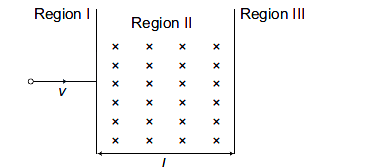 JEE Advanced 2008 Hard
 - The electric field E is measured at a point , generated due to various charge distributions and the dependence of E on d is found to be different for different charge distributions. List-I contains different relations between E and d. List-II describes different electric charge distributions, along with their locations. Match the functions in List-I with the related charge distributions in List-II.
LIST -I LIST -II A) is independent of d P) A point charge at the origin B) \(E \propto \frac{1}{d}\) Q) A small dipole with point charges \(Q\) at \((0,0, l)\) and \(-\operatorname{Qat}(0,0, l)\). Take \(2 l \ll d\) C) \(E \propto \frac{1}{d^2}\) R) An infinite line charge coincident with the \(x\)-axis, with uniform linear charge density \(\lambda\) D) \(E \propto \frac{1}{d^3}\) S) Two infinite wires carrying uniform linear charge density parallel to the \(x\) - axis. The one along \((y-0, z=l)\) has a charge density \(+\lambda\) and the one along \((y=0, z=-l)\) has a charge density \(-\lambda\). Take \(2 l \ll d\) T) Infinite plane charge coincident with the \(x y\) - plane with uniform surface charge density JEE Advanced 2018 Medium - A ball of mass \(0.2 \mathrm{~kg}\) rests on a vertical post of height \(5 \mathrm{~m}\). A bullet of mass \(0.01 \mathrm{~kg}\), travelling with a velocity \(v \mathrm{~m} / \mathrm{s}\) in a horizontal direction, hits the centre of the ball. After the collision, the ball and bullet travel independently. The ball hits the ground at a distance of \(20 \mathrm{~m}\) and the bullet at a distance of \(100 \mathrm{~m}\) from the foot of the post. The initial velocity \(v\) of the bullet is
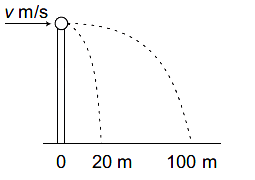 JEE Advanced 2011 Medium
More PYQs from JEE Advanced
- A Conductor (shown in the figure) carrying constant current is kept in the - plane in a uniform magnetic field . If is the magnitude of the total magnetic force acting on the conductor, then the correct statement(s) is (are)
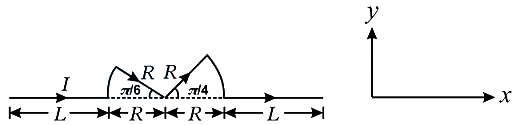 JEE Advanced 2015 Medium
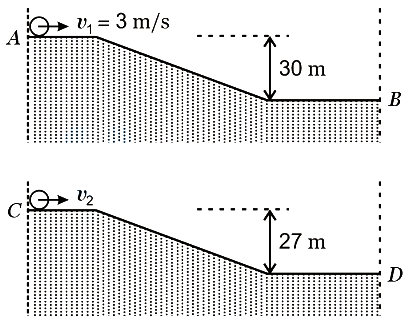
 - Two identical uniform discs roll without slipping on two different surfaces AB and CD (see figure) starting at A and C with linear speeds \(v_1\) and \(v_2\), respectively, and always remain in contact with the surfaces. If they reach B and D with the same linear speed and \(v_1=3 m / s\), then \(v_2\) in \(m / s\) is \(\left( g =10 \frac{m}{ s ^2}\right)\)
 JEE Advanced 2015 Medium
 - The synthesis of 3-octyne is achieved by adding a bromoalkane into a mixture of sodium amide and an alkyne. The bromoalkane and alkyne respectively areJEE Advanced 2010 Easy
- Paragraph:
\(RCONH _2\) is converted into \(RNH _2\) by means of Hofmann bromamide degradation.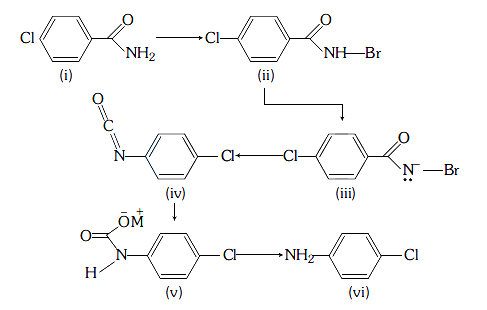
In this reaction, \(R \mathrm{CONHBr}\) is formed from which this reaction has derived its name. Electron donating group at phenyl activates the reaction. Hofmann degradation reaction is an intramolecular reaction.
Question:
How can the conversion of (i) to (ii) be brought about?JEE Advanced 2006 Easy - an isotope of Iodine that decays to an isotope of Xenon with a half-life of . A small amount of a serum labelled with is injected into the blood of a person. The activity of the amount of injected was Becquerel (Bq). It is known that the injected serum will get distributed uniformly in the blood stream in less than half an hour. After 11.5 hours, 2.5 ml of blood is drawn from the person's body, and gives an activity of . The total volume of blood in the person's body, in litres is approximately (you may use \(\mathrm{e}^{\mathrm{x}} \approx 1+\mathrm{x}\) for \(|\mathrm{x}|<<1\) and \(\ln 2 \approx 0.7\)).JEE Advanced 2017 Easy
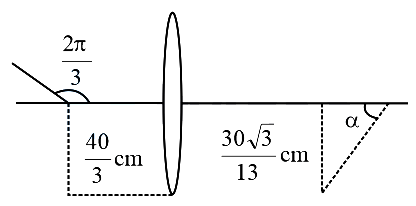
- A rod of length makes an angle with the principal axis of a thin convex lens. The lens has a focal length of and is placed at a distance of from the object as shown in the figure. The height of the image is and the angle made by it with respect to the principal axis is \(\alpha\) rad. The value of is , where is
 JEE Advanced 2022 Hard