


JEE Advanced · Physics · 13. Thermodynamics
One mole of a monatomic ideal gas is taken along two cyclic processes as shown in the PV diagram. The processes involved are purely isochoric, isobaric, isothermal or adiabatic.
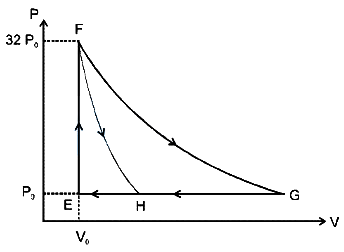
Match the paths in List I with the magnitudes of the work done in List II and select the correct answer using the codes given below the lists.
- A a-q;b-s;c-r;d-p;
- B a-s;b-r;c-q;d-p;
- C a-q;b-s;c-r;d-p;
- D a-q;b-r;c-s;d-p;
Answer & Solution
Correct Answer
(B) a-s;b-r;c-q;d-p;
Step-by-step Solution
Detailed explanation
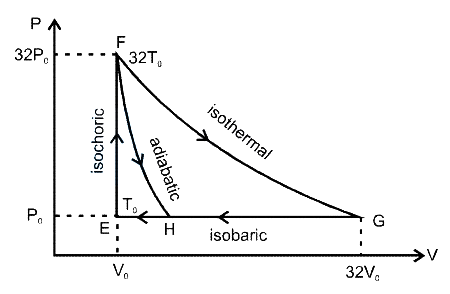
\(F \rightarrow G\) work done in isothermal process is \(nRT \ln \left(\frac{ V _{ f }}{ V _{ i }}\right)=32 P _0 V_0 \ln \left(\frac{32 V_0}{V_0}\right)\)
\(=32 P _0 V_0 \ln 2^5=10 P _0 V_0 \ln 2\)
\(\ln G \longrightarrow E , \Delta W = P _0\left(31 V_0\right)=31 P _0 V_0\)
ln \(G \longrightarrow H\) work done is less than \(31 P _0 V_0\) i.e., \(24 P _0 V_0\)
\(\ln F \longrightarrow H\) work done is \(36 P _0 V_0\)
See the Complete Solution
Get step-by-step explanations for this and 2.5 Lakh+ more JEE, NEET & CET questions.
- Unlock all solutions
- Practice the full chapter
- Track accuracy across PYQs
4.8 rated on Google Play · 14,000+ reviews
More questions from Physics
- An electron in a hydrogen atom undergoes a transition from an orbit with a quantum number to another quantum number . are the initial and final potential energies of the electron. If then the smallest isJEE Advanced 2017 Medium
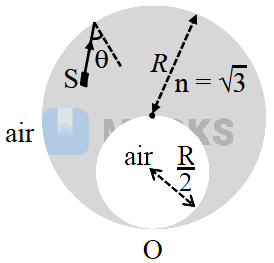
- A solid glass sphere of refractive index \(n=\sqrt{3}\) and radius \(R\) contains a spherical air cavity of radius \(\frac{\mathrm{R}}{2}\), as shown in the figure. A very thin glass layer is present at the point O so that the air cavity (refractive index \(n=1\)) remains inside the glass sphere. An unpolarized, unidirectional and monochromatic light source \(S\) emits a light ray from a point inside the glass sphere towards the periphery of the glass sphere. If the light is reflected from the point O and is fully polarized, then the angle of incidence at the inner surface of the glass sphere is \(\theta\). The value of \(\sin \theta\) is ______ [given : θ > 30°]
 JEE Advanced 2025 Hard
 - The general motion of a rigid body can be considered to be a combination of (i) a motion of its centre of mass about an axis, and (ii) its motion about an instantaneous axis passing through the centre of mass.
These axes need not be stationary. Consider, for example, a thin uniform disc welded (rigidly fixed) horizontally at its rim to a massless, stick, as shown in the figure. When the disc-stick system is rotated about the origin on a horizontal frictionless plane with angular speed \(\omega\), the motion at any instant can be taken as a combination of (i) a rotation of the centre of mass of the disc about the \(z\)-axis and (ii) a rotation of the disc through an instantaneous vertical axis passing through its centre of mass (as is seen from the changed orientation of points \(P\) and \(Q\) ). Both these motions have the same angular speed \(\omega\) in this case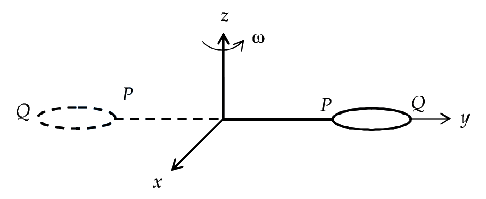
Now consider two similar systems as shown in the figure: Case
(a) the disc with its face vertical and parallel to \(x-z\) plane; Case
(b) the disc with its face making an angle of
\(45^{\circ}\) with \(x-y\) plane and its horizontal diameter parallel to \(x\)-axis. In both the cascs, the disc is welded at point \(\mathrm{P}\), and the systems are rotated with constant angular speed \(\omega\) about the \(z\) axis.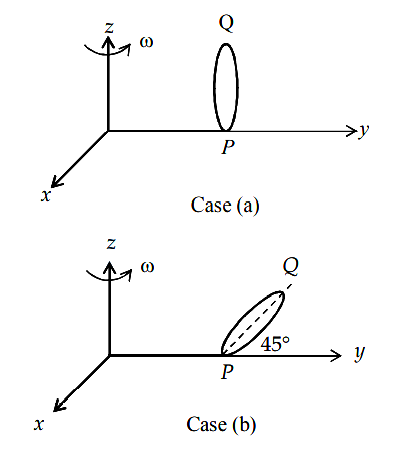
Question : Which of the following statements regarding the angular speed about the instantaneous axis (passing through the centre of mass) is correct?JEE Advanced 2012 Medium - The instantaneous voltages at three terminals marked and are given by
and
An ideal voltmeter is configured to read rms value of the potential difference between its terminals. It is connected between points and and then between and . The reading(s) of the voltmeter will beJEE Advanced 2017 Hard - Paragraph :
A wooden cylinder of diameter \(4 r\), height \(H\) and density \(\rho / 3\) is kept on a hole of diameter \(2 r\) of a tank, filled with liquid of density \(\rho\) as shown in the figure.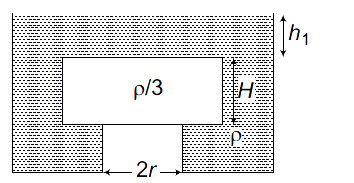
Question :
The block in the above question is maintained at the position by external means and the level of liquid is lowered. The height \(h_2\) when this external force reduces to zero is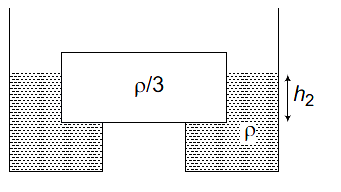 JEE Advanced 2006 Medium
 - Sometimes it is convenient to construct a system of units so that all quantities can be expressed in terms of only one physical quantity. In one such system, dimensions of different quantities are given in terms of a quantity as follows: ; ;; . ThenJEE Advanced 2020 Medium
More PYQs from JEE Advanced
- Let \(I=\int \frac{e^x}{e^{4 x}+e^{2 x}+1} d x, J=\int \frac{e^{-x}}{e^{-4 x}+e^{-2 x}+1} d x\).
Then, for an arbitrary constant \(C\), the value of \(J-I\) equalsJEE Advanced 2008 Easy - Two spherical planets \(P\) and \(Q\) have the same uniform density \(\rho\), masses \(M_{P}\) and \(M_{Q}\) and surface areas \(A\) and 4A respectively. A spherical planet \(R\) also has uniform density \(\rho\) and its mass is \(\left(M_{P}+M_{Q}\right)\). The escape velocities from the planets \(P, Q\) and \(R\) are \(V_{P}, V_{Q}\) and \(V_{R}\), respectively. ThenJEE Advanced 2012 Medium
- For the reduction of \(\mathrm{NO}_3^{-}\)ion in an aqueous solution \(E^{\circ}\) is \(+0.96 \mathrm{~V}\). Values of \(E^{\circ}\) for some metal ions are given below.
\(
\begin{aligned}
& \mathrm{V}^{2+}(a q)+2 e^{-} \longrightarrow \mathrm{V} ; E^{\circ}=-1.19 \mathrm{~V} \\
& \mathrm{Fe}^{3+}(a q)+3 e^{-} \longrightarrow \mathrm{Fe} ; \mathrm{E}^{\circ}=-0.04 \mathrm{~V} \\
& \mathrm{Au}^{3+}(a q)+3 e^{-} \longrightarrow \mathrm{Au} ; E^{\circ}=+1.40 \mathrm{~V}
\end{aligned}
\)
\(
\mathrm{Hg}^{2+}(a q)+2 e^{-} \longrightarrow \mathrm{Hg} ; E^{\circ}=+0.86 \mathrm{~V}
\)
The pair(s) of metals that is (are) oxidised by \(\mathrm{NO}_3^{-}\)in aqueous solution is (are)JEE Advanced 2009 Medium - Paragraph:
Let \(M=\left\{(x, y) \in \mathbb{R} \times \mathbb{R}: x^{2}+y^{2} \leq r^{2}\right\}\),
where \(r>0 .\) Consider the geometric progression \(a_{n}=\frac{1}{2^{n-1}}, n=1,2,3, \ldots .\) Let \(S_{0}=0\) and, for \(n \geq 1\), let \(S_{n}\) denote the sum of the first \(n\) terms of this progression. For \(n \geq 1\), let \(C_{n}\) denote the circle with center \(\left(S_{n-1}, 0\right)\) and radius \(a_{n}\), and \(D_{n}\) denote the circle with center \(\left(S_{n-1}, S_{n-1}\right)\) and radius \(a_{n}\).
Question:
Consider \(M\) with \(r=\frac{1025}{513}\). Let \(k\) be the number of all those circles \(C_{n}\) that are inside \(M\). Let \(l\) be the maximum possible number of circles among these \(k\) circles such that no two circles intersect. ThenJEE Advanced 2021 Medium - Paragraph:
When a particle is restricted to move along \(x\)-axis between \(x=0\) and \(x=a\), where \(a\) is of nanometer dimension, its energy can take only certain specific values. The allowed energies of the particle moving in such a restricted region, correspond to the formation of standing waves with nodes at its ends \(x=0\) and \(x=a\). The wavelength of this standing wave is related to the liner momentum \(p\) of the particle according to the de Broglie relation. The energy of the particle of mass \(m\) is related to its linear momentum as \(E=\frac{p^2}{2 m}\). Thus, the energy of the particle can be denoted by a quantum number \(n\) taking values \(1,2,3, \ldots(n=1\), called the ground state) corresponding to the number of loops in the standing wave.
Use the model described above to answer the following three questions for a particle moving in the line \(x=0\) to \(x=a\) [Take \(h=6.6 \times 10^{-34} \mathrm{Js}\) and \(e=1.6 \times 10^{-19} \mathrm{C}\) ]
Question:
The speed of the particle that can take discrete values is proportional toJEE Advanced 2009 Easy - For the reaction, \(\mathbf{X}(s) \rightleftharpoons \mathbf{Y}(s)+\mathbf{Z}(g)\), the plot of \(\ln \frac{p_{\mathbf{Z}}}{p^{\theta}}\) versus \(\frac{10^{4}}{T}\) is given below (in solid line), where \(p_{\mathbf{Z}}\) is the pressure (in bar) of the gas \(\mathbf{Z}\) at temperature \(T\) and \(p^{\theta}=1\) bar.
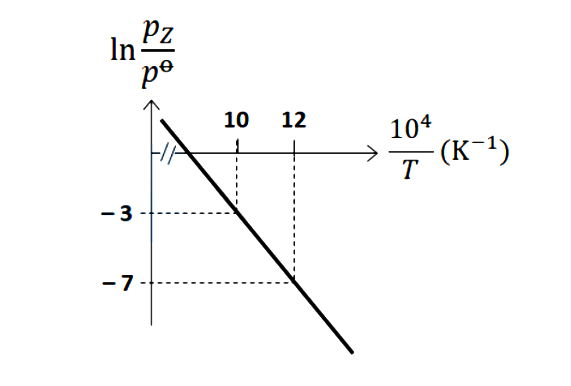
(Given, \(\frac{\mathrm{d}(\ln K)}{\mathrm{d}\left(\frac{1}{T}\right)}=-\frac{\Delta H^{\theta}}{R}\), where the equilibrium constant, \(K=\frac{p_{z}}{p^{\theta}}\) and the gas constant, \(\mathrm{R}=8.314 \mathrm{~J} \mathrm{~K}^{-1} \mathrm{~mol}^{-1}\) )
The value of standard enthalpy, (in ) for the given reaction is ___.JEE Advanced 2021 Hard