


JEE Advanced · Physics · 24. Ray Optics
A solid glass sphere of refractive index \(n=\sqrt{3}\) and radius \(R\) contains a spherical air cavity of radius \(\frac{\mathrm{R}}{2}\), as shown in the figure. A very thin glass layer is present at the point O so that the air cavity (refractive index \(n=1\)) remains inside the glass sphere. An unpolarized, unidirectional and monochromatic light source \(S\) emits a light ray from a point inside the glass sphere towards the periphery of the glass sphere. If the light is reflected from the point O and is fully polarized, then the angle of incidence at the inner surface of the glass sphere is \(\theta\). The value of \(\sin \theta\) is ______ [given : θ > 30°]
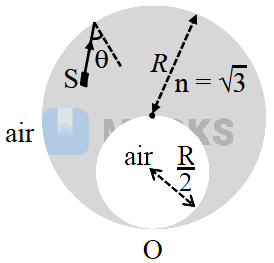
- A 0.7
- B 0.6
- C 0.75
- D 0.65
Answer & Solution
Correct Answer
(C) 0.75
Step-by-step Solution
Detailed explanation
We added a condition θ > 30° to make this question clear for students, otherwise 0.5 and 0.75 both are correct answers
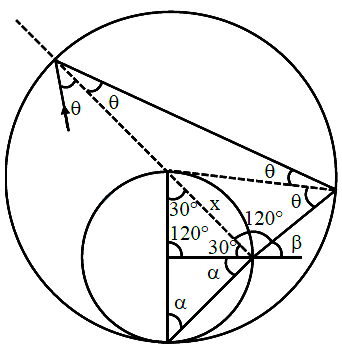
\(\begin{aligned} & \tan \alpha=\sqrt{3} \\ & \alpha=60^{\circ}\end{aligned}\)
\(\begin{aligned} & \sqrt{3} \sin \beta=1 \times \sin \alpha \Rightarrow \beta=30^{\circ} \\ & \frac{\mathrm{R}}{2 \sin 30^{\circ}}=\frac{\mathrm{x}}{\sin 120^{\circ}} \\ & \frac{\mathrm{R}}{\sin 120^{\circ}}=\frac{\mathrm{R} \sqrt{3}}{2 \times \sin \theta} \Rightarrow \sin \theta=\frac{\sqrt{3}}{2} \times \frac{\sqrt{3}}{2} \\ & \sin \theta=\frac{3}{4}\end{aligned}\)
\(\begin{aligned} & \tan \alpha=\sqrt{3} \\ & \alpha=60^{\circ}\end{aligned}\)
\(\begin{aligned} & \sqrt{3} \sin \beta=1 \times \sin \alpha \Rightarrow \beta=30^{\circ} \\ & \frac{\mathrm{R}}{2 \sin 30^{\circ}}=\frac{\mathrm{x}}{\sin 120^{\circ}} \\ & \frac{\mathrm{R}}{\sin 120^{\circ}}=\frac{\mathrm{R} \sqrt{3}}{2 \times \sin \theta} \Rightarrow \sin \theta=\frac{\sqrt{3}}{2} \times \frac{\sqrt{3}}{2} \\ & \sin \theta=\frac{3}{4}\end{aligned}\)
See the Complete Solution
Get step-by-step explanations for this and 2.5 Lakh+ more JEE, NEET & CET questions.
- Unlock all solutions
- Practice the full chapter
- Track accuracy across PYQs
4.8 rated on Google Play · 14,000+ reviews
More questions from Physics
- One mole of a monatomic ideal gas undergoes four thermodynamic processes as shown schematically in the PV - diagram below. Among these four processes, one is isobaric, one is isochoric, one is isothermal and one is adiabatic. Match the processes mentioned in List-1 with the corresponding statements in List-II.

LIST -I LIST -II A) In process P) Work done by the gas is zero B) In process Q) Temperature of the gas remains unchanged C) In process R) No heat is exchanged between the gas and its surroundings D) In process S) Work done by the gas is JEE Advanced 2018 Medium - Match the temperature of a black body given in List- with an appropriate statement in List-, and choose the correct option.
[Given: Wien’s constant as and ]List- List- The radiation at peak wavelength can lead to emission of photoelectrons from a metal of work function The radiation at peak wavelength is visible to human eye The radiation at peak emission wavelength will result in the widest central maximum of a single slit diffraction The power emitted per unit area is of that emitted by a blackbody at temperature The radiation at peak emission wavelength can be used to image human bones JEE Advanced 2023 Medium - List I contains four combinations of two lenses ( 1 and 2 ) whose focal lengths (in cm ) are indicated in the figures. In all cases, the object is placed 20 cm from the first lens on the left, and the distance between the two lenses is 5 cm . List II contains the positions of the final images.
Which one of the following options is correct?List - I List - II (I) 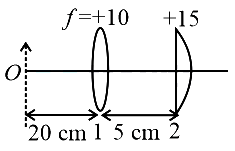
(P) Final image is formed at 7.5 cm on the right side of lens 2. (II) 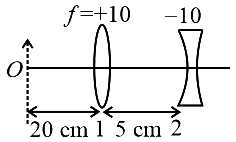
(Q) Final image is formed at 60.0 cm on the right side of lens 2. (III) 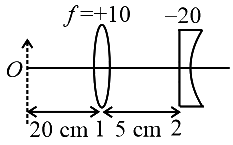
(R) Final image is formed at 30.0 cm on the left side of lens 2. (IV) 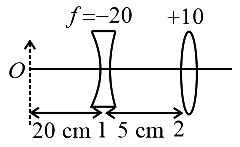
(S) Final image is formed at
6.0 cm on the right side of lens 2.(T) Final image is formed at 30.0 cm on the right side of lens 2. JEE Advanced 2022 Hard - Two solid cylinders \(P\) and \(Q\) of same mass and same radius start rolling down a fixed inclined plane from the same height at the same time. Cylinder \(P\) has most of its mass concentrated near its surface, while \(Q\) has most of its mass concentrated near the axis. Which statement(s) is(are) correct?JEE Advanced 2012 Medium
- An optical component and an object \(S\) placed along its optic axis are given in Column I. The distance between the object and the component can be varied. The properties of images are given in Column II. Match all the properties of images from Column II with the appropriate components given in Column I. Indicate your answer by darkening the appropriate bubble of the \(4 \times 4\) matrix given in the ORS.
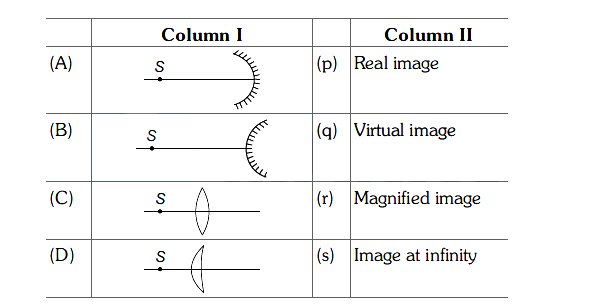 JEE Advanced 2008 Easy
 - Column-II gives certain systems undergoing a process. Column-I suggests changes in some of the parameters related to the system. Match the statements in Column-I to the appropriate process (es) from Column-II.
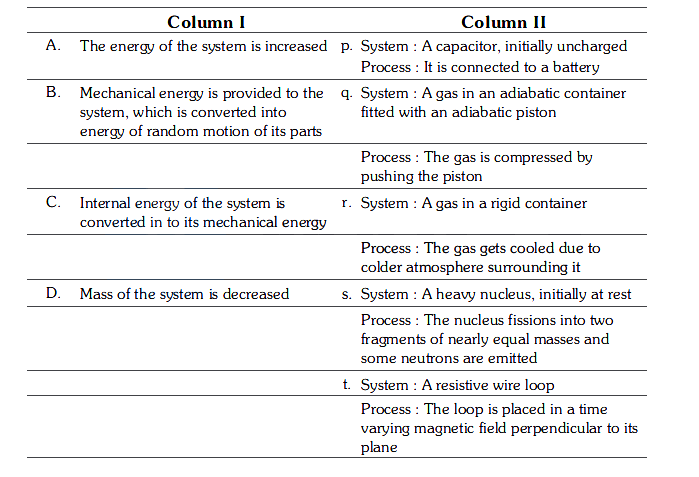 JEE Advanced 2009 Medium
More PYQs from JEE Advanced
- Let \(k \in \mathbb{R}\). If \(\lim _{x \rightarrow 0^+}(\sin (\sin k x)+\cos x+x)^{\frac{2}{x}}=e^6\), then the value of \(k\) isJEE Advanced 2024 Easy
- Let and be defined by . Then is -JEE Advanced 2016 Easy
- Coefficient of in the expansion of isJEE Advanced 2014 Hard
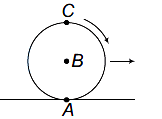
- A sphere is rolling without slipping on a fixed horizontal plane surface. In the figure, \(A\) is the point of contact. \(B\) is the centre of the sphere and \(C\) is its topmost point. Then,
 JEE Advanced 2009 Medium
 - Let for Suppose are in Arithmetic Progression (A.P.) with the common difference Suppose are in A.P. such that and If and thenJEE Advanced 2016 Hard
- A particle of mass M and positive charge Q, moving with a constant velocity , enters a region of uniform static magnetic field normal to the x-y plane. The region of the magnetic field extends from x = 0 to x = L for all values of y. After passing through this region, the particle emerges on the other side after 10 milliseconds with a velocity . The correct statement (s) is (are)JEE Advanced 2013 Medium