


JEE Advanced · Physics · 13. Thermodynamics
Match the following for the given process
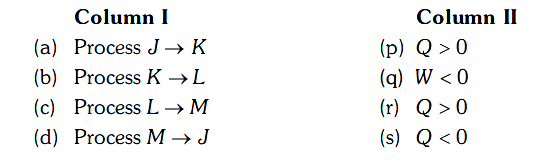
- A (a) s, (b) p, r, (c) r, (d) q,s
- B (a) r, (b) p, s, (c) q, (d) q
- C (a) s, (b) p, r, (c) q, (d) q
- D (a) r, (b) p, s, (c) r, (d) q,s
Answer & Solution
Correct Answer
(A) (a) s, (b) p, r, (c) r, (d) q,s
Step-by-step Solution
Detailed explanation
(a) \(\rightarrow \mathrm{s}\) (b) \(\rightarrow \mathrm{p}, \mathrm{r}\), (c) \(\rightarrow \mathrm{r}\) (d) \(\rightarrow \mathrm{q}, \mathrm{s}\)
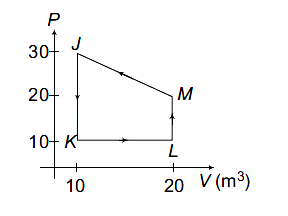
In process \(\mathbf{J} \rightarrow \mathbf{K}: V\) is constant whereas \(P\) is decreasing, Therefore, \(T\) should also decrease.
\(\therefore W=0, \Delta U=-\text { ve and } Q < 0\)
In process \(\mathbf{K} \rightarrow \mathbf{L}: P\) is constant while \(V\) is increasing. Therefore, temperature should also increase.
\(\therefore W>0, \Delta U>0 \text { and } Q>0\)
In process \(\mathbf{L} \rightarrow \mathbf{M}\) : This is inverse of process \(J \rightarrow K\).
\(\therefore W=0, \Delta U>0 \text { and } Q>0\)
In process \(\mathbf{M} \rightarrow \mathbf{J}: V\) is decreasing. Therefore, \(W < 0\)
\((P \mathrm{~V})_J < (P V)_M \)
\( \therefore T_J < T_M \text { or } \quad \Delta U < 0 \)
\( \text { Therefore, } Q < 0.\)
No, solution is required.
In process \(\mathbf{J} \rightarrow \mathbf{K}: V\) is constant whereas \(P\) is decreasing, Therefore, \(T\) should also decrease.
\(\therefore W=0, \Delta U=-\text { ve and } Q < 0\)
In process \(\mathbf{K} \rightarrow \mathbf{L}: P\) is constant while \(V\) is increasing. Therefore, temperature should also increase.
\(\therefore W>0, \Delta U>0 \text { and } Q>0\)
In process \(\mathbf{L} \rightarrow \mathbf{M}\) : This is inverse of process \(J \rightarrow K\).
\(\therefore W=0, \Delta U>0 \text { and } Q>0\)
In process \(\mathbf{M} \rightarrow \mathbf{J}: V\) is decreasing. Therefore, \(W < 0\)
\((P \mathrm{~V})_J < (P V)_M \)
\( \therefore T_J < T_M \text { or } \quad \Delta U < 0 \)
\( \text { Therefore, } Q < 0.\)
No, solution is required.
See the Complete Solution
Get step-by-step explanations for this and 2.5 Lakh+ more JEE, NEET & CET questions.
- Unlock all solutions
- Practice the full chapter
- Track accuracy across PYQs
4.8 rated on Google Play · 14,000+ reviews
More questions from Physics
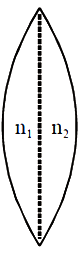
- A thin convex lens is made of two materials with refractive indices and as shown in figure. The radius of curvature of the left and right spherical surfaces are equal. is the focal length of the lens when The focal length is when and Assuming and the correct statement(s) is/are:
 JEE Advanced 2019 Medium
 - A moving coil galvanometer has 50 turns and each turn has an area . The magnetic field produced by the magnet inside the galvanometer is . The torsional constant of the suspension wire is . When a current flows through the galvanometer, a full scale deflection occurs if the coil rotates by . The resistance of the coil of the galvanometer is . This galvanometer is to be converted into an ammeter capable of measuring current in the range . For this purpose, a shunt resistance is to be added in parallel to the galvanometer. The value of this shunt resistance, in ohms, is __________.JEE Advanced 2018 Hard
- The \(\beta\)-decay process, discovered around 1900 , is basically the decay of a neutron \((n)\). In the laboratory, a proton \((p)\) and an electron \(\left(e^{-}\right)\)are observed as the decay products of the neutron. Therefore, considering the decay of a neutron as a two-body decay process, it was predicted theoretically that the kinetic energy of the electron should be a constant. But experimentally, it was observed that the electron kinetic energy has continuous spectrum. Considering a three-body decay process, i.e.
\(n \rightarrow p+e^{-}+\bar{v}_{e}\), around 1930, Pauli explained the observed electron energy spectrum. Assuming the anti-neutrino \(\left(\bar{v}_{e}\right)\) to be massless and possessing negligible energy, and the neutron to be at rest, momentum and energy conservation principles are applied. From this calculation, the maximum kinetic energy of the electron is \(0.8 \times 10^{6} \mathrm{eV}\). The kinetic energy carried by the proton is only the recoil energy.
Question:
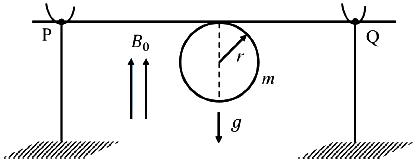
If the anti-neutrino had a mass of \(3 \mathrm{eV} / \mathrm{c}^{2}\) (where \(\mathrm{c}\) is the speed of light) instead of zero mass, what should be the range of the kinetic energy, \(K\), of the electron?JEE Advanced 2012 Hard - A thin stiff insulated metal wire is bent into a circular loop with its two ends extending tangentially from the same point of the loop. The wire loop has mass \(m\) and radius \(r\) and it is in a uniform vertical magnetic field \(B_0\), as shown in the figure. Initially, it hangs vertically downwards, because of acceleration due to gravity \(g\), on two conducting supports at \(\mathrm{P}\) and \(\mathrm{Q}\). When a current \(I\) is passed through the loop, the loop turns about the line \(\mathrm{PQ}\) by an angle \(\theta\) given by
 JEE Advanced 2024 Medium
 - A ball is dropped from a height of \(20 \mathrm{~m}\) above the surface of water in a lake. The refractive index of water is \(\frac{4}{3}\). A fish inside the lake, in the line of fall of the ball, is looking at the ball. At an instant, when the ball is \(12.8 \mathrm{~m}\) above the water surface, the fish sees the speed of ball asJEE Advanced 2009 Hard
- Two soap bubbles \(A\) and \(B\) are kept in a closed chamber where the air is maintained at pressure \(8 \mathrm{Nm}^{-2}\). The radii of bubbles \(A\) and \(B\) are \(2 \mathrm{~cm}\), respectively. Surface tension of the soap-water used to make bubbles is \(0.04\) \(\mathrm{Nm}^{-1}\). Find the ratio \(\frac{n_B}{n_A}\), where \(n_A\) and \(n_B\) are the number of moles of air in bubbles \(A\) and \(B\), respectively. [Neglect the effect of gravity]JEE Advanced 2009 Hard
More PYQs from JEE Advanced
- Match the electronic configurations in List-I with appropriate metal complex ions in List-II and choose the correct option.
[Atomic Number: ] List I List II JEE Advanced 2023 Medium - A bullet is fired vertically upwards with velocity from the surface of a spherical planet. When it reaches its maximum height, its acceleration due to the planet's gravity is of its value at the surface of the planet. If the escape velocity from the planet is , then the value of N is (ignore energy loss due to atmosphere)JEE Advanced 2015 Medium
- The stoichiometric reaction of of dimethyldichlorosilane with water results in a tetrameric cyclic product in yield. The weight (in ) of obtained is ____________
\(\left[\right.\)Use, molar mass\(.\left(\text{gmol} ^{-1}\right):\text H =1,\text C =12,\)\(\text O =16, \text{Si} =28, \text{Cl} =35.5]\)JEE Advanced 2023 Hard - Reaction of \(\mathbf{x}\) g of \(\mathrm{Sn}\) with \(\mathrm{HCl}\) quantitatively produced a salt. Entire amount of the salt reacted with \(\mathbf{y} g\) of nitrobenzene in the presence of required amount of \(\mathrm{HCl}\) to produce \(1.29 \mathrm{~g}\) of an organic salt (quantitatively).
(Use Molar masses (in \(\mathrm{g} \mathrm{mol}^{-1}\) ) of \(\mathrm{H}, \mathrm{C}, \mathrm{N}, \mathrm{O}, \mathrm{Cl}\) and \(\mathrm{Sn}\) as \(1,12,14,16,35\) and 119 , respectively).
The value of is _______ .JEE Advanced 2021 Easy - Paragraph:
Consider the circle \(x^2+y^2=9\) and the parabola \(y^2=8 x\). They intersect at \(P\) and \(Q\) in the first and the fourth quadrants, respectively. Tangents to the circle at \(P\) and \(Q\) intersect the \(\mathrm{X}\)-axis at \(R\) and tangents to the parabola at \(P\) and \(Q\) intersect the \(\mathrm{X}\)-axis at \(S\).Question:
The ratio of the areas of the \(\triangle P Q S\) and \(\triangle P Q R\) isJEE Advanced 2007 Medium - Consider all possible isomeric ketones, including stereoisomers of MW = 100. All these isomers are independently reacted with (NOTE: stereoisomers are also reacted separately). The total number of ketones that give a racemic product(s) is/areJEE Advanced 2014 Medium