


JEE Advanced · Physics · 17. Electrostatics
Consider a system of three charges \(\frac{q}{3}, \frac{q}{3}\) and \(-\frac{2 q}{3}\) placed at points \(A, B\) and \(C\), respectively, as shown in the figure. Take \(O\) to be the centre of the circle of radius \(R\) and angle \(C A B=60^{\circ}\).
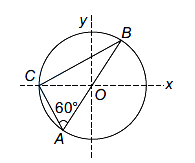
- A The electric field at point \(O\) is \(\frac{q}{8 \pi \varepsilon_0 R^2}\) directed along the negative \(x\)-axis
- B The potential energy of the system is zero
- C The magnitude of the force between the charges at \(C\) and \(B\) is \(\frac{q^2}{54 \pi \varepsilon_0 R^2}\)
- D The potential at point \(O\) is \(\frac{q}{12 \pi \varepsilon_0 R}\)
Answer & Solution
Correct Answer
(C) The magnitude of the force between the charges at \(C\) and \(B\) is \(\frac{q^2}{54 \pi \varepsilon_0 R^2}\)
Step-by-step Solution
Detailed explanation
Distance \(B C=A B \sin 60^{\circ}=(2 R) \frac{\sqrt{3}}{2}=\sqrt{3} R\)
\(\therefore \quad\left|F_{B C}\right|=\frac{1}{4 \pi \varepsilon_0} \frac{(q / 3)(2 q / 3)}{(\sqrt{3} R)^2}=\frac{q^2}{54 \pi \varepsilon_0 R^2}\)
\(\therefore\) correct option is (c).
\(\therefore \quad\left|F_{B C}\right|=\frac{1}{4 \pi \varepsilon_0} \frac{(q / 3)(2 q / 3)}{(\sqrt{3} R)^2}=\frac{q^2}{54 \pi \varepsilon_0 R^2}\)
\(\therefore\) correct option is (c).
See the Complete Solution
Get step-by-step explanations for this and 2.5 Lakh+ more JEE, NEET & CET questions.
- Unlock all solutions
- Practice the full chapter
- Track accuracy across PYQs
4.8 rated on Google Play · 14,000+ reviews
More questions from Physics
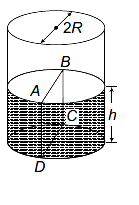
- Water is filled up to a height \(h\) in a beaker of radius \(R\) as shown in the figure. The density of water is \(\rho\), the surface tension of water is \(T\) and the atmospheric pressure is \(p_0\). Consider a vertical section \(A B C D\) of the water column through a diameter of the beaker. The force on water on one side of this section by water on the other side of this section has magnitude.
 JEE Advanced 2007 Hard
 - The radius of the orbit of an electron in a Hydrogen-like atom is \(4.5 a _0\), where \(a _0\) is the Bohr radius. Its orbital angular momentum is \(\frac{3 h}{2 \pi}\). It is given that \(h\) is Planck's constant and R is Rydberg constant. the possible wavelength \((s)\), when the atom de-excites, is (are)JEE Advanced 2013 Easy
- The general motion of a rigid body can be considered to be a combination of (i) a motion of its centre of mass about an axis, and (ii) its motion about an instantaneous axis passing through the centre of mass.
These axes need not be stationary. Consider, for example, a thin uniform disc welded (rigidly fixed) horizontally at its rim to a massless, stick, as shown in the figure. When the disc-stick system is rotated about the origin on a horizontal frictionless plane with angular speed \(\omega\), the motion at any instant can be taken as a combination of (i) a rotation of the centre of mass of the disc about the \(z\)-axis and (ii) a rotation of the disc through an instantaneous vertical axis passing through its centre of mass (as is seen from the changed orientation of points \(P\) and \(Q\) ). Both these motions have the same angular speed \(\omega\) in this case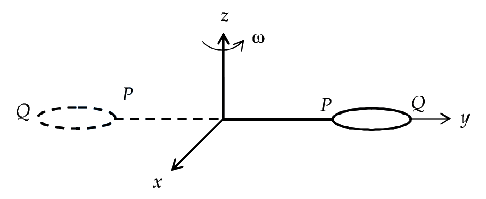
Now consider two similar systems as shown in the figure: Case
(a) the disc with its face vertical and parallel to \(x-z\) plane; Case
(b) the disc with its face making an angle of
\(45^{\circ}\) with \(x-y\) plane and its horizontal diameter parallel to \(x\)-axis. In both the cascs, the disc is welded at point \(\mathrm{P}\), and the systems are rotated with constant angular speed \(\omega\) about the \(z\) axis.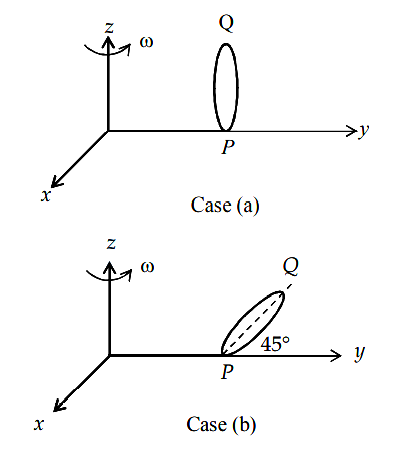
Question : Which of the following statements regarding the angular speed about the instantaneous axis (passing through the centre of mass) is correct?JEE Advanced 2012 Medium - The work done on a particle of mass m by a force (K being a constant of appropriate dimensions, when the particle is taken from the point (a,0) to the point (0,a) along a circular path of radius a about the origin in the x-y plane isJEE Advanced 2013 Medium
- Sunlight of intensity is incident normally on a thin convex lens of focal length . Ignore the energy loss of light due to the lens and assume that the lens aperture size is much smaller than its focal length. The average intensity of light, in , at a distance from the lens on the other side is __________.JEE Advanced 2018 Medium
- For spherical symmetrical charge distribution, variation of electric potential with distance from centre is given in diagram. Given that:
\(V=\frac{q}{4 \pi \varepsilon_0 R_0} \text { for } r \leq R_0\)
and \(V=\frac{q}{4 \pi \varepsilon_0 r}\) for \(r \geq R_0\)
Then which option(s) are correct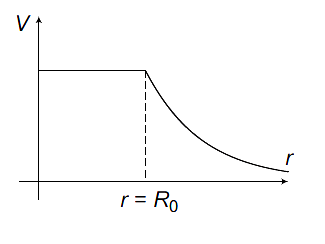 JEE Advanced 2006 Medium
More PYQs from JEE Advanced
- Three very large plates of same area are kept parallel and close to each other. They are considered as ideal black surfaces and have very high thermal conductivity. The first and third plates are maintained at temperatures \(2 T\) and \(3 T\) respectively. The temperature of the middle (i.e. second) plate under steady state condition isJEE Advanced 2012 Medium
- The correct statement(s) regarding defects in solids is (are)JEE Advanced 2009 Medium
- For , let the function be the solution of the differential equation Then, which of the following statements is/are TRUE?JEE Advanced 2022 Medium
- Let denote a curve which is in the first quadrant and let the point lie on it. Let the tangent to at a point intersect the y-axis at If has length for each point on then which of the following is options is/are correct?JEE Advanced 2019 Hard
- For a complex number , let denote the real part of . Let be the set of all complex numbers satisfying where . Then the minimum possible value of where with and is _______JEE Advanced 2020 Medium
- Atoms of metals and form face-centred cubic (fcc) unit cell of edge length , body-centred cubic (bcc) unit cell of edge length , and simple cubic unit cell of edge length , respectively. If and , then the correct statement(s) is(are)
[Given: , and are molar masses of metals , and , respectively. , and are atomic radii of metals , and , respectively.]JEE Advanced 2023 Medium