


JEE Advanced · Physics · 9. Gravitation
Consider a star of mass \(m_2 \mathrm{~kg}\) revolving in a circular orbit around another star of mass \(m_1 \mathrm{~kg}\) with \(m_1 \gg m_2\). The heavier star slowly acquires mass from the lighter star at a constant rate of \(\gamma \mathrm{kg} / \mathrm{s}\). In this transfer process, there is no other loss of mass. If the separation between the centers of the stars is \(r\), then its relative rate of change \(\frac{1}{r} \frac{\mathrm{~d} r}{\mathrm{~d} t}\left(\right.\) in s \(\left.^{-1}\right)\) is given by:
[Note: The original question was awarded bonus marks in the JEE Advanced 2025 exam. We have changed the options to make the question valid and solvable.]
- A \(\frac{3 \gamma}{2 m_2}\)
- B \(\frac{2 \gamma}{3 m_2}\)
- C \(\frac{2 \gamma}{m_1}\)
- D \(\frac{3 \gamma}{2 m_1}\)
Answer & Solution
Correct Answer
(B) \(\frac{2 \gamma}{3 m_2}\)
Step-by-step Solution
Detailed explanation
\(\begin{aligned} & v=v_0=\sqrt{\frac{G m_1}{r}} \\ & \frac{d v_0}{d t}=\frac{v_0}{2}\left[\frac{\gamma}{m_1}-\frac{1}{r} \frac{d r}{d t}\right]\end{aligned}\)
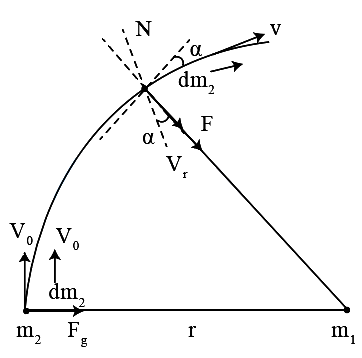
\(\begin{aligned} & F \alpha =m_2 \frac{d v}{d t} \\ & \frac{G m_1}{r^2} \frac{v_r}{v}=\frac{d v}{d t} \\ & \frac{v_0}{r} \cdot \frac{d r}{d t} \frac{1}{v_0}=\frac{d v}{d t}\end{aligned}\)
\(\frac{V_0}{\gamma} \frac{d \gamma}{d t}=\frac{X_0}{2}\left[\frac{r}{m_1}-\frac{1}{r} \frac{d r}{d t}\right]\)
\(\frac{3}{2} \frac{1}{\gamma} \frac{d \gamma}{d t}=\frac{r}{2 m_1} \rightarrow \frac{1}{\gamma} \frac{d r}{d t}=\frac{\gamma}{3 m_2}\)
\(\begin{aligned} & F \alpha =m_2 \frac{d v}{d t} \\ & \frac{G m_1}{r^2} \frac{v_r}{v}=\frac{d v}{d t} \\ & \frac{v_0}{r} \cdot \frac{d r}{d t} \frac{1}{v_0}=\frac{d v}{d t}\end{aligned}\)
\(\frac{V_0}{\gamma} \frac{d \gamma}{d t}=\frac{X_0}{2}\left[\frac{r}{m_1}-\frac{1}{r} \frac{d r}{d t}\right]\)
\(\frac{3}{2} \frac{1}{\gamma} \frac{d \gamma}{d t}=\frac{r}{2 m_1} \rightarrow \frac{1}{\gamma} \frac{d r}{d t}=\frac{\gamma}{3 m_2}\)
See the Complete Solution
Get step-by-step explanations for this and 2.5 Lakh+ more JEE, NEET & CET questions.
- Unlock all solutions
- Practice the full chapter
- Track accuracy across PYQs
4.8 rated on Google Play · 14,000+ reviews
More questions from Physics
- Paragraph:
\(\mathbf{P}_{17 \text { - } 19}\) : Paragraph for Questions Nos. 17 to 19 Two discs \(A\) and \(B\) are mounted coaxially on a vertical axle. The discs have moments of inertia I and 2I, respectively about the common axis. Disc \(A\) is imparted an initial angular velocity \(2 \omega\) using the entire potential energy of a spring compressed by a distance \(x_1\). Disc \(B\) is imparted an angular velocity \(\omega\) by a spring having the same spring constant and compressed by a distance \(x_2\). Both the discs rotate in the clockwise direction.Question:
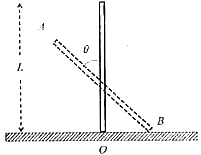
The ratio \(\frac{x_1}{x_2}\) isJEE Advanced 2007 Easy - A rigid uniform bar of length is slipping from its vertical position on a frictionless floor (as shown in the figure). At some instant of time, the angle made by the bar with the vertical is . Which of the following statements about its motion is correct?
 JEE Advanced 2017 Hard
 - A particle of unit mass is moving along the x-axis under the influence of a force and its total energy is conserved. Four possible forms of the potential energy of the particle are given in column I (a and are constants). Match the potential energies in column I to the corresponding statement(s) in column II.
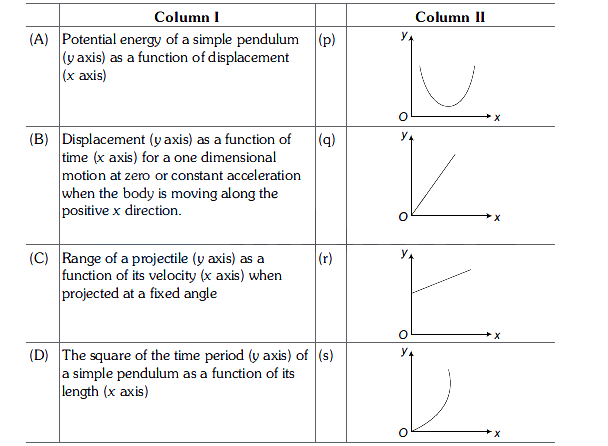
Column I Column II A. P. The force acting on the particle is zero at B. Q. The force acting on the particle is zero at . C. R. The force acting on the particle is zero at D. S. The particle experiences an attractive force towards in the region T. The particle with total energy can oscillate about the point JEE Advanced 2015 Hard - Column I gives a list of possible set of parameters measured in some experiments. The variations of the parameters in the form of graphs are shown in Column II. Match the set of parameters given in Column I with the graphs given in Column II. Indicate your answer by darkening the appropriate bubble of the \(4 \times 4\) matrix given in the ORS.
 JEE Advanced 2008 Easy
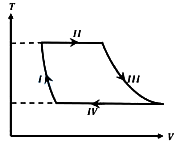
 - One mole of a monatomic ideal gas undergoes a cyclic process as shown in the figure (where V is the volume and T is the temperature). Which of the statements below is (are) true?
 JEE Advanced 2018 Medium
 - A circuit is connected as shown in the figure with the switch \(S\) open. When the switch is closed, the total amount of charge that flows from \(Y\) to \(X\) is
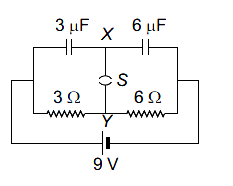 JEE Advanced 2007 Medium
More PYQs from JEE Advanced
- The major products obtained from the reactions in List-II are the reactants for the named reactions mentioned in List-I. Match List-I with List-II and choose the correct option.
List I List II Etard reaction Gattermann reaction Gattermann-Koch reaction Rosenmund reduction JEE Advanced 2023 Easy - The pair(s) of diamagnetic ions is(are)JEE Advanced 2025 Easy
- The total number of local maxima and local minima of the function \(f(x)=\left\{\begin{array}{lc}(2+x)^3 ; & -3 < x \leq-1 \\ x^{\frac{2}{3}} ; & -1 < x < 2\end{array}\right.\) isJEE Advanced 2008 Hard
- For a reaction, , the plots of with time at temperatures are given below.
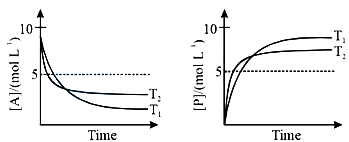
If , the correct statement(s) is (are)
(Assume are independent of temperature and ratio of is greater than . Here H, S , G and K are enthalpy, entropy, Gibbs energy and equilibrium constant, respectively.)JEE Advanced 2018 Hard - Suppose denote the distinct real roots of the quadratic polynomial and suppose denote the distinct complex roots of the quadratic polynomial . Then the value ofJEE Advanced 2020 Medium
- Ozonolysis of produces an oxide of chlorine. The average oxidation state of chlorine in this oxide is ______ .JEE Advanced 2021 Medium