


JEE Advanced · Chemistry · 26. Aldehydes & Ketones
The major products obtained from the reactions in List-II are the reactants for the named reactions mentioned in List-I. Match List-I with List-II and choose the correct option.
| List I | List II | ||
| Etard reaction | |||
| Gattermann reaction | |||
| Gattermann-Koch reaction | |||
| Rosenmund reduction | |||
- A
- B
- C
- D
Answer & Solution
Correct Answer
(D)
Step-by-step Solution
Detailed explanation
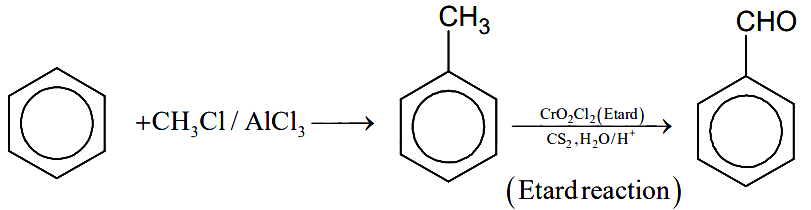
Toluene is formed in the Friedel Craft's reaction, which is the reactant in Etard reaction. The Etard reaction is a chemical reaction that involves the direct oxidation of an aromatic or heterocyclic bound methyl group to an aldehyde using chromyl chloride.
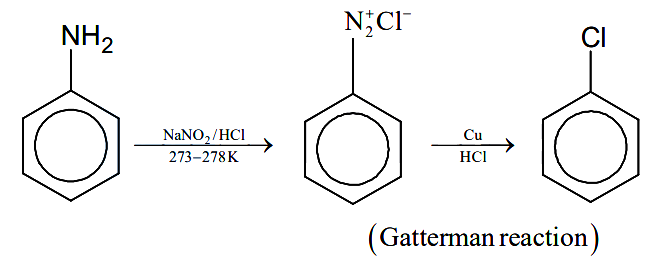
Aniline on diazotization reaction gives benzene diazonium salt, which is the starting material for Gattermann reaction. Gattermann reaction is used for obtaining chlorobenzene or bromobenzene from benzenediazonium chloride by treating it with respectively.
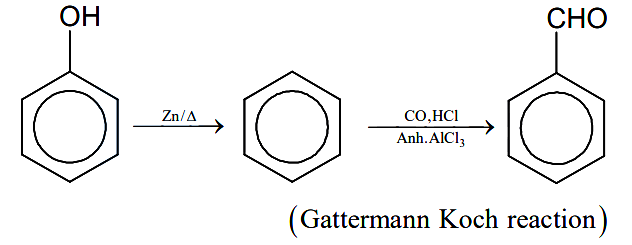
Phenol gives benzene on reaction with zinc dust, which is the starting material forGattermann-Kochreaction. The Gattermann-Kochreaction may simply be defined as a chemical transformation in which aromatic compounds are formylated by a mixture of carbon monoxide and hydrogen chloride in the presence of a Lewis acid catalyst such as .
Toluene on oxidation with potassium permanganate in basic medium gives benzoic acid. The benzoic acid on reaction with thionyl chloride gives benzoyl chloride. The acid chloride formed is the starting material for the Rosenmund reduction. The Rosenmund reduction is a hydrogenation process in which an acyl chloride is selectively reduced to an aldehyde.

Aniline on diazotization reaction gives benzene diazonium salt, which is the starting material for Gattermann reaction. Gattermann reaction is used for obtaining chlorobenzene or bromobenzene from benzenediazonium chloride by treating it with respectively.
Phenol gives benzene on reaction with zinc dust, which is the starting material forGattermann-Kochreaction. The Gattermann-Kochreaction may simply be defined as a chemical transformation in which aromatic compounds are formylated by a mixture of carbon monoxide and hydrogen chloride in the presence of a Lewis acid catalyst such as .
Toluene on oxidation with potassium permanganate in basic medium gives benzoic acid. The benzoic acid on reaction with thionyl chloride gives benzoyl chloride. The acid chloride formed is the starting material for the Rosenmund reduction. The Rosenmund reduction is a hydrogenation process in which an acyl chloride is selectively reduced to an aldehyde.
See the Complete Solution
Get step-by-step explanations for this and 2.5 Lakh+ more JEE, NEET & CET questions.
- Unlock all solutions
- Practice the full chapter
- Track accuracy across PYQs
4.8 rated on Google Play · 14,000+ reviews
More questions from Chemistry
- Among \(\left[ Ni ( CO )_4\right],\left[ NiCl _4\right]^{2-},\left[ Co \left( NH _3\right)_4 Cl _2\right] Cl , Na _3\) \(\left[ CoF _6\right], Na _2 O _2\) and \(CsO _2\), the total number of paramagnetic compounds isJEE Advanced 2016 Medium
- Aqueous solution of \(\text{Na} _2\text S_2\text O _3\) on reaction with \(\text{Cl} _2\) givesJEE Advanced 2008 Medium
- Paragraph:
An aqueous solution of a mixture of two inorganic salts, when treated with dilute \(H C\) ?, gave a precipitate \((\boldsymbol{P})\) and a filtrate \((\boldsymbol{Q})\). The precipitate \(\boldsymbol{P}\) was found to dissolve in hot water. The filtrate \((\boldsymbol{Q})\) remained unchanged, when treated with \(\mathrm{H}_{2} \mathrm{~S}\) in a dilute mineral acid medium. However, it gave a precipitate \((\boldsymbol{R})\) with \(H_{2} S\) in an ammoniacal medium. The precipitate \(\boldsymbol{R}\) gave a coloured solution \((\boldsymbol{S})\), when treated with \(\mathrm{H}_{2} \mathrm{O}_{2}\) in an aqueous \(\mathrm{NaOH}\) medium.
Question:
The coloured solution \(\boldsymbol{S}\) containsJEE Advanced 2013 Medium - Match the reactions (in the given stoichiometry of the reactants) in List-I with one of their products given in List-II and choose the correct option.
List - I List - II (P) \(P _2 O _3\) \(+~3 H _2 O \rightarrow\) (1) \(P ( O )\left( OCH _3\right)\) \(Cl _2\) (Q) \(P _4+3 NaOH\) \(+~3 H _2 O \rightarrow\) (2) \(H _3 PO _3\) (R) \(PCl _5+ CH _3\) \(COOH \rightarrow\) (3) \(PH _3\) (S) \(H _3 PO _2\) \(+~2 H _2 O ~+\) \(4 AgNO _3 \rightarrow\) (4) \(POCL _3\) (5) \(H _3 PO _4\) JEE Advanced 2023 Medium - On complete hydrogenation, natural rubber producesJEE Advanced 2016 Easy
- The carbon-based reduction method is NOT used for the extraction ofJEE Advanced 2013 Easy
More PYQs from JEE Advanced
- Let be an arithmetic progression with and common difference . Let be such that and fo . Then, which of the following is/are TRUE?JEE Advanced 2022 Hard
- let be defined by
List – I List – II (A) is (P) Onto but not one – one (B) is (Q) neither continuous nor one-one (C) of is (R) differentiable but not one-one (D) is (S) continuous and one-one JEE Advanced 2014 Medium - Paragraph:
There are some deposits of nitrates and phosphates in earth's crust. Nitrates are more soluble in water. Nitrates are difficult to reduce under the laboratory conditions but microbes do it easily. Ammonia forms large number of complexes with transition metal ions. Hybridisation easily explains the ease of sigma donation capability of \(\mathrm{NH}_3\) and \(\mathrm{PH}_3\). Phosphine is a flammable gas and is prepared from white phosphorus.
Question:
Among the following, the correct statement isJEE Advanced 2008 Easy - A rod of length makes an angle with the principal axis of a thin convex lens. The lens has a focal length of and is placed at a distance of from the object as shown in the figure. The height of the image is and the angle made by it with respect to the principal axis is \(\alpha\) rad. The value of is , where is
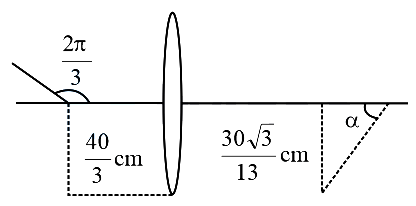 JEE Advanced 2022 Hard
 - Let the position vectors of points and be and , respectively. Then which of the following statements is true?JEE Advanced 2023 Medium
- The minimum kinetic energy needed by an alpha particle to cause the nuclear reaction in a laboratory frame is (in ). Assume that is at rest in the laboratory frame. The masses of and can be taken to be , and , respectively, where . The value of is
If the numerical value has more than two decimal places, truncate/round-off the value to TWO decimal places.JEE Advanced 2022 Medium