


JEE Advanced · Mathematics · 25. AOD
The total number of local maxima and local minima of the function \(f(x)=\left\{\begin{array}{lc}(2+x)^3 ; & -3 < x \leq-1 \\ x^{\frac{2}{3}} ; & -1 < x < 2\end{array}\right.\) is
- A
0
- B
1
- C
2
- D
3
Answer & Solution
Correct Answer
(C)
2
Step-by-step Solution
Detailed explanation
Given that, \(f(x)=\left\{\begin{array}{l}(2+x)^3 ;-3 < x \leq-1 \\ x^{2 / 3} ; \quad-1 < x < 2\end{array}\right.\)
\[
\Rightarrow \quad f^{\prime}(x)=\left\{\begin{array}{l}
3(2+x)^2 ;-3 < x \leq 1 \\
\frac{2}{3} x^{-\frac{1}{3}} ; \quad-1 < x < 2
\end{array}\right.
\]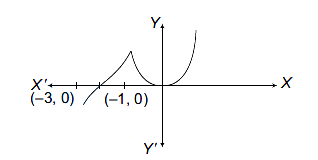
Clearly, \(f^{\prime}(x)\) changes its sign at \(x=-1\) from \(+\) ve to -ve and so \(f(x)\) has local maxima at \(x=-1\).
Also, \(f^{\prime}(0)\) does not exist but \(f^{\prime}\left(0^{-}\right) < 0\) and \(f^{\prime}\left(0^{+}\right) < 0\).
It can only be inferred that \(f(x)\) has a possibility of a minima at \(x=0\).
Hence, the given function has one local maxima at \(x=-1\) and one local minima at \(x=0\).
\[
\Rightarrow \quad f^{\prime}(x)=\left\{\begin{array}{l}
3(2+x)^2 ;-3 < x \leq 1 \\
\frac{2}{3} x^{-\frac{1}{3}} ; \quad-1 < x < 2
\end{array}\right.
\]
Clearly, \(f^{\prime}(x)\) changes its sign at \(x=-1\) from \(+\) ve to -ve and so \(f(x)\) has local maxima at \(x=-1\).
Also, \(f^{\prime}(0)\) does not exist but \(f^{\prime}\left(0^{-}\right) < 0\) and \(f^{\prime}\left(0^{+}\right) < 0\).
It can only be inferred that \(f(x)\) has a possibility of a minima at \(x=0\).
Hence, the given function has one local maxima at \(x=-1\) and one local minima at \(x=0\).
See the Complete Solution
Get step-by-step explanations for this and 2.5 Lakh+ more JEE, NEET & CET questions.
- Unlock all solutions
- Practice the full chapter
- Track accuracy across PYQs
4.8 rated on Google Play · 14,000+ reviews
More questions from Mathematics
- Consider the family of all circles whose centers lie on the straight line If this family of circles is represented by the differential equation where are functions of , then which of the following statements is (are) true ?JEE Advanced 2015 Easy
- For any complex number , let , where . Let and be real numbers such that for all complex numbers satisfying , the ordered pair lies on the circle
Then which of the following statements is(are) TRUE?JEE Advanced 2021 Hard - Paragraph:
A fair die is tossed repeatedly until a six is obtained. Let \(X\) denotes the number of tosses required.Question:
The conditional probability that \(X \geq 6\) given \(X>3\) equalsJEE Advanced 2009 Medium - Three numbers are chosen at random, one after another with replacement, from the set \(S=\{1,2,3, \ldots, 100\}\). Let \(p_{1}\) be the probability that the maximum of chosen numbers is at least 81 and \(p_{2}\) be the probability that the minimum of chosen numbers is at most 40 .
The value of isJEE Advanced 2021 Medium - Let \(\mathbf{a}, \mathbf{b}, \mathbf{c}\) be unit vectors such that \(\mathbf{a}+\mathbf{b}+\mathbf{c}=\mathbf{0}\). Which one of the following is correct?JEE Advanced 2007 Easy
- Internal bisector of \(\angle A\) of \(\triangle A B C\) meets side \(B C\) at \(D\). A line drawn through \(D\) perpendicular to \(A D\) intersects the side \(A C\) at \(E\) and side \(A B\) at \(F\). If \(a, b\) and \(c\) represent sides of \(\triangle A B C\), thenJEE Advanced 2006 Hard
More PYQs from JEE Advanced
- Consider a system of three connected strings, \(S_1, S_2\) and \(S_3\) with uniform linear mass densities \(\mu \mathrm{kg} / \mathrm{m}\), \(4 \mu \mathrm{~kg} / \mathrm{m}\) and \(16 \mu \mathrm{~kg} / \mathrm{m}\), respectively, as shown in the figure. \(S_1\) and \(S_2\) are connected at the point \(P\), whereas \(S_2\) and \(S_3\) are connected at the point \(Q\), and the other end of \(S_3\) is connected to a wall. A wave generator O is connected to the free end of \(S_1\). The wave from the generator is represented by \(y=y_0\) \(\cos (\omega t-k x) \mathrm{cm}\), where \(y_0, \omega\) and \(k\) are constants of appropriate dimensions. Which of the following statements is/are correct:
 JEE Advanced 2025 Hard
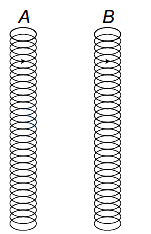
 - Two metallic rings \(A\) and \(B\), identical in shape and size but having different resistivities \(\rho_A\) and \(\rho_B\), are kept on top of two identical solenoids as shown in the figure. When current \(I\) is switched on in both the solenoids in identical manner, the rings \(A\) and \(B\) jump to heights \(h_A\) and \(h_B\), respectively, with \(h_A>h_B\). The possible relation(s) between their resistivities and their masses \(m_A\) and \(m_B\) is(are)
 JEE Advanced 2009 Hard
 - The solubility of barium iodate in an aqueous solution prepared by mixing 200 mL of 0.010 M barium nitrate with 100 mL of 0.10 M sodium iodate is \(\boldsymbol{X} \times 10^{-6} \mathrm{~mol} \mathrm{dm}^{-3}\). The value of \(\boldsymbol{X}\) is \(\qquad\) .
Use: Solubility product constant \(\left(K_{\mathrm{sp}}\right)\) of barium iodate \(=1.58 \times 10^{-9}\)JEE Advanced 2025 Hard - List- shows different radioactive decay processes and List- provides possible emitted particles. Match each entry in List- with an appropriate entry from List-, and choose the correct option.
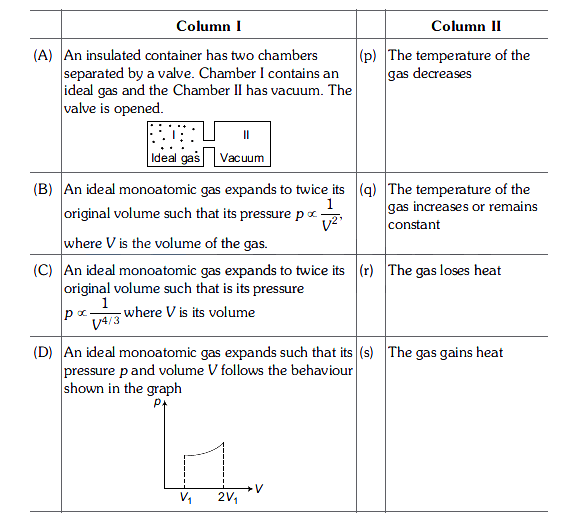
List- List- one particle and one particle three particles and one particle two particles and one particle one particle and one particle one particle and two particles JEE Advanced 2023 Easy - Column I contains a list of processes involving expansion of an ideal gas. Match this with Column II describing the thermodynamic change during this process. Indicate your answer by darkening the appropriate bubbles of the \(4 \times 4\) matrix given in the ORS.
 JEE Advanced 2008 Hard
 - Suppose holds for some positive integer Then equalsJEE Advanced 2019 Hard