


JEE Advanced · Physics · 12. Thermal Properties
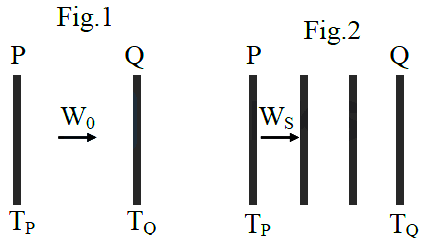
Two identical plates P and Q , radiating as perfect black bodies, are kept in vacuum at constant absolute temperatures \(\mathrm{T}_{\mathrm{P}}\) and \(\mathrm{T}_{\mathrm{Q}}\), respectively, with \(\mathrm{T}_{\mathrm{Q}}<\mathrm{T}_{\mathrm{P}}\), as shown in Fig. 1. The radiated power transferred per unit area from P to Q is \(W_0\). Subsequently, two more plates, identical to P and Q, are introduced between P and Q, as shown in Fig. 2. Assume that heat transfer takes place only between adjacent plates. If the power transferred per unit area in the direction from P to Q (Fig. 2) in the steady state is \(W_S\), then the ratio \(\frac{W_0}{W_S}\) is ________.
- A 3
- B 4
- C 5
- D 6
Answer & Solution
Correct Answer
(A) 3
Step-by-step Solution
Detailed explanation
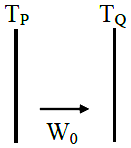
Initially :
\(\mathrm{W}_0=\sigma\left(\mathrm{T}_{\mathrm{P}}^4-\mathrm{T}_{\mathrm{Q}}^4\right)\)
Finally :
Putting heat currents equal in steady state :
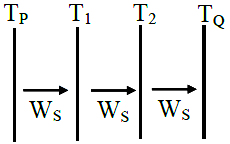
\(\begin{aligned} & \sigma\left(\mathrm{T}_{\mathrm{P}}^4-\mathrm{T}_1^4\right)=\sigma\left(\mathrm{T}_1^4-\mathrm{T}_2^4\right) \\ & \sigma\left(\mathrm{T}_1^4-\mathrm{T}_2^4\right)=\sigma\left(\mathrm{T}_2^4-\mathrm{T}_{\mathrm{Q}}^4\right)\end{aligned}\)
Adding :
\(\mathrm{T}_{\mathrm{P}}^4-\mathrm{T}_1^4=\mathrm{T}_2^4-\mathrm{T}_{\mathrm{Q}}^4\)
\(\Rightarrow \mathrm{T}_1^4+\mathrm{T}_2^4=\mathrm{T}_{\mathrm{P}}^4+\mathrm{T}_{\mathrm{Q}}^4\)
and \(\quad \Rightarrow \mathrm{T}_1^4-\mathrm{T}_2^4=\mathrm{T}_{\mathrm{P}}^4-\mathrm{T}_1^4\)
Adding : \(\mathrm{T}_1^4=\frac{2 \mathrm{~T}_{\mathrm{P}}^4+\mathrm{T}_{\mathrm{Q}}^4}{3}\)
So \(\mathrm{W}_{\mathrm{S}}=\sigma\left(\mathrm{T}_{\mathrm{P}}^4-\mathrm{T}_1^4\right)\)
\(=\sigma\left(\mathrm{T}_{\mathrm{P}}^4-\left(\frac{2 \mathrm{~T}_{\mathrm{P}}^4+\mathrm{T}_{\mathrm{Q}}^4}{3}\right)\right)=\sigma\left(\frac{\mathrm{T}_{\mathrm{P}}^4-\mathrm{T}_{\mathrm{Q}}^4}{3}\right)\)
hence \(\frac{\mathrm{W}_{\mathrm{S}}}{\mathrm{W}_0}=3\)
\(\mathrm{W}_0=\sigma\left(\mathrm{T}_{\mathrm{P}}^4-\mathrm{T}_{\mathrm{Q}}^4\right)\)
Finally :
Putting heat currents equal in steady state :
\(\begin{aligned} & \sigma\left(\mathrm{T}_{\mathrm{P}}^4-\mathrm{T}_1^4\right)=\sigma\left(\mathrm{T}_1^4-\mathrm{T}_2^4\right) \\ & \sigma\left(\mathrm{T}_1^4-\mathrm{T}_2^4\right)=\sigma\left(\mathrm{T}_2^4-\mathrm{T}_{\mathrm{Q}}^4\right)\end{aligned}\)
Adding :
\(\mathrm{T}_{\mathrm{P}}^4-\mathrm{T}_1^4=\mathrm{T}_2^4-\mathrm{T}_{\mathrm{Q}}^4\)
\(\Rightarrow \mathrm{T}_1^4+\mathrm{T}_2^4=\mathrm{T}_{\mathrm{P}}^4+\mathrm{T}_{\mathrm{Q}}^4\)
and \(\quad \Rightarrow \mathrm{T}_1^4-\mathrm{T}_2^4=\mathrm{T}_{\mathrm{P}}^4-\mathrm{T}_1^4\)
Adding : \(\mathrm{T}_1^4=\frac{2 \mathrm{~T}_{\mathrm{P}}^4+\mathrm{T}_{\mathrm{Q}}^4}{3}\)
So \(\mathrm{W}_{\mathrm{S}}=\sigma\left(\mathrm{T}_{\mathrm{P}}^4-\mathrm{T}_1^4\right)\)
\(=\sigma\left(\mathrm{T}_{\mathrm{P}}^4-\left(\frac{2 \mathrm{~T}_{\mathrm{P}}^4+\mathrm{T}_{\mathrm{Q}}^4}{3}\right)\right)=\sigma\left(\frac{\mathrm{T}_{\mathrm{P}}^4-\mathrm{T}_{\mathrm{Q}}^4}{3}\right)\)
hence \(\frac{\mathrm{W}_{\mathrm{S}}}{\mathrm{W}_0}=3\)
See the Complete Solution
Get step-by-step explanations for this and 2.5 Lakh+ more JEE, NEET & CET questions.
- Unlock all solutions
- Practice the full chapter
- Track accuracy across PYQs
4.8 rated on Google Play · 14,000+ reviews
More questions from Physics
- A silver sphere of radius \(1 \mathrm{~cm}\) and work function \(4.7 \mathrm{eV}\) is suspended from an insulating thread in free-space. It is under continuous illumination of \(200 \mathrm{~nm}\) wavelength light. As photoelectrons are emitted, the sphere gets charged and acquires a potential. The maximum number of photoelectrons emitted from the sphere is \(A \times 10^Z\) (where \(1 < A < 10\) ). The value of \(Z\) isJEE Advanced 2011 Medium
- An optical bench has long scale having four equal divisions in each While measuring the focal length of a convex lens, the lens is kept at mark of the scale and the object pin is kept at mark. The image of the object pin on the other side of the lens overlaps with image pin that is kept at mark. In this experiment, the percentage error in the measurement of the focal length of the lens is_____JEE Advanced 2019 Medium
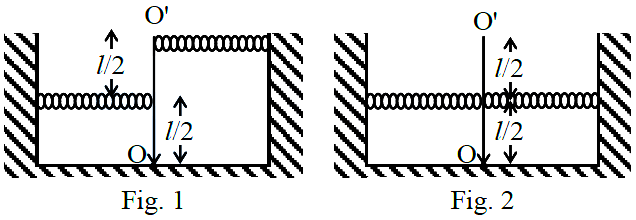
- As shown in the figures, a uniform rod \(O O^{\prime}\) of length \(l\) is hinged at the point \(O\) and held in place vertically between two walls using two massless springs of same spring constant. The springs are connected at the midpoint and at the top-end \(\left(O^{\prime}\right)\) of the rod, as shown in Fig. 1 and the rod is made to oscillate by a small angular displacement. The frequency of oscillation of the rod is \(f_1\). On the other hand, if both the springs are connected at the midpoint of the rod, as shown in Fig. 2 and the rod is made to oscillate by a small angular displacement, then the frequency of oscillation is \(f_2\). Ignoring gravity and assuming motion only in the plane of the diagram, the value of \(\frac{f_1}{f_2}\) is:
 JEE Advanced 2025 Hard
 - A projectile of mass 200 g is launched in a viscous medium at an angle \(60^{\circ}\) with the horizontal, with an initial velocity of \(270 \mathrm{~m} / \mathrm{s}\). It experiences a viscous drag force \(\vec{F}=-c \vec{v}\) where the drag coefficient \(c=0.1 \mathrm{~kg} / \mathrm{s}\) and \(\vec{v}\) is the instantaneous velocity of the projectile. The projectile hits a vertical wall after 2 s . Taking \(e=2.7\), the horizontal distance of the wall from the point of projection (in m ) isJEE Advanced 2025 Medium
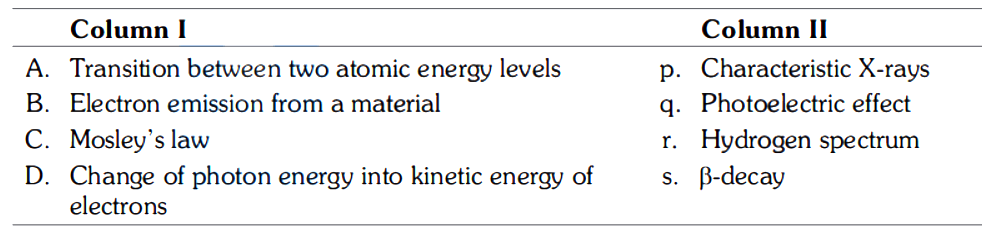
- Some laws/processes are given in Column I. Match these with the physical phenomena given in Column II and indicate your answer by darkening appropriate bubbles in the \(4 \times 4\) matrix given in the ORS.
 JEE Advanced 2007 Medium
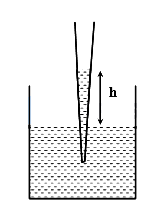
 - A glass capillary tube is of the shape of a truncated cone with an apex angle so that its two ends have cross-sections of different radii. When dipped in water vertically, the water rises in it to a height , where the radius of its cross-section is . If the surface tension of water is , its density is , and its contact angle with glass is , then the value of will be ( is the acceleration due to gravity)
 JEE Advanced 2014 Hard
More PYQs from JEE Advanced
- In an atom, the total number of electrons having quantum numbers and isJEE Advanced 2014 Easy
- Match the specified conditions in solids listed in Column I with their properties in Column II. Indicate your answer by darkening the appropriate bubbles of the \(4 \times 4\) matrix given in the ORS.
Column I Column II A. Simple cubic and face-centered cubic p. Have these cell parameters \(a=b=c \text { and } \alpha=\beta=\gamma\) B. Cubic and rhombohedral q. Are two crystal systems C. Cubic and tetragonal r. Have only two crystallographic angles of \(90^{\circ}\) D. Hexagonal and monoclinic s. Belong to same crystal system JEE Advanced 2007 Easy - A charged particle is introduced at the origin with a given initial velocity . A uniform electric field and a uniform magnetic field exist everywhere. The velocity , electric field and a uniform magnetic field are given in the columns below
In which case will the particle move in a straight line with a constant velocity?Column 1 Column 2 Column 3 1. Electron with (i) (P) 2. Electron with (ii) (Q) 3.Proton with =0 (iii) (R) 4. Proton with (iv) (S) JEE Advanced 2017 Easy - Among the following compounds, the most acidic isJEE Advanced 2011 Medium
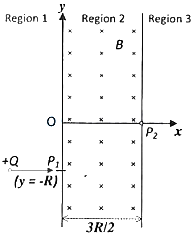
- A uniform magnetic field B exists in the region between and (region 2 in the figure) pointing normally into the plane of the paper. A particle with charge and momentum p directed along -axis enters region 2 from region 1 at point Which of the following option(s) is/are correct?
 JEE Advanced 2017 Hard
 - Consider three points \(P=(-\sin (\beta-\alpha),-\cos \beta), Q=(\cos (\beta-\alpha), \sin \beta)\) and \(R=(\cos (\beta-\alpha+\theta), \sin (\beta-\theta)\), where \(0 < \alpha, \beta, \theta < \frac{\pi}{4}\). Then,JEE Advanced 2008 Easy