


JEE Advanced · Mathematics · 18. Matrices
The number of \(3 \times 3\) matrices \(A\) whose entries are either 0 or 1 and for which the system \(A\left[\begin{array}{l}x \\ y \\ z\end{array}\right]=\left[\begin{array}{l}1 \\ 0 \\ 0\end{array}\right]\) has exactly two distinct solutions, is
- A
0
- B
\(2^9-1\)
- C
168
- D
2
Answer & Solution
Correct Answer
(A)
0
Step-by-step Solution
Detailed explanation
Since, \(A\left[\begin{array}{l}x \\ y \\ z\end{array}\right]=\left[\begin{array}{l}1 \\ 0 \\ 0\end{array}\right]\) is linear equation in three variables and that could have only unique, no solution or infinitely many solution.
\(\therefore\) It is not possible to have two solutions.
Hence, number of matrices \(A\) is zero.
\(\therefore\) It is not possible to have two solutions.
Hence, number of matrices \(A\) is zero.
See the Complete Solution
Get step-by-step explanations for this and 2.5 Lakh+ more JEE, NEET & CET questions.
- Unlock all solutions
- Practice the full chapter
- Track accuracy across PYQs
4.8 rated on Google Play · 14,000+ reviews
More questions from Mathematics
- Let \(\mathbb{R}\) denote the set of all real numbers. Let \(f: \mathbb{R} \rightarrow \mathbb{R}\) and \(g: \mathbb{R} \rightarrow(0,4)\) be functions defined by \(f(x)=\log _e\left(x^2+2 x+4\right)\), and \(g(x)=\frac{4}{1+e^{-2 x}}\)
Define the composite function \(f \circ g^{-1}\) by \(\left(f \circ g^{-1}\right)(x)=\left(g^{-1}(x)\right)\), where \(g^{-1}\) is the inverse of the function \(g\).
Then the value of the derivative of the composite function \(f \circ g^{-1}\) at \(x=2\) is ________ .JEE Advanced 2025 Hard - Let and be real numbers. Consider the following system of linear equations Match each entry in List-I to the correct entries in List-II.
The correct option is:List-I List-II If and then the system has a unique solution If and , then the system has no solution If where and , then the system has infinitely many solutions If where and , then the system has and as a solution and as a solution JEE Advanced 2023 Medium - Paragraph:
Let \(p\) be an odd prime number and \(T_p\) be the following set of \(2 \times 2\) matrices
\[
T_p=\left\{A=\left[\begin{array}{ll}
a & b \\
c & a
\end{array}\right] ; a, b, c \in\{0,1,2, \ldots, p-1\}\right\}
\]Question:
The number of \(A\) in \(T_p\) such that \(\operatorname{det}(A)\) is not divisible by \(p\), isJEE Advanced 2010 Easy - Let determine diagonals of a parallelogram PQRS and be another vector. Then the volume of the parallelepiped determined by the vectors isJEE Advanced 2013 Medium
- Paragraph:
Let \(O\) be the origin, and \(\overrightarrow{O X}, \overrightarrow{O Y}, \overrightarrow{O Z}\) be three unit vectors in the directions of the sides \(\overrightarrow{Q R}, \overrightarrow{R P}\), \(\overrightarrow{P Q}\), respectively, of a triangle \(P Q R\).
Question:
\(|\overrightarrow{O X} \times \overrightarrow{O Y}|=\)JEE Advanced 2017 Easy - Match the following
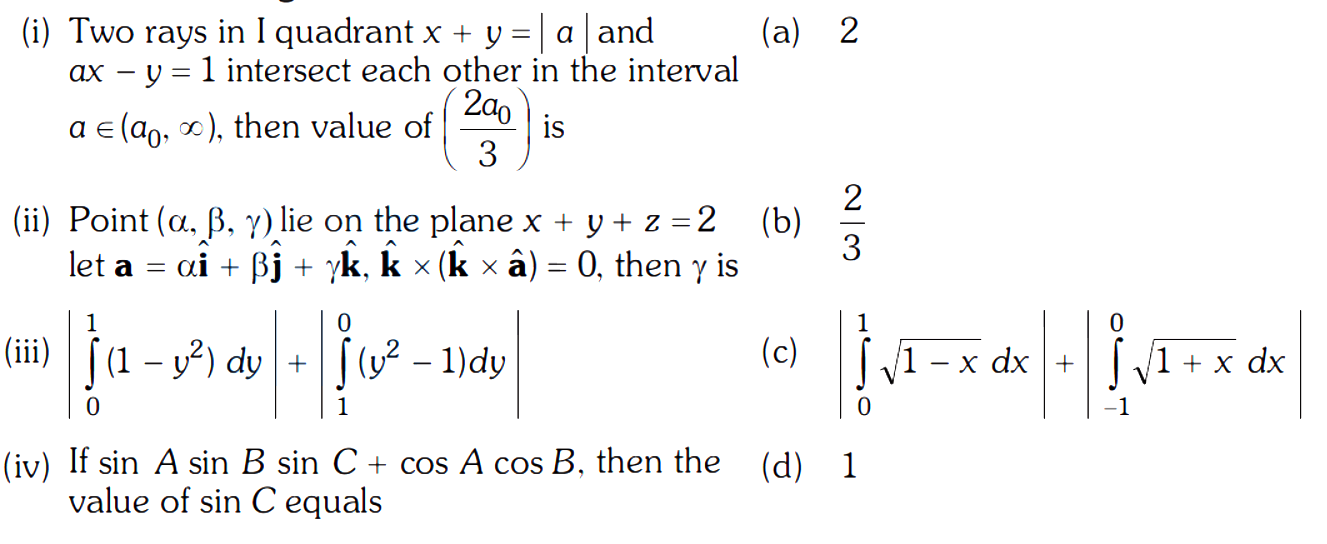 JEE Advanced 2006 Medium
More PYQs from JEE Advanced
-

Which is correct statement if \(\mathrm{N}_2\) is added at equilibrium condition?JEE Advanced 2006 Easy - Vessel-1 contains \(\mathbf{w}_2 \mathrm{~g}\) of a non-volatile solute \(\mathbf{X}\) dissolved in \(\mathbf{w}_1 \mathrm{~g}\) of water. Vessel- 2 contains \(\mathbf{w}_2 \mathrm{~g}\) of another non-volatile solute \(\mathbf{Y}\) dissolved in \(\mathbf{w}_1 \mathrm{~g}\) of water. Both the vessels are at the same temperature and pressure. The molar mass of \(\mathbf{X}\) is \(80 \%\) of that of \(\mathbf{Y}\). The van't Hoff factor for \(\mathbf{X}\) is 1.2 times of that of \(\mathbf{Y}\) for their respective concentrations.
The elevation of boiling point for solution in Vessel-1 is ________. \(\%\) of the solution in Vessel-2.JEE Advanced 2024 Medium - Each of the following options contains a set of four molecules. Identify the option(s) where all four molecules possess permanent dipole moment at room temperature.JEE Advanced 2019 Medium
- Paragraph :
A frame of reference that is accelerated with respect to an inertial frame of reference is called a non-inertial frame of reference. A coordinate system fixed on a circular disc rotating about a fixed axis with a constant angular velocity \(\omega\) is an example of a non-inertial frame of reference.
The relationship between the force \(\vec{F}_{\text {rot }}\) experienced by a particle of mass \(m\) moving on the rotating disc and the force \(\vec{F}_{\text {in }}\) experienced by the particle in an inertial frame of reference is
\(\vec{F}_{\mathrm{rot}}=\vec{F}_{\mathrm{in}}+2 m\left(\vec{v}_{\mathrm{rot}} \times \vec{\omega}\right)+m(\vec{\omega} \times \vec{r}) \times \vec{\omega}\),
where \(\vec{v}_{\text {rot }}\) is the velocity of the particle in the rotating frame of reference and \(\vec{r}\) is the position vector of the particle with respect to the centre of the disc.
Now consider a smooth slot along a diameter of a disc of radius \(R\) rotating counter-clockwise with a constant angular speed \(\omega\) about its vertical axis through its center. We assign a coordinate system with the origin at the center of the disc, the \(x\)-axis along the slot, the \(y\)-axis perpendicular to the slot and the \(z\)-axis along the rotation axis \((\vec{\omega}=\omega \hat{k}) .\) A small block of mass \(m\) is gently placed in the slot at \(\vec{r}=(R / 2) \hat{i}\) at \(t=0\) and is constrained to move only along the slot.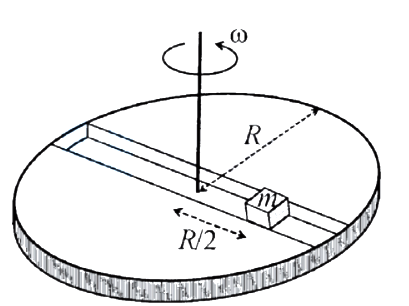
Question :
The net reaction of the disc on the block isJEE Advanced 2016 Medium - The \(\beta\)-decay process, discovered around 1900 , is basically the decay of a neutron \((n)\). In the laboratory, a proton \((p)\) and an electron \(\left(e^{-}\right)\)are observed as the decay products of the neutron. Therefore, considering the decay of a neutron as a two-body decay process, it was predicted theoretically that the kinetic energy of the electron should be a constant. But experimentally, it was observed that the electron kinetic energy has continuous spectrum. Considering a three-body decay process, i.e.
\(n \rightarrow p+e^{-}+\bar{v}_{e}\), around 1930, Pauli explained the observed electron energy spectrum. Assuming the anti-neutrino \(\left(\bar{v}_{e}\right)\) to be massless and possessing negligible energy, and the neutron to be at rest, momentum and energy conservation principles are applied. From this calculation, the maximum kinetic energy of the electron is \(0.8 \times 10^{6} \mathrm{eV}\). The kinetic energy carried by the proton is only the recoil energy.
Question:
What is the maximum energy of the anti-neutrino?JEE Advanced 2012 Medium - Consider the lines \(L_{1}\) and \(L_{2}\) defined by
\[
L_{1}: x \sqrt{2}+y-1=0 \text { and } L_{2}: x \sqrt{2}-y+1=0
\]
For a fixed constant \(\lambda\), let \(C\) be the locus of a point \(P\) such that the product of the distance of \(P\) from \(L_{1}\) and the distance of \(P\) from \(L_{2}\) is \(\lambda^{2}\). The line \(y=2 x+1\) meets \(C\) at two points \(R\) and \(S\), where the distance between \(R\) and \(S\) is \(\sqrt{270}\).
Let the perpendicular bisector of \(R S\) meet \(C\) at two distinct points \(R^{\prime}\) and \(S^{\prime}\). Let \(D\) be the square of the distance between \(R^{\prime}\) and \(S^{\prime}\).
The value of isJEE Advanced 2021 Hard