


JEE Advanced · Physics · 15. Oscillations
Function \(x=A \sin ^2 \omega t+B \cos ^2 \omega t+C\) \(\sin \omega t \cos \omega t\) represents SHM.
- A For any value of \(A, B\) and \(C\) (except \(C=0\) )
- B If \(A=-B, C=2 B\), amplitude \(=|B \sqrt{2}|\)
- C If \(A=B ; C=0\)
- D If \(A=B ; C=2 B\), amplitude \(=|B|\)
Answer & Solution
Correct Answer
(D) If \(A=B ; C=2 B\), amplitude \(=|B|\)
Step-by-step Solution
Detailed explanation
For \(A=-B\) and \(C=2 B\)
\(
X=B \cos 2 \omega t+B \sin 2 \omega t=\)\(\sqrt{2 B} \sin \left(2 \omega t+\frac{\pi}{4}\right)
\)
This is equation of SHM of amplitude \(\sqrt{2} B\)
If \(A=B\) and \(C=2 B\), then \(X=B+B \sin 2 \omega t\)
This is also equation of SHM about the point \(X=B\). Function oscillates between \(X=0\) and \(X=2 B\) with amplitude \(B\).
\(
X=B \cos 2 \omega t+B \sin 2 \omega t=\)\(\sqrt{2 B} \sin \left(2 \omega t+\frac{\pi}{4}\right)
\)
This is equation of SHM of amplitude \(\sqrt{2} B\)
If \(A=B\) and \(C=2 B\), then \(X=B+B \sin 2 \omega t\)
This is also equation of SHM about the point \(X=B\). Function oscillates between \(X=0\) and \(X=2 B\) with amplitude \(B\).
See the Complete Solution
Get step-by-step explanations for this and 2.5 Lakh+ more JEE, NEET & CET questions.
- Unlock all solutions
- Practice the full chapter
- Track accuracy across PYQs
4.8 rated on Google Play · 14,000+ reviews
More questions from Physics
- Consider a thin square plate floating on a viscous liquid in a large tank. The height of the liquid in the tank is much less than the width of the tank. The floating plate is pulled horizontally with a constant velocity . Which of the following statements is (are) true?JEE Advanced 2018 Easy
- Consider a hydrogen atom with its electron in the orbital. An electromagnetic radiation of wavelength 90 nm is used to ionize the atom. If the kinetic energy of the ejected electron is 10.4 eV, then the value of n isJEE Advanced 2015 Easy
- Young’s modulus of elasticity is expressed in terms of three derived quantities, namely, the gravitational constant , Planck’s constant and the speed of light , as . Which of the following is the correct option?JEE Advanced 2023 Easy
- The figure shows the \(p-V\) plot of an ideal gas taken through a cycle \(A B C D A\). The part \(A B C\) is a semi-circle and \(C D A\) is half of an ellipse. Then,
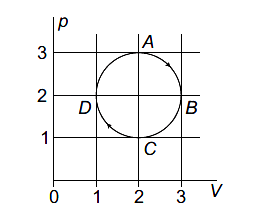 JEE Advanced 2009 Medium
 - A container has a base of and height , as shown in the figure. It has two parallel electrically conducting walls each of area . The remaining walls of the container are thin and non-conducting. The container is being filled with a liquid of dielectric constant at a uniform rate of . What is the value of the capacitance of the container after seconds?
[Given: Permittivity of free space , the effects of the non-conducting walls on the capacitance are negligible]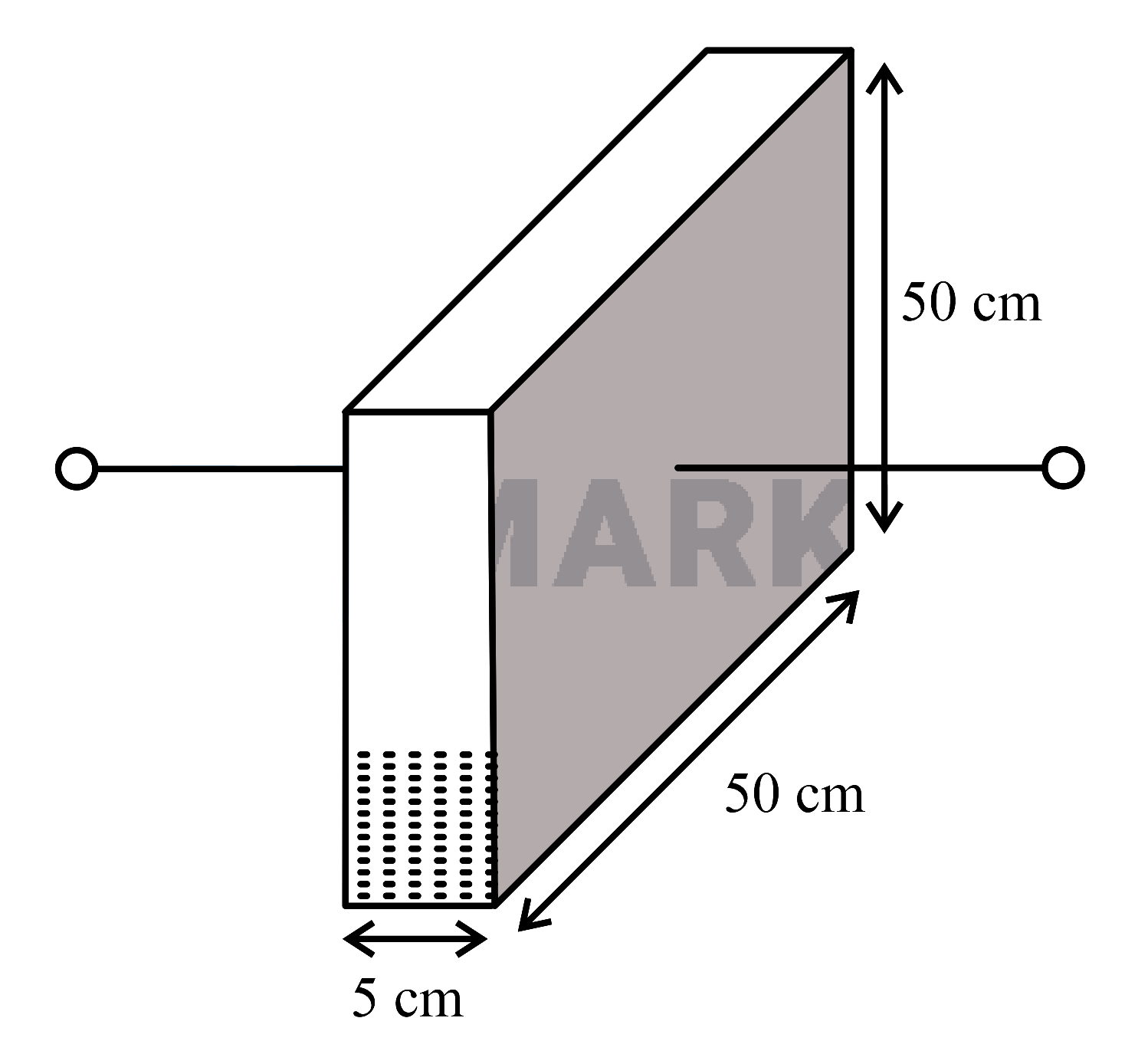 JEE Advanced 2023 Medium
 - In a photoelectric experiment, a parallel beam of monochromatic light with the power of is incident on a perfectly absorbing cathode of work function . The frequency of light is just above the threshold frequency so that the photoelectrons are emitted with negligible kinetic energy. Assume that the photoelectron emission efficiency is 100%. A potential difference of is applied between the cathode and the anode. All the emitted electrons are incident normally on the anode and are absorbed. The anode experiences a force due to the impact of the electrons. The value of is __________. Mass of the electron \(\text{m}_\text e =9 \times 10^{-31} kg\) and \(1.0 eV =1.6 \times\) \(10^{-19}\text{ J}.\)JEE Advanced 2018 Hard
More PYQs from JEE Advanced
- A small circular loop of area and resistance is fixed on a horizontal -plane with the center of the loop always on the axis of a long solenoid. The solenoid has turns per unit length and carries current counter clockwise as shown in the figure. The magnetic field due to the solenoid is in direction. List-I gives time dependences of in terms of a constant angular frequency . List-II gives the torques experienced by the circular loop at time , Let .
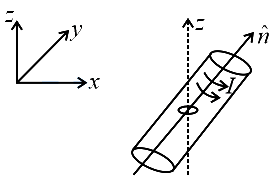
Which one of the following options is correct?List-I List-II (i) (p) (ii) (q) (iii) (r) (iv) (s) (t) JEE Advanced 2022 Hard - Match the following.
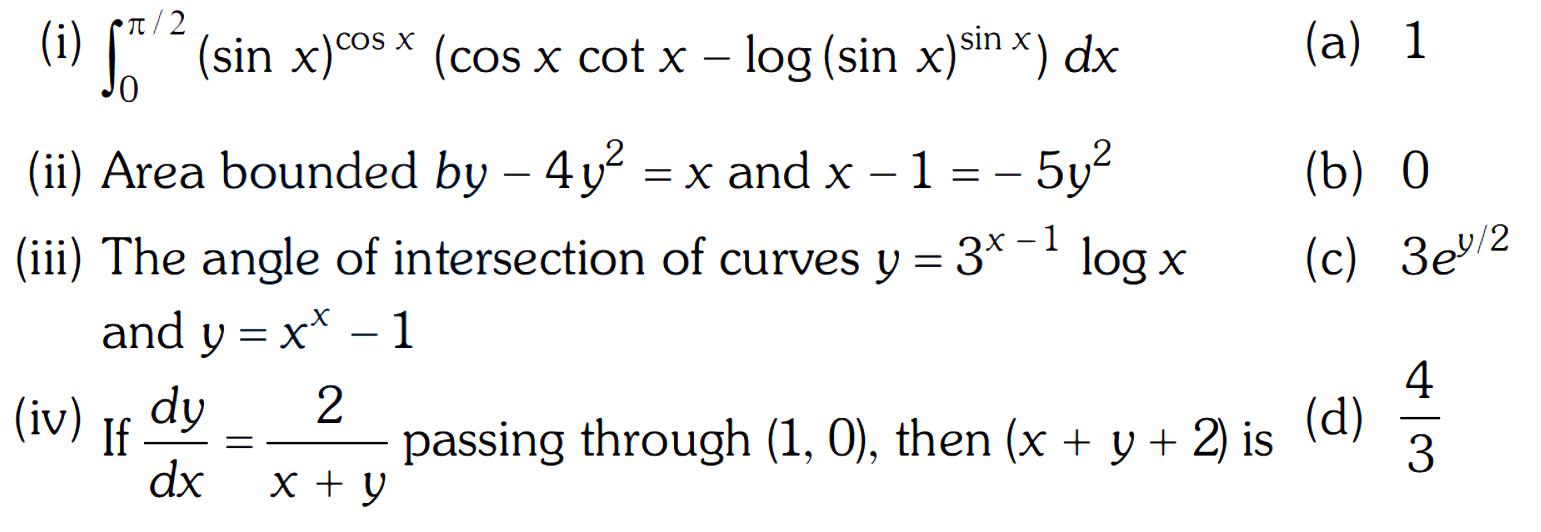 JEE Advanced 2006 Hard
 - The unbalanced chemical reactions given in List I show missing reagent or condition (?) which are provided in list II. match List I with List II and select the correct answer using the code given below the lists :
List - I List - II A. \(PbO _2+ H _2 SO _4 \xrightarrow{?}\) \(PbSO _4 + O _2+\) other product P. \(\text{NO}\) B. \(Na _2 S_2 O _3+ H _2 O \xrightarrow{?}\) \(NaHSO _4~+\) other product Q. \(\text{I}_2\) C. \(N _2 H _4 \xrightarrow{?} N_2 +\) other product R. Warm D. \(XeF _2 \xrightarrow{?} Xe ~+\) other product S. \(\text{Cl}_2\) JEE Advanced 2013 Easy - A light beam is travelling from Region I to Region IV (refer figure). The refractive index in Region I, II, III and IV are \(n_0, \frac{n_0}{2}, \frac{n_0}{6}\) and \(\frac{n_0}{8}\), respectively. The angle of incidence \(\theta\) for which the beam just misses entering Region IV is
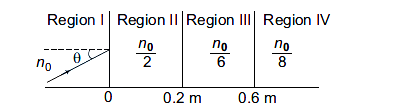 JEE Advanced 2008 Easy
 - Consider \(L_1: 2 x+3 y+p-3=0 ; L_2: 2 x+3 y+p+3=0\) where \(p\) is a real number and \(C: x^2+y^2+6 x-10 y+30=0\).
Statement 1 If line \(L_1\) is a chord of circle \(C\), then line \(L_2\) is not always a diameter of circle \(C\).
Statement 2 If line \(L_1\) is a diameter of circle \(C\), then line \(L_2\) is not a chord of circle \(C\).JEE Advanced 2008 Easy - Paragraph:
Tollen's reagent is used for the detection of aldehyde when a solution of \(\mathrm{AgNO}_3\) is added to glucose with \(\mathrm{NH}_4 \mathrm{OH}\) then gluconic acid is formed
\(\mathrm{Ag}^{+}+e^{-} \rightarrow \mathrm{Ag} E_{\text {red }}^{\circ}=0.8 \mathrm{~V} \)
\( \mathrm{C}_6 \mathrm{H}_{12} \mathrm{O}_6+\mathrm{H}_2 \mathrm{O} \rightarrow \text { Gluconic acid }\left(\mathrm{C}_6 \mathrm{H}_{12} \mathrm{O}_7\right)\) \(+~2 \mathrm{H}^{+}+2 e^{-} ; -E_{\mathrm{red}}^{\circ}=-0.05 \mathrm{~V} \)
\( \mathrm{Ag}\left(\mathrm{NH}_3\right)_2^{+}+e^{-} \rightarrow \mathrm{Ag}(s)+2 \mathrm{NH}_3 ; E_{\mathrm{red}}^{\circ}\) \(=0.337 \mathrm{~V}\)
[Use \(2.303 \times \frac{R T}{F}=0.0592\) and \(\frac{F}{R T}=38.92\) at \(298 \mathrm{~K}\)]
Question:
\(2 \mathrm{Ag}^{+}+\mathrm{C}_6 \mathrm{H}_{12} \mathrm{O}_6+\mathrm{H}_2 \mathrm{O} \rightarrow 2 \mathrm{Ag}(\mathrm{s})\) \(+~\mathrm{C}_6 \mathrm{H}_{12} \mathrm{O}_4+2 \mathrm{H}^{+}\). Find \(\ln \mathrm{K}\) of this reaction.JEE Advanced 2006 Medium