


JEE Advanced · Physics · 6. Work Power Energy
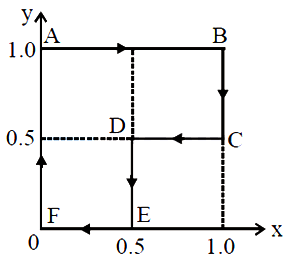
A particle is moved along a path as shown in figure, in presence of a force where and are in meter and The work done on the particle by this force will be ____ Joule.
- A 0.25
- B 0.5
- C 0.1
- D 0.75
Answer & Solution
Correct Answer
(D) 0.75
Step-by-step Solution
Detailed explanation
Now, total work done in whole path is given by,
\(W=W_{A B}+W_{B C}+W_{C D}+W_{D E}+W_{E F}+\)\(W_{F A}\)
\(A \rightarrow B, y=1, d y=0, W_{A \rightarrow B}=\int \alpha y d x=\alpha \cdot\) \(1 \int_0^1 d x=\alpha\)
\(B \rightarrow C, x=1, d x=0, W_{B \rightarrow C}=2 \alpha \cdot 1 \int_1^{0.5}\) \(d y=-2 \alpha(0.5)=-\alpha\)
\(C \rightarrow D, y=0.5, d y=0, W_{C \rightarrow D}=\int_1^{0.5} \alpha y d x\)\(=\alpha \cdot \frac{1}{2} \int_1^{0.5} d x=-\frac{\alpha}{4}\)
\(D \rightarrow E, x=0.5, d x=0, W_{D \rightarrow E}=2 \alpha \int x d y=\)\(2 \alpha \cdot \frac{1}{2} \int_1^{0.5} d y=-\frac{\alpha}{2}\)
\(E \rightarrow F, y=0, d y=0, W_{E F}=0\)
\(F \rightarrow A, x=0, d x=0, W_{E \rightarrow A}=0\)
\(\therefore W=\alpha-\alpha-\frac{\alpha}{4}-\frac{\alpha}{2}=-\frac{3 \alpha}{4}\)
Given \(\alpha=-1 \Rightarrow W=+\frac{3}{4} J=0.75 J\)
See the Complete Solution
Get step-by-step explanations for this and 2.5 Lakh+ more JEE, NEET & CET questions.
- Unlock all solutions
- Practice the full chapter
- Track accuracy across PYQs
4.8 rated on Google Play · 14,000+ reviews
More questions from Physics
- The radius of the orbit of an electron in a Hydrogen-like atom is \(4.5 a _0\), where \(a _0\) is the Bohr radius. Its orbital angular momentum is \(\frac{3 h}{2 \pi}\). It is given that \(h\) is Planck's constant and R is Rydberg constant. the possible wavelength \((s)\), when the atom de-excites, is (are)JEE Advanced 2013 Easy
- A ring and a disc are initially at rest, side by side, at the top of an inclined plane which makes an angle with the horizontal. They start to roll without slipping at the same instant of time along the shortest path. If the time difference between their reaching the ground is , then the height of the top of the inclined plane (in meters) is __________. Take .JEE Advanced 2018 Easy
- Six point charges are kept at the vertices of a regular hexagon of side \(\mathrm{L}\) and centre \(O\), as shown in the figure.
Given that \(K=\frac{1}{4 \pi \varepsilon_{0}} \frac{q}{L^{2}}\), which of the following statement(s) is (are) correct?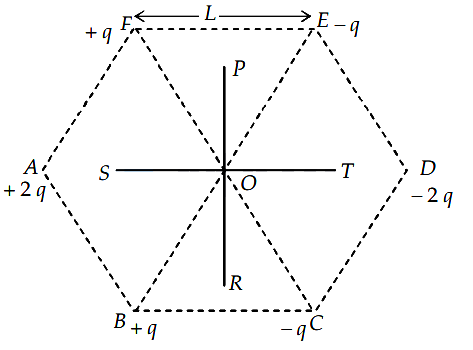 JEE Advanced 2012 Medium
 - A particle of mass moves in circular orbits with potential energy , where is a positive constant and is its distance from the origin. Its energies are calculated using the Bohr model. If the radius of the particle's orbit is denoted by and its speed and energy are denoted by and respectively, then for the orbit (here is the Planck's constant)JEE Advanced 2020 Medium
- A small object of uniform density rolls up a curved surface with an initial velocity \(v\). It reaches up to a maximum height of \(\frac{3 v^2}{4 g}\) with respect to the initial\(
\text { position. The object is }
\)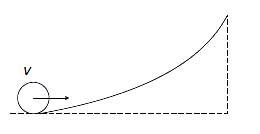 JEE Advanced 2007 Medium
 - Starting at time from the origin with speed , a particle follows a two-dimensional trajectory in the plane so that its coordinates are related by the equation . The and components of its acceleration are denoted by and , respectively. ThenJEE Advanced 2020 Medium
More PYQs from JEE Advanced
- Let \(\mathbf{a}=\hat{\mathbf{i}}+\hat{\mathbf{j}}+\hat{\mathbf{k}}, \mathbf{b}=\hat{\mathbf{i}}-\hat{\mathbf{j}}+\hat{\mathbf{k}}\) and \(\mathbf{c}=\hat{\mathbf{i}}-\hat{\mathbf{j}}-\hat{\mathbf{k}}\) be three vectors. A vector \(\mathbf{v}\) in the plane of \(\mathbf{a}\) and \(\mathbf{b}\) whose projection of \(\mathbf{c}\) is \(\frac{1}{\sqrt{3}}\), is given byJEE Advanced 2011 Medium
- A particle of mass \(m\) is under the influence of the gravitational field of a body of mass \(M(\gg m)\). The particle is moving in a circular orbit of radius \(r_0\) with time period \(T_0\) around the mass \(M\). Then, the particle is subjected to an additional central force, corresponding to the potential energy \(V_{\mathrm{c}}(r)=m \alpha / r^3\), where \(\alpha\) is a positive constant of suitable dimensions and \(r\) is the distance from the center of the orbit. If the particle moves in the same circular orbit of radius \(r_0\) in the combined gravitational potential due to \(M\) and \(V_{\mathrm{c}}(r)\), but with a new time period \(T_1\), then \(\left(T_1^2-T_0^2\right) / T_1^2\) is given by
[ \(G\) is the gravitational constant.]JEE Advanced 2024 Medium - In a Young's double slit experiment, each of the two slits A and B, as shown in the figure, are oscillating about their fixed center and with a mean separation of \(0.8 \mathrm{~mm}\). The distance between the slits at time \(t\) is given by \(d=(0.8+0.04 \sin \omega t) \mathrm{mm}\), where \(\omega=0.08 \mathrm{rad} \mathrm{s}^{-1}\). The distance of the screen from the slits is \(1 \mathrm{~m}\) and the wavelength of the light used to illuminate the slits is \(6000 Ã…\). The interference pattern on the screen changes with time, while the central bright fringe (zeroth fringe) remains fixed at point \(O\).
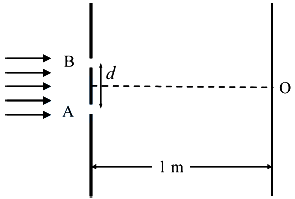
The maximum speed in \(\mu \mathrm{m} / \mathrm{s}\) at which the \(8^{\text {th }}\) bright fringe will move is ________ .JEE Advanced 2024 Hard - At the reaction of with produces a xenon compound The total number of lone pair(s) of electrons present on the whole molecule of is __________JEE Advanced 2019 Medium
- Look at the drawing given in the figure, which has been drawn with ink of uniform line-thickness.
The mass of ink used to draw each of the two inner circles, and each of the two line segments is \(m\). The mass of the ink used to draw the outer circle is \(6 \mathrm{~m}\). The coordinates of the centres of the different parts are, outer circle 10 , \(0)\), left inner circle \((0,0)\), right inner circle \((a, a)\), vertical line \((0,0)\) and horizontal line \((0,-a)\). The \(y\)-coordinate of the centre of mass of the ink in this drawing isJEE Advanced 2009 Medium - Paragraph:
Chemical reactions involve interaction of atoms and molecules. A large number of atoms/molecules (approximately \(6.023 \times 10^{23}\) ) are present in a few grams of any chemical compound varying with their atomic/molecular masses. To handle such large numbers conveniently, the mole concept was introduced. This concept has implications in diverse areas such as analytical chemistry, biochemistry, electrochemistry and radiochemistry. The following example illustrates a typical case, involving chemical/electrochemical reaction, which requires a clear understanding of the mole concept.
A \(4.0\) molar aqueous solution of \(\mathrm{NaCl}\) is prepared and \(500 \mathrm{~mL}\) of this solution is electrolysed. This leads to the evolution of chlorine gas at one of electrodes (atomic mass: \(\mathrm{Na}=23, \mathrm{Hg}=200 ; 1\) faraday \(=96500\) coulombs).
Question:
The total charge (coulombs) required for complete electrolysis isJEE Advanced 2007 Medium