


JEE Advanced · Physics · 17. Electrostatics
Six point charges are kept at the vertices of a regular hexagon of side \(\mathrm{L}\) and centre \(O\), as shown in the figure.
Given that \(K=\frac{1}{4 \pi \varepsilon_{0}} \frac{q}{L^{2}}\), which of the following statement(s) is (are) correct?
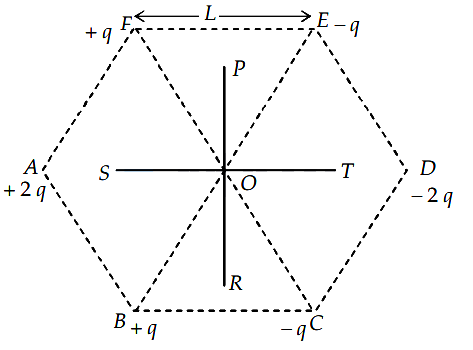
- A The electric field at \(O\) is \(6 \mathrm{~K}\) along \(O D\)
- B The potential at \(O\) is zero
- C The potential at all points on the line \(P R\) is same
- D The potential at all points on the line \(S T\) is same
Answer & Solution
Correct Answer
(A) The electric field at \(O\) is \(6 \mathrm{~K}\) along \(O D\)
Step-by-step Solution
Detailed explanation
Here
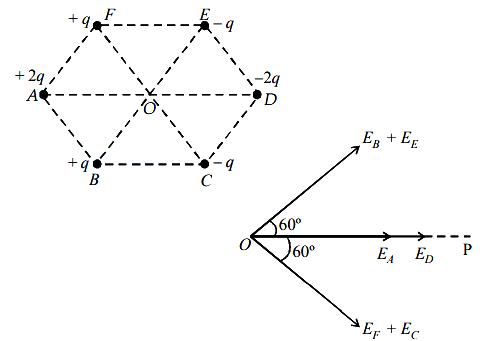
\(\frac{\left|\overrightarrow{E_{A}}\right|}{2}=\left|\overrightarrow{E_{B}}\right|=\left|\overrightarrow{E_{C}}\right|=\frac{\left|\overrightarrow{E_{D}}\right|}{2}=\left|\overrightarrow{E_{E}}\right|\) \(=\left|\overrightarrow{E_{F}}\right|=K \)
\( \therefore E_{O}=E_{A}+E_{D}+\left(E_{F}+E_{C}\right) \cos 60^{\circ}+\) \(\left(E_{B}+E_{C}\right) \cos 60^{\circ} \)
\( =2 \mathrm{~K}+2 \mathrm{~K}+(\mathrm{K}+\mathrm{K}) \times \frac{1}{2}+(\mathrm{K}+\mathrm{K})\) \(\times \frac{1}{2}=6 \mathrm{~K}\)
Electric potential at \(O\)
\(V_{O}=\frac{1}{4 \pi \varepsilon_{0} L}[2 q+q+q-q-q-2 q]=0\)
Potential at all points on the line PR is same not on line ST. \(P R\) is perpendicular bisector (the equatorial line) for the electric dipoles \(A B, F E\) and \(B C\). Therefore the electric potential will be zero at any point on \(P R\).
\(\frac{\left|\overrightarrow{E_{A}}\right|}{2}=\left|\overrightarrow{E_{B}}\right|=\left|\overrightarrow{E_{C}}\right|=\frac{\left|\overrightarrow{E_{D}}\right|}{2}=\left|\overrightarrow{E_{E}}\right|\) \(=\left|\overrightarrow{E_{F}}\right|=K \)
\( \therefore E_{O}=E_{A}+E_{D}+\left(E_{F}+E_{C}\right) \cos 60^{\circ}+\) \(\left(E_{B}+E_{C}\right) \cos 60^{\circ} \)
\( =2 \mathrm{~K}+2 \mathrm{~K}+(\mathrm{K}+\mathrm{K}) \times \frac{1}{2}+(\mathrm{K}+\mathrm{K})\) \(\times \frac{1}{2}=6 \mathrm{~K}\)
Electric potential at \(O\)
\(V_{O}=\frac{1}{4 \pi \varepsilon_{0} L}[2 q+q+q-q-q-2 q]=0\)
Potential at all points on the line PR is same not on line ST. \(P R\) is perpendicular bisector (the equatorial line) for the electric dipoles \(A B, F E\) and \(B C\). Therefore the electric potential will be zero at any point on \(P R\).
See the Complete Solution
Get step-by-step explanations for this and 2.5 Lakh+ more JEE, NEET & CET questions.
- Unlock all solutions
- Practice the full chapter
- Track accuracy across PYQs
4.8 rated on Google Play · 14,000+ reviews
More questions from Physics
- A long, hollow conducting cylinder is kept coaxially inside another long, hollow conducting cylinder of larger radius. Both the cylinders are initially electrically neutral.JEE Advanced 2007 Medium
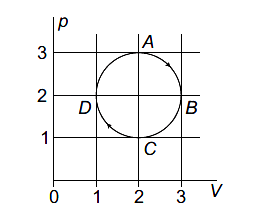
- The figure shows the \(p-V\) plot of an ideal gas taken through a cycle \(A B C D A\). The part \(A B C\) is a semi-circle and \(C D A\) is half of an ellipse. Then,
 JEE Advanced 2009 Medium
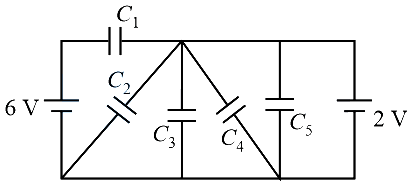
 - In the following circuit and . The charge stored in is
 JEE Advanced 2022 Easy
 - A planet of radius (radius of Earth) has the same mass density as Earth. Scientists dig a well of depth on it and lower a wire of the same length and of linear mass density into it. If the wire is not touching anywhere, the force applied at the top of the wire by a person holding it in place is (take the radius of Earth and the acceleration due to gravity of Earth is )JEE Advanced 2014 Hard
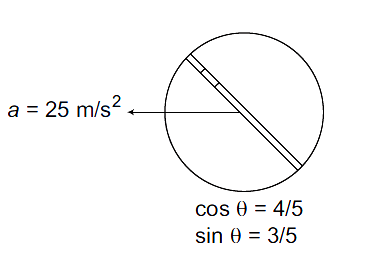
- A circular disc with a groove along its diameter is placed horizontally. A block of mass \(1 \mathrm{~kg}\) is placed as shown. The coefficient of friction between the block and all surfaces of groove in contact is \(\mu=2 / 5\). The disc has an acceleration of \(25 \mathrm{~m} / \mathrm{s}^2\). Find the acceleration of the block with respect to disc.
 JEE Advanced 2006 Hard
 - Positive and negative point charges of equal magnitude are kept at \(\left(0,0, \frac{a}{2}\right)\) and \(\left(0,0, \frac{-a}{2}\right)\), respectively. The work done by the electric field when another positive point charge is moved from \((-a, 0,0)\) to \((0, a, 0)\) isJEE Advanced 2007 Easy
More PYQs from JEE Advanced
- Statement I Alkali metals dissolve in liquid ammonia to give blue solutions. Statement II Alkali metals in liquid ammonia give solvated species of the type \(\left(M\left(\mathrm{NH}_3\right)_n\right]^{+}(M=\) alkali metals \()\).JEE Advanced 2007 Hard
- The value of is equal toJEE Advanced 2016 Hard
- Let be a twice differentiable function such that for all . If , then which of the following statement(s) is (are) TRUE ?JEE Advanced 2018 Medium
- The sum of the spin only magnetic moment values (in B.M.) of \(\left[\mathrm{Mn}(\mathrm{Br})_6\right]^{3-}\) and \(\left[\mathrm{Mn}(\mathrm{CN})_6\right]^{3-}\) is _____.JEE Advanced 2025 Medium
- Let \(A_1, B_1, C_1\) be three points in the \(x y\)-plane. Suppose that the lines \(A_1 C_1\) and \(B_1 C_1\) are tangents to the curve \(y^2=8 x\) at \(A_1\) and \(B_1\), respectively. If \(O=(0,0)\) and \(C_1=(-4,0)\), then which of the following statements is (are) TRUE?JEE Advanced 2024 Medium
- Paragraph: When potassium iodide is added to an aqueous solution of potassium ferricyanide, a reversible reaction is observed in which a complex \(\mathrm{P}\) is formed. In a strong acidic medium, the equilibrium shifts completely towards \(\mathrm{P}\). Addition of zinc chloride to \(\mathrm{P}\) in a slightly acidic medium results in a sparingly soluble complex Q.
Question: The number of moles of potassium iodide required to produce two moles of \(\mathbf{P}\) isJEE Advanced 2024 Medium