


JEE Advanced · Physics · 27. Atomic Physics
A particle of mass moves in circular orbits with potential energy , where is a positive constant and is its distance from the origin. Its energies are calculated using the Bohr model. If the radius of the particle's orbit is denoted by and its speed and energy are denoted by and respectively, then for the orbit (here is the Planck's constant)
- A and
- B and
- C
- D
Answer & Solution
Correct Answer
(C)
Step-by-step Solution
Detailed explanation
See the Complete Solution
Get step-by-step explanations for this and 2.5 Lakh+ more JEE, NEET & CET questions.
- Unlock all solutions
- Practice the full chapter
- Track accuracy across PYQs
4.8 rated on Google Play · 14,000+ reviews
More questions from Physics
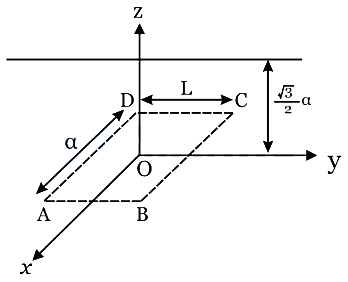
- An infinitely long uniform line charge distribution of charge per unit length lies parallel to the -axis in the - plane at (see figure). If the magnitude of the flux of the electric field through the rectangular surface lying in the - plane with its centre at the origin is ( permittivity of free space), then the value of is
 JEE Advanced 2015 Hard
 - A pendulum consists of a bob of mass \(m=0.1 \mathrm{~kg}\) and a massless inextensible string of length \(L=1.0 \mathrm{~m}\). It is suspended from a fixed point at height \(H=0.9 \mathrm{~m}\) above a frictionless horizontal floor. Initially, the bob of the pendulum is lying on the floor at rest vertically below the point of suspension. A horizontal impulse \(P=0.2 \mathrm{~kg}-\mathrm{m} / \mathrm{s}\) is imparted to the bob at some instant. After the bob slides for some distance, the string becomes taut and the bob lifts off the floor. The magnitude of the angular momentum of the pendulum about the point of suspension just before the bob lifts off is \(J \mathrm{~kg}-\mathrm{m}^{2} / \mathrm{s}\). The kinetic energy of the pendulum just after the liftoff is \(K\) Joules.
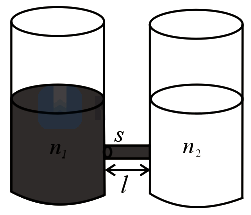
The value of is ____.JEE Advanced 2021 Hard - As shown schematically in the figure, two vessels contain water solutions (at temperature ) of potassium permanganate of different concentrations and molecules per unit volume with When they are connected by a tube of small length and cross-sectional area starts to diffuse from the left to the right vessel through the tube. Consider the collection of molecules to behave as dilute ideal gases and the difference in their partial pressure in the two vessels causing the diffusion. The speed of the molecules is limited by the viscous force on each molecule, where is a constant. Neglecting all terms of the order . Which of the following is/are correct? ( is the Boltzmann constant)
 JEE Advanced 2020 Hard
 - A student is performing an experiment using a resonance column and a tuning fork of frequency \(244 s^{-1}\). He is told that the air in the tube has been replaced by another gas (assume that the column remains filled with the gas). If the minimum height at which resonance occurs is \((0.350 \pm 0.005) m\), the gas in the tube is (Useful information: \(\sqrt{167\text{ RT}}=640\text{ J}^{\frac{1}{2}}\text{ mol}^{-\frac{1}{2}} ;\) \(\sqrt{140\text{ RT}}=590\text{ J}^{\frac{1}{2}}\text{ mole}^{-\frac{1}{2}}\) . The molar masses M in grams are given in the options. Take the values of \(\sqrt{\frac{10}{\text M }}\) for each gas as given there.)JEE Advanced 2014 Easy
- Two large, identical water tanks, 1 and 2, kept on the top of a building of height \(H\), are filled with water up to height \(h\) in each tank. Both the tanks contain an identical hole of small radius on their sides, close to their bottom. A pipe of the same internal radius as that of the hole is connected to tank 2 , and the pipe ends at the ground level. When the water flows from the tanks 1 and 2 through the holes, the times taken to empty the tanks are \(t_1\) and \(t_2\), respectively. If \(H=\left(\frac{16}{9}\right) h\), then the ratio \(t_1 / t_2\) is _______ .JEE Advanced 2024 Medium
- A container has a base of and height , as shown in the figure. It has two parallel electrically conducting walls each of area . The remaining walls of the container are thin and non-conducting. The container is being filled with a liquid of dielectric constant at a uniform rate of . What is the value of the capacitance of the container after seconds?
[Given: Permittivity of free space , the effects of the non-conducting walls on the capacitance are negligible]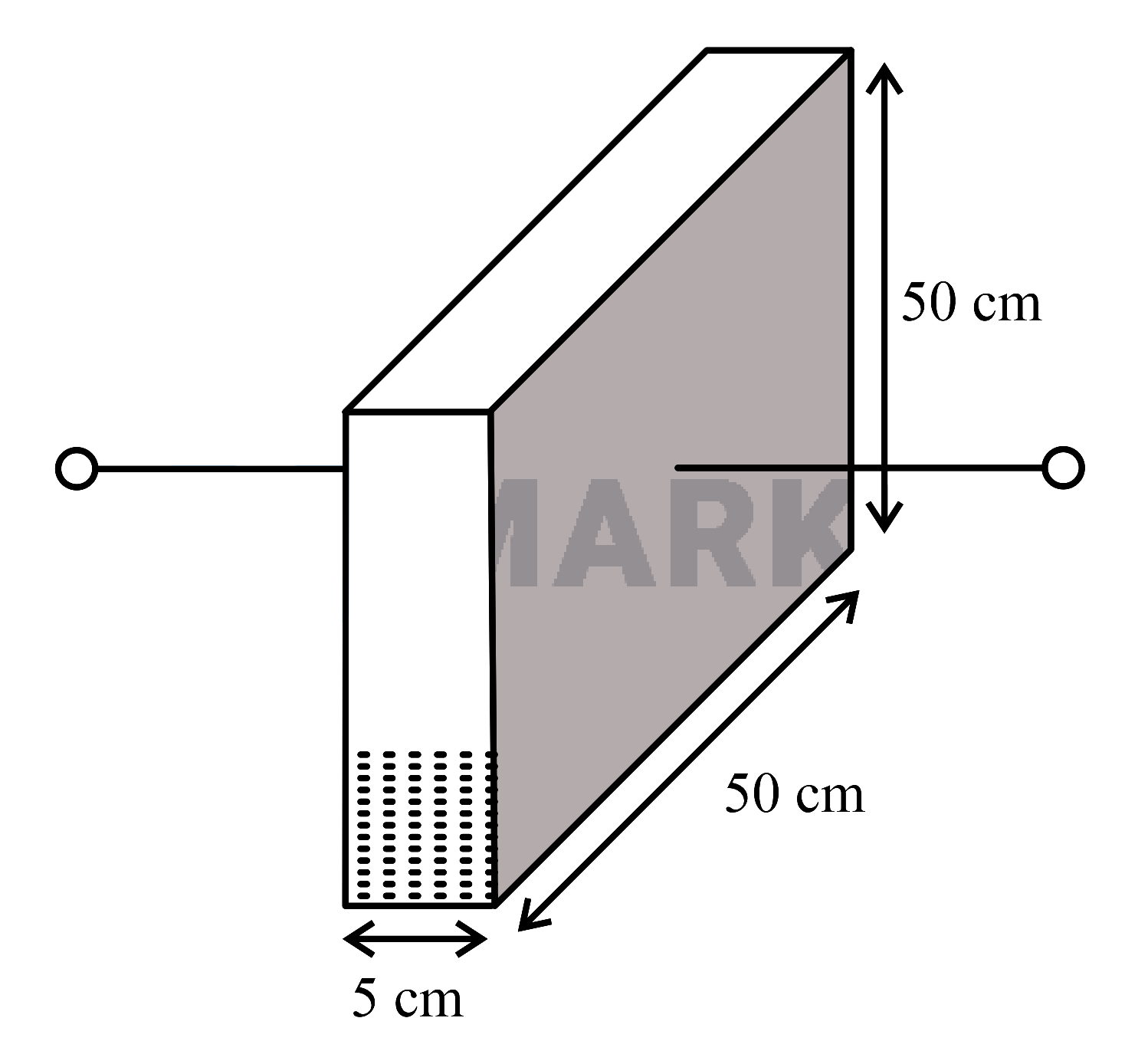 JEE Advanced 2023 Medium
More PYQs from JEE Advanced
- is reduced to by usingJEE Advanced 2015 Easy
- One end of a taut string of length 3m along the x axis is fixed at x = 0. The speed of the waves in the string is . The other end of the string is vibrating in the y direction so that stationary waves are set up in the string. The possible waveform(s) of these stationary waves is (are)JEE Advanced 2014 Medium
- Incandescent bulbs are designed by keeping in mind that the resistance of their filament increases with the increase in temperature. If at room temperature, \(100 \mathrm{~W}, 60 \mathrm{~W}\) and \(40 \mathrm{~W}\) bulbs have filament resistances \(R_{100}, R_{60}\) and \(R_{40}\), respectively, the relation between these resistances isJEE Advanced 2010 Medium
- Consider the two curves
\(C_1: y^2=4 x\)
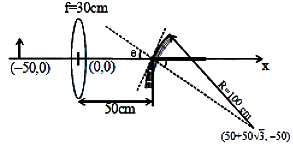
\(C_2: x^2+y^2-6 x+1=0\), thenJEE Advanced 2008 Easy - A small object is placed 50 cm to the left of thin convex lens of focal length 30 cm. A convex spherical mirror of radius of curvature 100 cm is placed to the right of the lens at a distance of 50 cm. The mirror is tilted such that the axis of the mirror is at an angle to the axis of the lens, as shown in the figure. If the origin of the coordinate system is taken to be at the centre of the lens, the coordinates (in cm) of the point (x, y) at which the image is formed are:
 JEE Advanced 2016 Hard
 - A cylindrical vessel of height \(500 \mathrm{~mm}\) has an orifice (small hole) at its bottom. The orifice is initially closed and water is filled in it upto height \(H\). Now the top is completely sealed with a cap and the orifice at the bottom is opened. Some water comes out from the orifice and the water level in the vessel becomes steady with height of water column being 200 \(\mathrm{mm}\). Find the fall in height (in \(\mathrm{mm}\) ) of water level due to opening of the orifice.
[Take atmospheric pressure \(=1.0 \times 10^5 \mathrm{Nm}^{-2}\), density of water \(=1000 \mathrm{~kg} \mathrm{~m}^{-3}\) and \(g=10\) \(\mathrm{ms}^{-2}\). Neglect any effect of surface tension.]JEE Advanced 2009 Easy