


JEE Advanced · Physics · 25. Wave Optics
In a Young's double slit experiment, each of the two slits A and B, as shown in the figure, are oscillating about their fixed center and with a mean separation of \(0.8 \mathrm{~mm}\). The distance between the slits at time \(t\) is given by \(d=(0.8+0.04 \sin \omega t) \mathrm{mm}\), where \(\omega=0.08 \mathrm{rad} \mathrm{s}^{-1}\). The distance of the screen from the slits is \(1 \mathrm{~m}\) and the wavelength of the light used to illuminate the slits is \(6000 Ã…\). The interference pattern on the screen changes with time, while the central bright fringe (zeroth fringe) remains fixed at point \(O\).
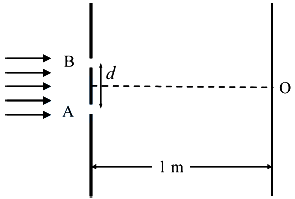
The maximum speed in \(\mu \mathrm{m} / \mathrm{s}\) at which the \(8^{\text {th }}\) bright fringe will move is ________ .
- A 24
- B 25
- C 26
- D 27
Answer & Solution
Correct Answer
(A) 24
Step-by-step Solution
Detailed explanation
\(\begin{aligned}
& \mathrm{y}=\mathrm{n} \cdot \frac{\lambda \mathrm{D}}{\mathrm{d}} \\
& \mathrm{v}=\frac{\mathrm{dy}}{\mathrm{dt}}=-\mathrm{n} \cdot \frac{\lambda \cdot \mathrm{d}}{\mathrm{d}^2} \cdot \frac{d(d)}{d t} \\
& d=0.8+0.04 \sin \omega t \\
& \frac{d(d)}{d t}=0.04 \omega \cos \omega t
\end{aligned}\)
\(\text { for } \mathrm{v} \rightarrow \max \Rightarrow \frac{\mathrm{d}(\mathrm{d})}{\mathrm{dt}} \rightarrow \max \text {. }\)
For \(\frac{\mathrm{d}(\mathrm{d})}{\mathrm{dt}} \rightarrow \max\).
\(\cos \omega \mathrm{t}=1 \Rightarrow \sin \omega \mathrm{t}=0 \)
\( \Rightarrow\left(\frac{\mathrm{d}(\mathrm{d})}{\mathrm{dt}}\right)_{\max }=0.04 \)
\( \Rightarrow \mathrm{d}=0.8 \mathrm{~mm} \)
\( \mathrm{v}_{\max }=\frac{8 \times 6000 \times 10^{-10} \times 1 \times 0.04 \times 0.08}{0.8 \times 0.8 \times 10^{-6} \times 10^{-3}}\) \(=24 \mu \mathrm{m} / \mathrm{s}.\)
(range is from 23.5 to 24.5)
& \mathrm{y}=\mathrm{n} \cdot \frac{\lambda \mathrm{D}}{\mathrm{d}} \\
& \mathrm{v}=\frac{\mathrm{dy}}{\mathrm{dt}}=-\mathrm{n} \cdot \frac{\lambda \cdot \mathrm{d}}{\mathrm{d}^2} \cdot \frac{d(d)}{d t} \\
& d=0.8+0.04 \sin \omega t \\
& \frac{d(d)}{d t}=0.04 \omega \cos \omega t
\end{aligned}\)
\(\text { for } \mathrm{v} \rightarrow \max \Rightarrow \frac{\mathrm{d}(\mathrm{d})}{\mathrm{dt}} \rightarrow \max \text {. }\)
For \(\frac{\mathrm{d}(\mathrm{d})}{\mathrm{dt}} \rightarrow \max\).
\(\cos \omega \mathrm{t}=1 \Rightarrow \sin \omega \mathrm{t}=0 \)
\( \Rightarrow\left(\frac{\mathrm{d}(\mathrm{d})}{\mathrm{dt}}\right)_{\max }=0.04 \)
\( \Rightarrow \mathrm{d}=0.8 \mathrm{~mm} \)
\( \mathrm{v}_{\max }=\frac{8 \times 6000 \times 10^{-10} \times 1 \times 0.04 \times 0.08}{0.8 \times 0.8 \times 10^{-6} \times 10^{-3}}\) \(=24 \mu \mathrm{m} / \mathrm{s}.\)
(range is from 23.5 to 24.5)
See the Complete Solution
Get step-by-step explanations for this and 2.5 Lakh+ more JEE, NEET & CET questions.
- Unlock all solutions
- Practice the full chapter
- Track accuracy across PYQs
4.8 rated on Google Play · 14,000+ reviews
More questions from Physics
- Column I gives some devices and Column II gives some processes on which the functioning of these devices depend. Match the devices in Column I with the processes in Column II and indicate your answer by darkening appropriate bubbles in the \(4 \times 4\) matrix given in the ORS.
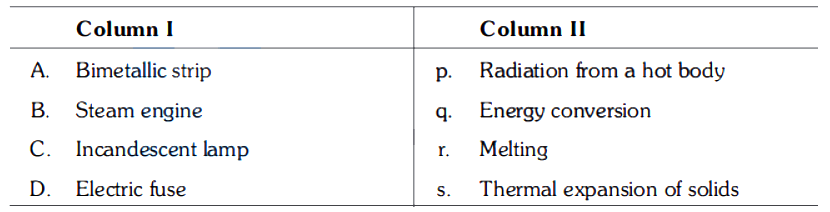 JEE Advanced 2007 Medium
 - Paragraph II: Two particles, 1 and 2 , each of mass \(m\), are connected by a massless spring, and are on a horizontal frictionless plane, as shown in the figure. Initially, the two particles, with their center of mass at \(x_0\), are oscillating with amplitude \(a\) and angular frequency \(\omega\). Thus, their positions at time \(t\) are given by \(x_1(t)=\left(x_0+d\right)+a \sin \omega t\) and \(x_2(t)=\left(x_0-d\right)-a \sin \omega t\), respectively, where \(d>2 a\). Particle 3 of mass \(m\) moves towards this system with speed \(u_0=a \omega / 2\), and undergoes instantaneous elastic collision with particle 2 , at time \(t_0\). Finally, particles 1 and 2 acquire a center of mass speed \(v_{\mathrm{cm}}\) and oscillate with amplitude \(b\) and the same angular frequency \(\omega\).

If the collision occurs at time \(t_0=0\), the value of \(v_{\mathrm{cm}} /(a \omega)\) will be ________ .JEE Advanced 2024 Medium - Paragraph :
A special metal \(S\) conducts electricity without any resistance. A closed wire loop, made of \(S\), does not allow any change in flux through itself by inducing a suitable current to generate a compensating flux. The induced current in the loop cannot decay due to its zero resistance. This current gives rise to a magnetic moment which in turn repels the source of magnetic field or flux. Consider such a loop, of radius \(a\), with its center at the origin. A magnetic dipole of moment \(m\) is brought along the axis of this loop from infinity to a point at distance \(r(\gg a)\) from the center of the loop with its north pole always facing the loop, as shown in the figure below.
The magnitude of magnetic field of a dipole \(m\), at a point on its axis at distance \(r\), is \(\frac{\mu_{0}}{2 \pi} \frac{m}{r^{3}}\), where \(\mu_{0}\) is the permeability of free space. The magnitude of the force between two magnetic dipoles with moments, \(m_{1}\) and \(m_{2}\), separated by a distance \(r\) on the common axis, with their north poles facing each other, is \(\frac{k m_{1} m_{2}}{r^{4}}\), where \(k\) is a constant of appropriate dimensions. The direction of this force is along the line joining the two dipoles.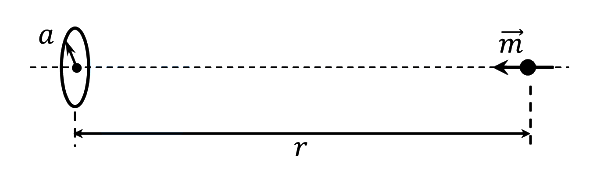
Question :
When the dipole m is placed at a distance r from the centre of the loop (as shown in the figure), the current induced in the loop will be proportional to:JEE Advanced 2021 Medium - Statement I In an elastic collision between two bodies, the relative speed of the bodies after collision is equal to the relative speed before the collision.
Statement II In an elastic collision, the linear momentum of the system is conserved.JEE Advanced 2007 Easy - Two soap bubbles \(A\) and \(B\) are kept in a closed chamber where the air is maintained at pressure \(8 \mathrm{Nm}^{-2}\). The radii of bubbles \(A\) and \(B\) are \(2 \mathrm{~cm}\), respectively. Surface tension of the soap-water used to make bubbles is \(0.04\) \(\mathrm{Nm}^{-1}\). Find the ratio \(\frac{n_B}{n_A}\), where \(n_A\) and \(n_B\) are the number of moles of air in bubbles \(A\) and \(B\), respectively. [Neglect the effect of gravity]JEE Advanced 2009 Hard
- Paragraph:
A point charge \(Q\) is moving in a circular orbit of radius \(R\) in the \(x-y\) plane with an angular velocity \(\omega .\) This can be considered as equivalent to a loop carrying a steady current \(\frac{Q \omega}{2 \pi}\). A uniform magnetic field along the positive \(z\)-axis is now switched on, which increases at a constant rate from 0 to \(B\) in one second. Assume that the radius of the orbit remains constant. The application of the magnetic field induces an emf in the orbit. The induced emf is defined as the work done by an induced electric field in moving a unit positive charge around a closed loop. It is known that, for an orbiting charge, the magnetic dipole moment is proportional to the angular momentum with a proportionality constant \(\gamma\).
Question:
The change in the magnetic dipole moment associated with the orbit, at the end of the time interval of the magnetic field change, isJEE Advanced 2013 Medium
More PYQs from JEE Advanced
- of is combusted in a fixed volume bomb calorimeter with excess of at and into . During the reaction, temperature increases from to . If heat capacity of the bomb calorimeter and enthalpy of formation of are and at , respectively, the calculated standard molar enthalpy of formation of at is . The value of is___[Given: Gas constant ]JEE Advanced 2022 Hard
- The green colour produced in the borax bead test of a chromium(III) salt is due to -JEE Advanced 2019 Easy
- Paragraph:
Let \(A, B, C\) be three sets of complex numbers as defined below.
\(A=\{z ; \operatorname{lm} z \geq 1\} ; B=\{z:|z-2-i|=3\} ;\) \(C=\{z: \operatorname{Re}((1-i) z)=\sqrt{2}\}\).
Question:
The number of elements in the set \(A \cap B \cap C\) isJEE Advanced 2008 Hard - The correct order of acidity for the following compounds is :
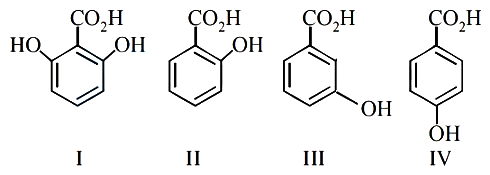 JEE Advanced 2016 Medium
 - Two wires each carrying a steady current \(I\) are shown in four configurations in Column I. Some of the resulting effects are described in Column II. Match the statements in Column I with the statements in Column II and indicate your answer by darkening appropriate bubbles in the \(4 \times 4\) matrix given in the ORS.
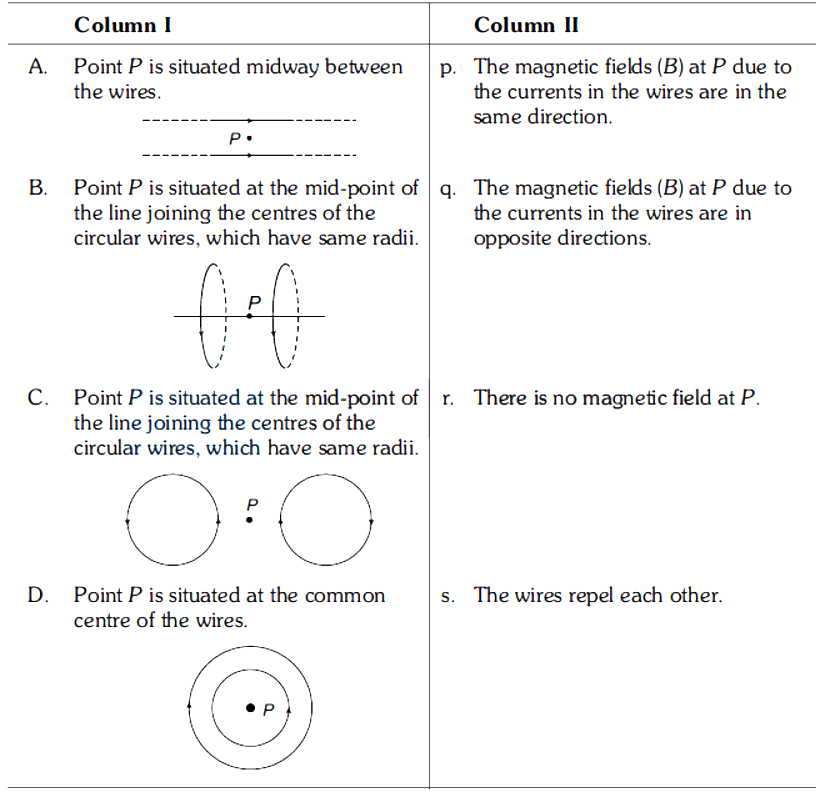 JEE Advanced 2007 Hard
 - Two parallel chords of a circle of radius 2 are at a distance \(\sqrt{3}+1\) apart. If the chords subtend at the centre, angles of \(\frac{\pi}{k}\) and \(\frac{2 \pi}{k}\), where \(k>0\), then the value of \([k]\) is
[Note : \([k]\) denotes the largest integer less than or equal to \(k\) ]JEE Advanced 2010 Hard