


JEE Advanced · Mathematics · 16. Limits
Paragraph:
Read the following passage and answer the questions.
For every function \(f(x)\) which is twice differentiable, these will be good approximation of \(\int_a^b f(x) d x \cong\left(\frac{b-a}{2}\right)\{f(a)+f(b)\}\). Now, if we take \(c=\frac{a+b}{2}\), then using above again, we get \(\int_a^b f(x) d x=\int_a^c f(x) d x+\int_c^b f(x) d x \cong \frac{b-a}{4}\{f(a)+f(b)+2 f(c)\}\) and so on.
We get approximation for value of \(\int_a^b f(x) d x\).Question:
If \(\lim _{t \rightarrow a} \frac{\int_a^t f(x) d x-\frac{(t-a)}{2}\{f(t)+f(a)\}}{(t-a)^3}=0\), then degree of polynomial function \(f(x)\) at most is
- A 0
- B 1
- C 3
- D 2
Answer & Solution
Correct Answer
(B) 1
Step-by-step Solution
Detailed explanation
\[
\begin{aligned}
\lim _{t \rightarrow a} \frac{\int_a^t f(t) d t-\frac{(t-a)}{2}(f(t)+f(a))}{(t-a)^3} & =0 \\
\Rightarrow \quad \lim _{h \rightarrow 0} \frac{\int_a^{a+h} f(t) d t-\frac{h}{2}(f(a+h)+f(a))}{h^3} & =0 \\
\Rightarrow \quad \lim _{h \rightarrow 0} \frac{f(a+h)-\frac{1}{2}(f(a+h)+f(a))-\frac{h}{2}\left(f^{\prime}(a+h)\right)}{3 h^2} & =0
\end{aligned}
\]
\(f^{\prime}(a+h)-\frac{1}{2} f^{\prime}(a+h)\)
\(\Rightarrow \quad \lim _{h \rightarrow 0} \frac{-\frac{1}{2} f^{\prime}(a+h)-\frac{h}{2} f^{\prime \prime}(a+h)}{6 h}=0\)
\(\Rightarrow \quad \lim _{h \rightarrow 0} \frac{-\frac{h}{2} f^{\prime}(a+h)}{6 h}=0\)
\(\Rightarrow \quad f^{\prime \prime}(a)=0, \forall a \in R\)
\(\Rightarrow(x)\) must have maximum degree 1.
\begin{aligned}
\lim _{t \rightarrow a} \frac{\int_a^t f(t) d t-\frac{(t-a)}{2}(f(t)+f(a))}{(t-a)^3} & =0 \\
\Rightarrow \quad \lim _{h \rightarrow 0} \frac{\int_a^{a+h} f(t) d t-\frac{h}{2}(f(a+h)+f(a))}{h^3} & =0 \\
\Rightarrow \quad \lim _{h \rightarrow 0} \frac{f(a+h)-\frac{1}{2}(f(a+h)+f(a))-\frac{h}{2}\left(f^{\prime}(a+h)\right)}{3 h^2} & =0
\end{aligned}
\]
\(f^{\prime}(a+h)-\frac{1}{2} f^{\prime}(a+h)\)
\(\Rightarrow \quad \lim _{h \rightarrow 0} \frac{-\frac{1}{2} f^{\prime}(a+h)-\frac{h}{2} f^{\prime \prime}(a+h)}{6 h}=0\)
\(\Rightarrow \quad \lim _{h \rightarrow 0} \frac{-\frac{h}{2} f^{\prime}(a+h)}{6 h}=0\)
\(\Rightarrow \quad f^{\prime \prime}(a)=0, \forall a \in R\)
\(\Rightarrow(x)\) must have maximum degree 1.
See the Complete Solution
Get step-by-step explanations for this and 2.5 Lakh+ more JEE, NEET & CET questions.
- Unlock all solutions
- Practice the full chapter
- Track accuracy across PYQs
4.8 rated on Google Play · 14,000+ reviews
More questions from Mathematics
- A group of 9 students, \(\mathrm{s}_1, \mathrm{~s}_2, \ldots \ldots, \mathrm{s}_9\), is to be divided to from three teams \(\mathrm{X}, \mathrm{Y}\), and \(\mathrm{Z}\) of sizes 2,3 , and 4 , respectively. Suppose that \(s_1\) cannot be selected for the team \(\mathrm{X}\), and \(\mathrm{s}_2\) cannot be selected for the team Y. Then the number of ways to from such teams, isJEE Advanced 2024 Hard
- Two parallel chords of a circle of radius 2 are at a distance \(\sqrt{3}+1\) apart. If the chords subtend at the centre, angles of \(\frac{\pi}{k}\) and \(\frac{2 \pi}{k}\), where \(k>0\), then the value of \([k]\) is
[Note : \([k]\) denotes the largest integer less than or equal to \(k\) ]JEE Advanced 2010 Hard - Let \(S=\left\{(x, y) \in \mathbb{R} \times \mathbb{R}: x \geq 0, y \geq 0, y^2 \leq 4 x, y^2 \leq 12-2 x\right.\) and \(\left.3 y+\sqrt{8} x \leq 5 \sqrt{8}\right\}\). If the area of the region \(S\) is \(\alpha \sqrt{2}\), then \(\alpha\) is equal toJEE Advanced 2024 Medium
- Let be two non-constant differentiable functions. If , and then which of the following statement(s) is (are) TRUE?JEE Advanced 2018 Medium
- Match the Statements/Expressions in Column I with the Statements/Expressions in Column II.
Column I Column II (A) The minimum value of \(\frac{x^2+2 x+4}{x+2}\) is (p) 0 (B) Let \(A\) and \(B\) be \(3 \times 3\) matrices of real numbers, where \(A\) is symmetric, \(B\) is skew-symmetric and \((A+B)(A-B) =\) \((A-B)(A+B)\). If \((A B)^t=(-1)^k\) \(A B\), where \((A B)^t\) is the transpose of the matrix \(A B\), then possible values of \(k\) are (q) 1 (C) Let \(a=\log _3 \log _3 2\). An integer \(k\) satisfying \(1<2^{\left(-k+3^{-a}\right)}<2\), must be less than (r) 2 (D) If \(\sin \theta=\cos \phi\), then the possible values of \(\frac{1}{\pi}\left(\theta \pm \phi-\frac{\pi}{2}\right)\) are (s) 3 JEE Advanced 2008 Hard - Let \(a_{n}\) denote the number of all \(n\)-digit positive integers formed by the digits 0,1 or both such that no consecutive digits in them are 0 . Let \(b_{n}=\) the number of such \(n\)-digit integers ending with digit 1 and \(c_{n}=\) the number of such \(n\)-digit integers ending with digit 0 .
Question:
Which of the following is correct?JEE Advanced 2012 Hard
More PYQs from JEE Advanced
- Let S be the set of all twice differentiable functions f from to such that for all . For , let be the number of points for which . Then which of the following statements is(are) true?JEE Advanced 2023 Medium
- The instantaneous voltages at three terminals marked and are given by
and
An ideal voltmeter is configured to read rms value of the potential difference between its terminals. It is connected between points and and then between and . The reading(s) of the voltmeter will beJEE Advanced 2017 Hard - Paragraph:
A fair die is tossed repeatedly until a six is obtained. Let \(X\) denotes the number of tosses required.Question:
The conditional probability that \(X \geq 6\) given \(X>3\) equalsJEE Advanced 2009 Medium - A monochromatic beam of light is incident at on one face of an equilateral prism of refractive index and emerges from the opposite face making an angle with the normal (see the figure). For the value of is and . The value of is
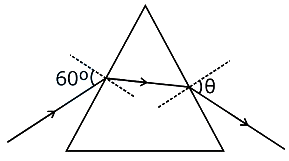 JEE Advanced 2015 Hard
 - The acidic hydrolysis of ether (X) shown below is fastest when
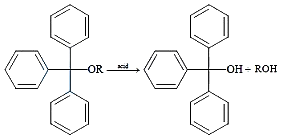 JEE Advanced 2014 Medium
 - Consider three planes
\[
P_1: x-y+z=1, P_2: x+y-z=-1
\]
and \(P_3: x-3 y+3 z=2\)
Let \(L_1, L_2\) and \(L_3\) be the lines of intersection of the planes \(P_2\) and \(P_3, P_3\) and \(P_1, P_1\) and \(P_2\), respectively.
Statement 1 Atleast two of the lines \(L_1, L_2\) and \(L_3\) are non-parallel.
Statement 2 The three planes do not have a common point.JEE Advanced 2008 Medium