


JEE Advanced · Mathematics · 1. Basic Math
Match the Statements/Expressions in Column I with the Statements/Expressions in Column II.
| Column I | Column II |
| (A) The minimum value of \(\frac{x^2+2 x+4}{x+2}\) is | (p) 0 |
| (B) Let \(A\) and \(B\) be \(3 \times 3\) matrices of real numbers, where \(A\) is symmetric, \(B\) is skew-symmetric and \((A+B)(A-B) =\) \((A-B)(A+B)\). If \((A B)^t=(-1)^k\) \(A B\), where \((A B)^t\) is the transpose of the matrix \(A B\), then possible values of \(k\) are | (q) 1 |
| (C) Let \(a=\log _3 \log _3 2\). An integer \(k\) satisfying \(1<2^{\left(-k+3^{-a}\right)}<2\), must be less than | (r) 2 |
| (D) If \(\sin \theta=\cos \phi\), then the possible values of \(\frac{1}{\pi}\left(\theta \pm \phi-\frac{\pi}{2}\right)\) are | (s) 3 |
- A (A) r, (B) q,r, (C) s, (D) p,r
- B (A) s, (B) q,s, (C) r, (D) p,q
- C (A) s, (B) q,r, (C) s, (D) p,q
- D (A) r, (B) q,s, (C) r, (D) p,r
Answer & Solution
Correct Answer
(D) (A) r, (B) q,s, (C) r, (D) p,r
Step-by-step Solution
Detailed explanation
(A) Let \(y=\frac{x^2+2 x+4}{x+2}\)
\(\Rightarrow x^2+(2-y) x+(4-2 y)=0 \)
\( \Rightarrow (2-y)^2-4(4-2 y) \geq 0 \)
\( \Rightarrow y^2+4 y-12 \geq 0 \)
\( \Rightarrow y \leq-6, y \geq 2\)
\(\therefore\) Minimum value of \(y\) is 2 .
(B) Since, \((A+B)(A-B)=(A-B)(A+B)\)
\(\Rightarrow A^2-A B+B A-B^2=A^2+A B\) \(-~B A-B^2 \)
\( \Rightarrow A B=B A \)
\( \text { and } (A B)^t=(-1)^k A B \)
\( \Rightarrow B^t A^t=(-1)^k A B \)
\( \Rightarrow -B A=(-1)^k A B [\because B^t=-B, A^t\) \(=A] \)
\( \Rightarrow B A=(-1)^{k+1} A B \)
\( \Rightarrow (-1)^{k+1}=1\)
\(\therefore k+1\) is even or \(k\) is odd.
(C) \(1 < 2^{\left(-k+3^{-a}\right)} < 2 \Rightarrow 0 < -k+3^{-a} < 1\)
Given, \(a=\log _3 \log _3 2 \Rightarrow 3^a=\log _3 2\)
\(\Rightarrow 3^{-a}=\log _2 3 \)
\( \therefore k < \log _2 3 < 2 \)
\( \text { and } 1+k>\log _2 3>1 \Rightarrow k>0\)
From Eqs. (ii) and (iii), \(0 < k < 2 \Rightarrow k=1\)
\([\because k\) is an integer]
\(\text { (D) } \sin \theta =\cos \phi \)
\( \Rightarrow \cos \left(\frac{\pi}{2}-\theta\right) =\cos \phi \)
\( \Rightarrow \frac{\pi}{2}-\theta =2 n \pi \pm \phi, n \in Z \)
\( \Rightarrow \theta \pm \phi-\frac{\pi}{2} =-2 n \pi, n \in Z \)
\( \Rightarrow \frac{1}{\pi}\left(\theta \pm \phi-\frac{\pi}{2}\right) =-2 n, n \in Z\)
\(\Rightarrow x^2+(2-y) x+(4-2 y)=0 \)
\( \Rightarrow (2-y)^2-4(4-2 y) \geq 0 \)
\( \Rightarrow y^2+4 y-12 \geq 0 \)
\( \Rightarrow y \leq-6, y \geq 2\)
\(\therefore\) Minimum value of \(y\) is 2 .
(B) Since, \((A+B)(A-B)=(A-B)(A+B)\)
\(\Rightarrow A^2-A B+B A-B^2=A^2+A B\) \(-~B A-B^2 \)
\( \Rightarrow A B=B A \)
\( \text { and } (A B)^t=(-1)^k A B \)
\( \Rightarrow B^t A^t=(-1)^k A B \)
\( \Rightarrow -B A=(-1)^k A B [\because B^t=-B, A^t\) \(=A] \)
\( \Rightarrow B A=(-1)^{k+1} A B \)
\( \Rightarrow (-1)^{k+1}=1\)
\(\therefore k+1\) is even or \(k\) is odd.
(C) \(1 < 2^{\left(-k+3^{-a}\right)} < 2 \Rightarrow 0 < -k+3^{-a} < 1\)
Given, \(a=\log _3 \log _3 2 \Rightarrow 3^a=\log _3 2\)
\(\Rightarrow 3^{-a}=\log _2 3 \)
\( \therefore k < \log _2 3 < 2 \)
\( \text { and } 1+k>\log _2 3>1 \Rightarrow k>0\)
From Eqs. (ii) and (iii), \(0 < k < 2 \Rightarrow k=1\)
\([\because k\) is an integer]
\(\text { (D) } \sin \theta =\cos \phi \)
\( \Rightarrow \cos \left(\frac{\pi}{2}-\theta\right) =\cos \phi \)
\( \Rightarrow \frac{\pi}{2}-\theta =2 n \pi \pm \phi, n \in Z \)
\( \Rightarrow \theta \pm \phi-\frac{\pi}{2} =-2 n \pi, n \in Z \)
\( \Rightarrow \frac{1}{\pi}\left(\theta \pm \phi-\frac{\pi}{2}\right) =-2 n, n \in Z\)
See the Complete Solution
Get step-by-step explanations for this and 2.5 Lakh+ more JEE, NEET & CET questions.
- Unlock all solutions
- Practice the full chapter
- Track accuracy across PYQs
4.8 rated on Google Play · 14,000+ reviews
More questions from Mathematics
- Let and be two unit vectors such that For some let If and the vector is inclined at the same angle to both and then the value of isJEE Advanced 2018 Medium
- Two lines and are coplanar. Then can take value(s)JEE Advanced 2013 Easy
- Paragraph:
Box \(1\) contains three cards bearing numbers \(1,2,3\); box \(2\) contains five cards bearing numbers \(1,2,3,4,5\); and box \(3\) contains seven cards bearing numbers \(1,2,3,4,5,6,7\). A card is drawn from each of the boxes. Let \(x_{i}\) be the number on the card drawn from the \(i^{t h}\) box, \(i=1,2,3\).
Question:
The probability that \(x_{1}, x_{2}, x_{3}\) are in an arithmetic progression, isJEE Advanced 2014 Easy - Let be given by ThenJEE Advanced 2014 Medium
- The number of distinct real values of \(\lambda\), for which the vectors \(-\lambda^2 \hat{\mathbf{i}}+\hat{\mathbf{j}}+\hat{\mathbf{k}}\), \(\hat{\mathbf{i}}-\lambda^2 \hat{\mathbf{j}}+\hat{\mathbf{k}}\) and \(\hat{\mathbf{i}}+\hat{\mathbf{j}}-\lambda^2 \hat{\mathbf{k}}\) are coplanar, isJEE Advanced 2007 Easy
- Lines \(L_1: y-x=0\) and \(L_2: 2 x+y=0\) intersect the line \(L_3: y+2=0\) at \(P\) and \(Q\), respectively. The bisector of the acute angle between \(L_1\) and \(L_2\) intersects \(L_3\) at \(R\).
Statement I The ratio \(P R: R Q\) equals \(2 \sqrt{2}: \sqrt{5}\).
Statement II In any triangle, bisector of an angle divides the triangle into two similar triangles.JEE Advanced 2007 Medium
More PYQs from JEE Advanced
- Let P be the point on the parabola which is at the shortest distance from the center S of the circle Let Q be the point on the circle dividing the line segment SP internally. Then -JEE Advanced 2016 Medium
- The mole fraction of a solute in a solution is . At , the molarity of this solution is the same as its molality. The density of this solution at is . The ratio of the molecular weights of the solute and solvent, , is:JEE Advanced 2016 Medium
- Paragraph:
Reimer-Tiemann reaction introduces an aldehyde group, on to the aromatic ring of phenol, ortho to the hydroxyl group. This reaction involves electrophilic aromatic substitution. This is a general method for the synthesis of substituted salicylaldehydes as depicted below.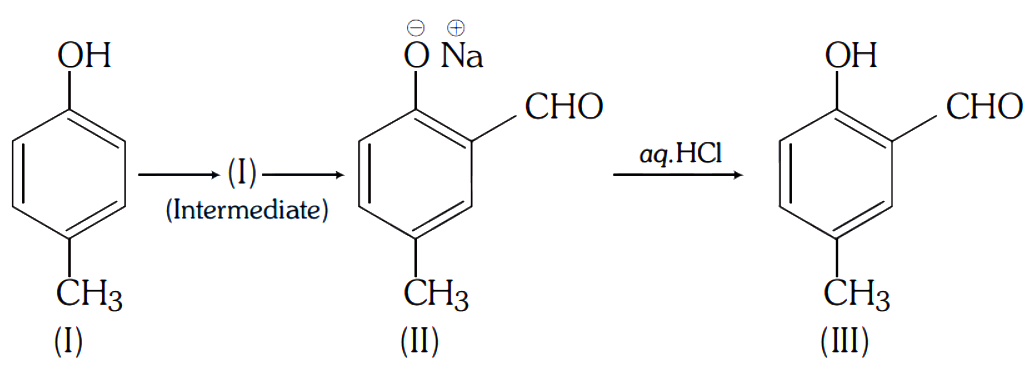
Question:
Which one of the following reagents is used the above reaction?JEE Advanced 2007 Medium - Paragraph:
In hexagonal system of crystals, a frequently encountered arrangement of atoms is described as a hexagonal prism. Here, the top and bottom of the cell are regular hexagons and three atoms are sandwiched in between them. A space-filling model of this structure, called hexagonal close-packed (HCP), is constituted of a sphere on a flat surface surrounded in the same plane by six identical spheres as closely as possible. Three spheres are then placed over the first layer so that they touch each other and represent the second layer. Each one of the three spheres touches three spheres of the bottom layer. Finally, the second layer is covered with a third layer that is identical to the bottom layer in relative position. Assume radius of every sphere to be ' \(r\) '.
Question:
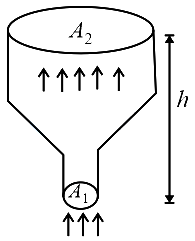
The empty space in this \(\mathrm{HCP}\) unit cell isJEE Advanced 2008 Medium - An ideal gas of density enters a chimney of height at the rate of from its lower end, and escapes through the upper end as shown in the figure. The cross-sectional area of the lower end is and the upper end is . The pressure and the temperature of the gas at the lower end are and , respectively, while its temperature at the upper end is . The chimney is heat insulated so that the gas undergoes adiabatic expansion. Take and the ratio of specific heats of the gas . Ignore atmospheric pressure.
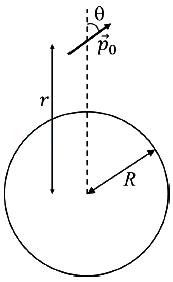
Which of the following statement(s) is(are) correct?JEE Advanced 2022 Hard - A small electric dipole \(\vec{p}_0\), having a moment of inertia \(I\) about its center, is kept at a distance \(r\) from the center of a spherical shell of radius \(R\). The surface charge density \(\sigma\) is uniformly distributed on the spherical shell. The dipole is initially oriented at a small angle \(\theta\) as shown in the figure. While staying at a distance \(r\), the dipole is free to rotate about its center.
If released from rest, then which of the following statement(s) is(are) correct?
[ \(\varepsilon_0\) is the permittivity of free space.]JEE Advanced 2024 Medium