


JEE Advanced · Mathematics · 32. Probability
Paragraph:
A fair die is tossed repeatedly until a six is obtained. Let \(X\) denotes the number of tosses required.Question:
The conditional probability that \(X \geq 6\) given \(X>3\) equals
- A
\(\frac{125}{216}\)
- B
\(\frac{25}{216}\)
- C
\(\frac{5}{36}\)
- D
\(\frac{25}{36}\)
Answer & Solution
Correct Answer
(D)
\(\frac{25}{36}\)
Step-by-step Solution
Detailed explanation
\(P((X \geq 6) /(X>3))\)
\[
\begin{aligned}
& =\frac{P((X>3) /(X \geq 6)) \cdot P(X \geq 6)}{P(X>3)} \\
& =\frac{1 \cdot\left[\left(\frac{5}{6}\right)^5 \cdot \frac{1}{6}+\left(\frac{5}{6}\right)^6 \cdot \frac{1}{6}+\ldots \infty\right]}{\left[\left(\frac{5}{6}\right)^3 \cdot \frac{1}{6}+\left(\frac{5}{6}\right)^4 \cdot \frac{1}{6}+\ldots \infty\right]}=\frac{25}{36} \\
&
\end{aligned}
\]
\[
\begin{aligned}
& =\frac{P((X>3) /(X \geq 6)) \cdot P(X \geq 6)}{P(X>3)} \\
& =\frac{1 \cdot\left[\left(\frac{5}{6}\right)^5 \cdot \frac{1}{6}+\left(\frac{5}{6}\right)^6 \cdot \frac{1}{6}+\ldots \infty\right]}{\left[\left(\frac{5}{6}\right)^3 \cdot \frac{1}{6}+\left(\frac{5}{6}\right)^4 \cdot \frac{1}{6}+\ldots \infty\right]}=\frac{25}{36} \\
&
\end{aligned}
\]
See the Complete Solution
Get step-by-step explanations for this and 2.5 Lakh+ more JEE, NEET & CET questions.
- Unlock all solutions
- Practice the full chapter
- Track accuracy across PYQs
4.8 rated on Google Play · 14,000+ reviews
More questions from Mathematics
- Let \(\omega\) be a complex cube root of unity with \(\omega \neq 1\). A fair die is thrown three times. If \(r_1, r_2\) and \(r_3\) are the numbers obtained on the die, then the probability that \(\omega^{r_1}+\omega^{r_2}+\omega^{r_3}=0\) isJEE Advanced 2010 Hard
- Axis of a parabola is \(y=x\) and vertex and focus are at a distance \(\sqrt{2}\) and \(2 \sqrt{2}\) respectively, from the origin. Then, equation of the parabola isJEE Advanced 2006 Medium
- Let be a continuous function such that and Then which of the following statements is (are) TRUE?JEE Advanced 2021 Medium
- Consider the lines \(L_{1}\) and \(L_{2}\) defined by
\[
L_{1}: x \sqrt{2}+y-1=0 \text { and } L_{2}: x \sqrt{2}-y+1=0
\]
For a fixed constant \(\lambda\), let \(C\) be the locus of a point \(P\) such that the product of the distance of \(P\) from \(L_{1}\) and the distance of \(P\) from \(L_{2}\) is \(\lambda^{2}\). The line \(y=2 x+1\) meets \(C\) at two points \(R\) and \(S\), where the distance between \(R\) and \(S\) is \(\sqrt{270}\).
Let the perpendicular bisector of \(R S\) meet \(C\) at two distinct points \(R^{\prime}\) and \(S^{\prime}\). Let \(D\) be the square of the distance between \(R^{\prime}\) and \(S^{\prime}\).
The value of isJEE Advanced 2021 Hard - If is a differentiable function such that for all and thenJEE Advanced 2017 Hard
- Let denote the set of all the terms of an infinite arithmetic progression with first term a and common difference If then equals ____JEE Advanced 2019 Medium
More PYQs from JEE Advanced
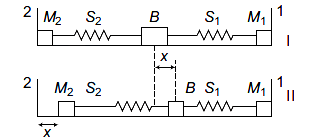
- A block \((B)\) is attached to two unstretched \(S_1\) and \(S_2\) with spring constants \(k\) and \(4 k\), respectively (see figure I). The other ends are attached to identical supports \(M_1\) and \(M_2\) not attached to the walls. The springs and supports have negligible mass. There is no friction anywhere. The block \(B\) is displaced towards wall 1 by a small distance \(x\) (figure II) and released. The block returns and moves a maximum distance \(y\) towards wall 2 . Displacements \(x\) and \(y\) are measured with respect to the equilibrium position of the block \(B\). The ratio \(\frac{y}{-1}\) is
 JEE Advanced 2008 Medium
 - In an experiment to determine the focal length \((f)\) of a concave mirror by the \(u-v\) method, a student places the object pin \(A\) on the principal axis at a distance \(x\) from the pole \(P\). The student looks at the pin and its inverted image from a distance keeping his/her eye in line with PA. When the student shifts his/her eye towards left, the image appears to the right of the object pin. ThenJEE Advanced 2007 Easy
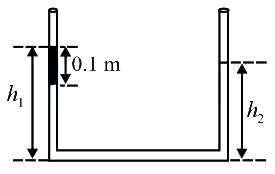
- An open-ended U-tube of uniform cross-sectional area contains water (density ). Initially the water level stands at from the bottom in each arm. Kerosene oil (a water-immiscible liquid) of density is added to the left arm until its length is , as shown in the schematic figure below. The ratio of the heights of the liquid in the two arms is
 JEE Advanced 2020 Easy
 - Paragraph:
Chemical reactions involve interaction of atoms and molecules. A large number of atoms/molecules (approximately \(6.023 \times 10^{23}\) ) are present in a few grams of any chemical compound varying with their atomic/molecular masses. To handle such large numbers conveniently, the mole concept was introduced. This concept has implications in diverse areas such as analytical chemistry, biochemistry, electrochemistry and radiochemistry. The following example illustrates a typical case, involving chemical/electrochemical reaction, which requires a clear understanding of the mole concept.
A \(4.0\) molar aqueous solution of \(\mathrm{NaCl}\) is prepared and \(500 \mathrm{~mL}\) of this solution is electrolysed. This leads to the evolution of chlorine gas at one of electrodes (atomic mass: \(\mathrm{Na}=23, \mathrm{Hg}=200 ; 1\) faraday \(=96500\) coulombs).
Question:
The total number of moles of chlorine gas evolved isJEE Advanced 2007 Medium - Among the following, the number of compounds than can react with \(\mathrm{PCl}_5\) to give \(\mathrm{POCl}_3\) is \(\mathrm{O}_2, \mathrm{CO}_2, \mathrm{SO}_2, \mathrm{H}_2 \mathrm{O}, \mathrm{H}_2 \mathrm{SO}_4, \mathrm{P}_4 \mathrm{O}_{10}\).JEE Advanced 2011 Medium
- Among the triatomic molecules/ions, and , the total number of linear molecule(s)/ion(s) where the hybridization of the central atom does not have contribution from the d-orbital(s) is
[Atomic number: S = 16, Cl = 17, I = 53 and Xe = 54]JEE Advanced 2015 Medium