


JEE Advanced · Mathematics · 19. Determinants
Consider three planes
\[
P_1: x-y+z=1, P_2: x+y-z=-1
\]
and \(P_3: x-3 y+3 z=2\)
Let \(L_1, L_2\) and \(L_3\) be the lines of intersection of the planes \(P_2\) and \(P_3, P_3\) and \(P_1, P_1\) and \(P_2\), respectively.
Statement 1 Atleast two of the lines \(L_1, L_2\) and \(L_3\) are non-parallel.
Statement 2 The three planes do not have a common point.
- A
Statement 1 is true, Statement 2 is true, Statement 2 is a correct explanation for Statement 1.
- B
Statement 1 is true, Statement 2 is true, Statement 2 is not a correct explanation for Statement 1.
- C
Statement 1 is true, Statement 2 is false.
- D
Statement 1 is false, Statement 2 is true
Answer & Solution
Correct Answer
(D)
Statement 1 is false, Statement 2 is true
Step-by-step Solution
Detailed explanation
The given equations are
\[
\begin{aligned}
& x-y+z=1, \\
& x+y-z=-1 \text { and } x-3 y+3 z=2
\end{aligned}
\]
The system of equations can be put in matrix form as \(A X=B\)
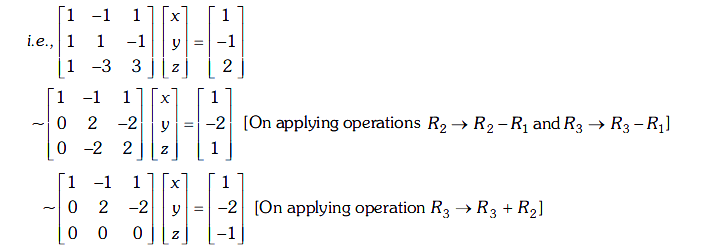
which is inconsistent as \(\rho(A: B) \neq \rho(A)\).
\(\Rightarrow\) The three planes do not have a common point.
\(\Rightarrow\) Statement 2 is true.
Since, planes \(P_1, P_2\) and \(P_3\) are pairwise intersection, their lines of intersection are parallel.
Statement 1 is false.
\[
\begin{aligned}
& x-y+z=1, \\
& x+y-z=-1 \text { and } x-3 y+3 z=2
\end{aligned}
\]
The system of equations can be put in matrix form as \(A X=B\)
which is inconsistent as \(\rho(A: B) \neq \rho(A)\).
\(\Rightarrow\) The three planes do not have a common point.
\(\Rightarrow\) Statement 2 is true.
Since, planes \(P_1, P_2\) and \(P_3\) are pairwise intersection, their lines of intersection are parallel.
Statement 1 is false.
See the Complete Solution
Get step-by-step explanations for this and 2.5 Lakh+ more JEE, NEET & CET questions.
- Unlock all solutions
- Practice the full chapter
- Track accuracy across PYQs
4.8 rated on Google Play · 14,000+ reviews
More questions from Mathematics
- If is the solution of the differential equation for , and the slope of the curve is never zero, then the value of is _____ .JEE Advanced 2022 Easy
- Paragraph:
A circle \(C\) of radius 1 is inscribed in an equilateral \(\triangle P Q R\). The points of contact of \(C\) with the sides \(P Q, Q R, R P\) are \(D, E, F\) respectively. The line \(P Q\) is given by the equation
\(\sqrt{3} x+y-6=0\) and the point \(D\) is \(\left(\frac{3 \sqrt{3}}{2}, \frac{3}{2}\right)\). Further, it is given that the origin and the centre of \(C\) are on the same side of the line \(P Q\).Question:
Equations of the sides \(Q R, R P\) areJEE Advanced 2008 Easy - Consider a pyramid located in the first octant with, as origin, and and, along the and the , respectively. The base of the pyramid is a square with. The point S is directly above the mid-point T of diagonal, , such that, . ThenJEE Advanced 2016 Medium
- Let \(S=\{a+b \sqrt{2}: a, b \in \mathbb{Z}\}, T_1=\)\(\left\{(-1+\sqrt{2})^n: n \in \mathbb{N}\right\}\), and \(T_2=\left\{(1+\sqrt{2})^n: n \in \mathbb{N}\right\}\). Then which of the following statements is (are) TRUE?JEE Advanced 2024 Medium
- If the line divides the area of the region into two equal parts, thenJEE Advanced 2017 Medium
- Let be given by ThenJEE Advanced 2014 Medium
More PYQs from JEE Advanced
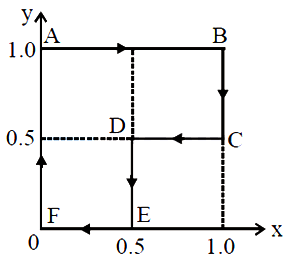
- A particle is moved along a path as shown in figure, in presence of a force where and are in meter and The work done on the particle by this force will be ____ Joule.
 JEE Advanced 2019 Medium
 - A bar of mass and length is lying on a horizontal frictionless surface. One end of the bar is pivoted at a point about which it is free to rotate. A small mass is moving on the same horizontal surface with speed on a path perpendicular to the bar. It hits the bar at a distance from the pivoted end and returns back on the same path with speed . After this elastic collision, the bar rotates with an angular velocity . Which of the following statement is correct?JEE Advanced 2023 Hard
- In the following reactions, and are the major products.
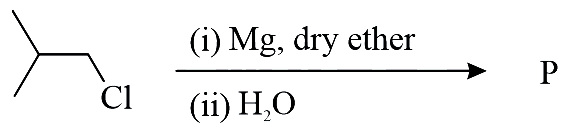
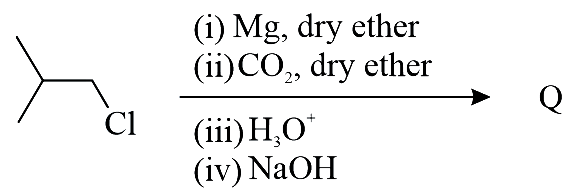
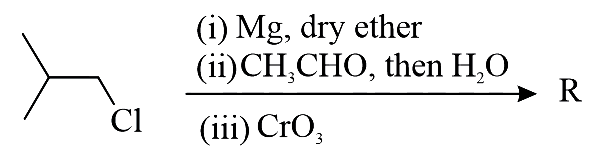
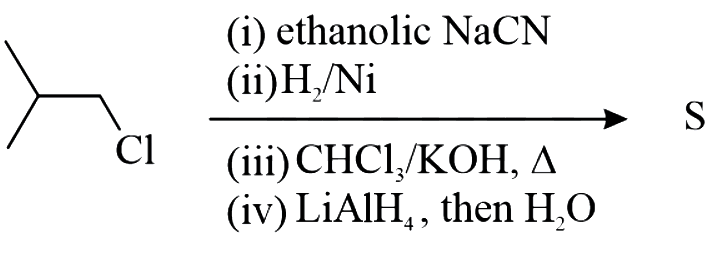
The correct statement about and isJEE Advanced 2023 Hard - Match each set of hybrid orbitals from LIST-I with complex (es) given in LIST-II.
LIST -I LIST -II A) P) B) Q) C) R) D) S) T) U) JEE Advanced 2018 Medium - The plot given below shows curves (where, is the pressure and is the temperature) for two solvents and and isomolal solutions of in these solvents. is completely dissociates in both the solvents.
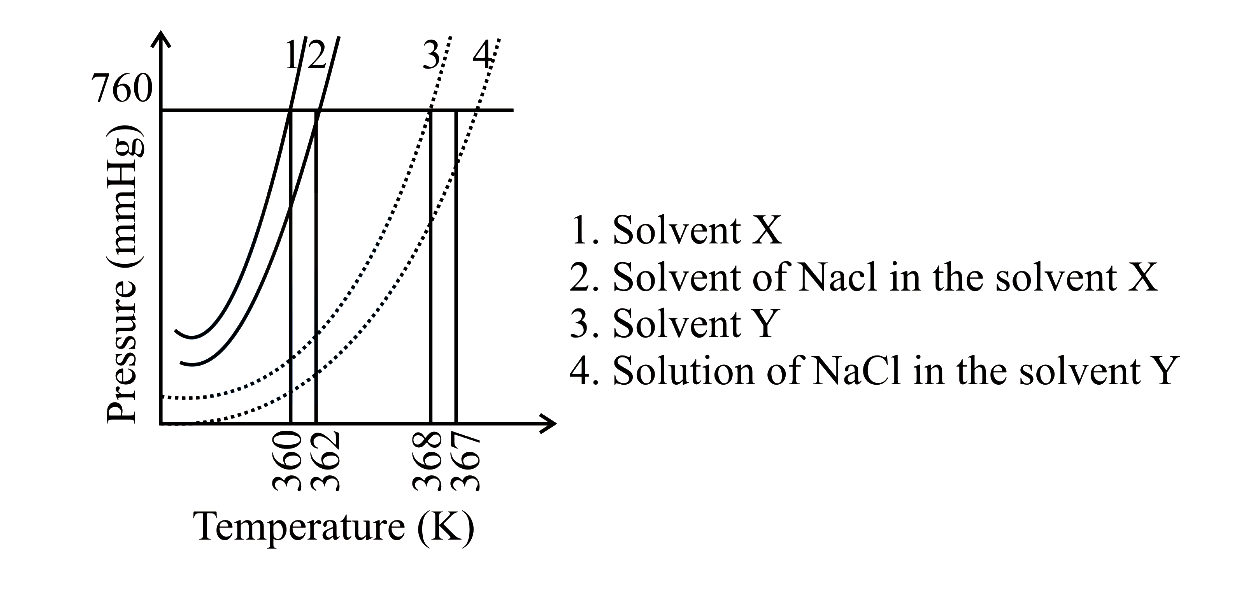
On the addition of equal number of moles of a non-volatile solute in equal amount (in ) of these solvents, the elevation of boiling point of solvent is three times that of solvent . The solute is known to undergo dimerization in these solvents. If the degree of dimerization is in the solvent , the degree of dimerization in the solvent is _______.JEE Advanced 2018 Hard - Under the same reaction conditions, initial concentration of \(1.386 \mathrm{~mol} \mathrm{dm}^{-3}\) of a substance becomes half in 40 s and 20 s through first-order and zero-order kinetics, respectively. Ratio \(\left(\frac{k_1}{k_0}\right)\) of the rate constants for first order \(\left(k_1\right)\) and zero \(\operatorname{order}\left(k_0\right)\) of the reaction isJEE Advanced 2008 Easy