


JEE Advanced · Mathematics · 5. Sequences & Series
Paragraph:
Let \(V_r\) denotes the sum of the first \(r\) terms of an arithmetic progression \((A P)\) whose first term is \(r\) and the common difference is \((2 r-1)\). Let \(T_r=V_{r+1}-V_r-2\) and \(Q_r=T_{r+1}-T_r\) for \(r=1,2, \ldots\)
Question:
Which one of the following is a correct statement?
- A \(Q_1, Q_2, Q_3, \ldots\) are in AP with common difference 5
- B \(Q_1, Q_2, Q_3, \ldots\) are in AP with common difference 6
- C \(Q_1, Q_2, Q_3, \ldots\) are in AP with common difference 11
- D \(Q_1=Q_2=Q_3=\ldots\)
Answer & Solution
Correct Answer
(B) \(Q_1, Q_2, Q_3, \ldots\) are in AP with common difference 6
Step-by-step Solution
Detailed explanation
Since, \(T_r=3 r^2+2 r-1\)
\(\therefore T_{r+1} =3(r+1)^2+2(r+1)-1 \)
\( \therefore Q_r =T_{r+1}-T_r=3[2 r+1]+2[1] \)
\( \Rightarrow Q_r =6 r+5 \)
\( \Rightarrow Q_{r+1} =6(r+1)+5\)
Common difference \(=Q_{r+1}-Q_r=6\)
\(\therefore T_{r+1} =3(r+1)^2+2(r+1)-1 \)
\( \therefore Q_r =T_{r+1}-T_r=3[2 r+1]+2[1] \)
\( \Rightarrow Q_r =6 r+5 \)
\( \Rightarrow Q_{r+1} =6(r+1)+5\)
Common difference \(=Q_{r+1}-Q_r=6\)
See the Complete Solution
Get step-by-step explanations for this and 2.5 Lakh+ more JEE, NEET & CET questions.
- Unlock all solutions
- Practice the full chapter
- Track accuracy across PYQs
4.8 rated on Google Play · 14,000+ reviews
More questions from Mathematics
- The total number of local maxima and local minima of the function \(f(x)=\left\{\begin{array}{lc}(2+x)^3 ; & -3 < x \leq-1 \\ x^{\frac{2}{3}} ; & -1 < x < 2\end{array}\right.\) isJEE Advanced 2008 Hard
- Let \(p\) and \(q\) be real numbers such that \(p \neq 0, p^3 \neq q\) and \(p^3 \neq-q\). If \(\alpha\) and \(\beta\) are non-zero complex numbers satisfying \(\alpha+\beta=-p\) and \(\alpha^3+\beta^3=q\), then \(a\) quadratic equation having \(\frac{\alpha}{\beta}\) and \(\frac{\beta}{\alpha}\) as its roots isJEE Advanced 2010 Medium
- The maximum value of the expression \(\frac{1}{\sin ^2 \theta+3 \sin \theta \cos \theta+5 \cos ^2 \theta}\) isJEE Advanced 2010 Easy
- Let and be positive real numbers. Suppose is an end point of the latus rectum of the parabola , and suppose the ellipse passes through the point . If the tangents to the parabola and the ellipse at the point are perpendicular to each other, then the eccentricity of the ellipse isJEE Advanced 2020 Easy
- Consider a triangle \(A B C\) and let \(a, b\) and \(c\) denote the lengths of the sides opposite to vertices \(A, B\) and \(C\) respectively. Suppose \(a=6, b=10\) and the area of the triangle is \(15 \sqrt{3}\). If \(\angle A C B\) is obtuse and if \(r\) denotes the radius of the incircle of the triangle, then \(r^2\) is equal toJEE Advanced 2010 Easy
- Match the following.
List – I List – II (A) The number of polynomials f(x) with non – negative integer coefficients of degree satisfying f(0) =0 and (P) 8 (B) The number of point in the interval at which attains its maximum value, is (Q) 2 (C) equals (R) 4 (D) (S) 0 JEE Advanced 2014 Hard
More PYQs from JEE Advanced
- For the given compound X, the total number of optically active stereoisomers is ____.
 JEE Advanced 2018 Medium
 - A soft plastic bottle, filled with water of density \(1 \mathrm{gm} / \mathrm{cc}\), carries an inverted glass test-tube with some air (ideal gas) trapped as shown in the figure. The test-tube has a mass of \(5 \mathrm{gm}\), and it is made of a thick glass of density \(2.5 \mathrm{gm} / \mathrm{cc}\). Initially the bottle is sealed at atmospheric pressure \(p_{0}=10^{5} \mathrm{~Pa}\) so that the volume of the trapped air is \(v_{0}=3.3 \mathrm{cc}\). When the bottle is squeezed from outside at constant temperature, the pressure inside rises and the volume of the trapped air reduces. It is found that the test tube begins to sink at pressure \(p_{0}+\Delta p\) without changing its orientation. At this pressure, the volume of the trapped air is \(v_{0}-\Delta v\).
Let \(\Delta v=X\) cc and \(\Delta p=Y \times 10^{3} \mathrm{~Pa}\).
The value of is ____.JEE Advanced 2021 Hard - Match the transformation in Column I with appropriate options in Column II.
Column I Column II A. \(CO _2(s) \rightarrow CO _2(g)\) p. Phase transition B. \(CaCO _3(s) \rightarrow CaO (s)\) \(+~ CO _2(g)\) q. Allotropic change C. \(2 H \rightarrow H _2(g)\) r. \(\Delta\text{H}\) is positive D. \(P _{\text {(white, solid) }} \rightarrow P _{\text {(red, solid) }}\) s. \(\Delta\text{S}\) is positive t. \(\Delta\text{S}\) is negative JEE Advanced 2011 Easy - Which of the following is (are) NOT the square of a matrix with real entries?JEE Advanced 2017 Easy
- A long straight wire carries a current, ampere. A semi-circular conducting rod is placed beside it on two conducting parallel rails of negligible resistance. Both the rails are parallel to the wire. The wire, the rod and the rails lie in the same horizontal plane, as shown in the figure. Two ends of the semi-circular rod are at distances and from the wire. At time , the rod starts moving on the rails with a speed (see the figure). A resistor and a capacitor are connected in series between the rails. At time , is uncharged. Which of the following statement(s) is (are) correct? [ SI units. Take ]
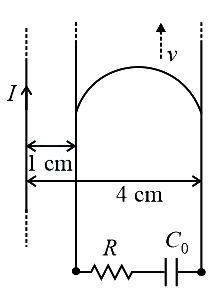 JEE Advanced 2021 Medium
 - Benzene and naphthalene form an ideal solution at room temperature. For this process, the true statement(s) is (are)JEE Advanced 2013 Medium