


JEE Advanced · Mathematics · 2. Quadratic Equations
Let \(p\) and \(q\) be real numbers such that \(p \neq 0, p^3 \neq q\) and \(p^3 \neq-q\). If \(\alpha\) and \(\beta\) are non-zero complex numbers satisfying \(\alpha+\beta=-p\) and \(\alpha^3+\beta^3=q\), then \(a\) quadratic equation having \(\frac{\alpha}{\beta}\) and \(\frac{\beta}{\alpha}\) as its roots is
- A \(\left(p^3+q\right) x^2-\left(p^3+2 q\right) x\) \(+\left(p^3+q\right)=0\)
- B \(\left(p^3+q\right) x^2-\left(p^3-2 q\right) x\) \(+\left(p^3+q\right)=0\)
- C \(\left(p^3-q\right) x^2-\left(5 p^3-2 q\right) x\) \(+\left(p^3-q\right)=0\)
- D \(\left(p^3-q\right) x^2-\left(5 p^3+2 q\right) x\) \(+\left(p^3-q\right)=0\)
Answer & Solution
Correct Answer
(B) \(\left(p^3+q\right) x^2-\left(p^3-2 q\right) x\) \(+\left(p^3+q\right)=0\)
Step-by-step Solution
Detailed explanation
Sum of roots \(=\frac{\alpha^2+\beta^2}{\alpha \beta}\) and product \(=1\)
Given, \(\alpha+\beta=-p\) and \(\alpha^3+\beta^3=q\)
\(\Rightarrow(\alpha+\beta)\left(\alpha^2-\alpha \beta+\beta^2\right)=q \)
\( \therefore \alpha^2+\beta^2-\alpha \beta=\frac{-q}{p}\)
and \(\quad(\alpha+\beta)^2=p^2\)
\(
\Rightarrow \alpha^2+\beta^2+2 \alpha \beta=p^2
\)
From Eqs. (i) and (ii), we get
\(
\alpha^2+\beta^2=\frac{p^3-2 q}{3 p}
\)
and \(\alpha \beta=\frac{p^3+q}{3 p}\)
\(\therefore\) Required equation is
\( x^2-\frac{\left(p^3-2 q\right) x}{\left(p^3+q\right)}+1=0 \)
\( \Rightarrow\left(p^3+q\right) x^2-\left(p^3-2 q\right) x~+\) \(\left(p^3+q\right)=0 \)
Given, \(\alpha+\beta=-p\) and \(\alpha^3+\beta^3=q\)
\(\Rightarrow(\alpha+\beta)\left(\alpha^2-\alpha \beta+\beta^2\right)=q \)
\( \therefore \alpha^2+\beta^2-\alpha \beta=\frac{-q}{p}\)
and \(\quad(\alpha+\beta)^2=p^2\)
\(
\Rightarrow \alpha^2+\beta^2+2 \alpha \beta=p^2
\)
From Eqs. (i) and (ii), we get
\(
\alpha^2+\beta^2=\frac{p^3-2 q}{3 p}
\)
and \(\alpha \beta=\frac{p^3+q}{3 p}\)
\(\therefore\) Required equation is
\( x^2-\frac{\left(p^3-2 q\right) x}{\left(p^3+q\right)}+1=0 \)
\( \Rightarrow\left(p^3+q\right) x^2-\left(p^3-2 q\right) x~+\) \(\left(p^3+q\right)=0 \)
See the Complete Solution
Get step-by-step explanations for this and 2.5 Lakh+ more JEE, NEET & CET questions.
- Unlock all solutions
- Practice the full chapter
- Track accuracy across PYQs
4.8 rated on Google Play · 14,000+ reviews
More questions from Mathematics
- Let \(g_{i}:\left[\frac{\pi}{8}, \frac{3 \pi}{8}\right] \rightarrow \mathbb{R}, i=1,2\), and \(f:\left[\frac{\pi}{8}, \frac{3 \pi}{8}\right] \rightarrow \mathbb{R}\) be functions such that \(g_{1}(x)=1, g_{2}(x)=|4 x-\pi|\) and \(f(x)=\sin ^{2} x\), for all \(x \in\left[\frac{\pi}{8}, \frac{3 \pi}{8}\right]\)
Define
\(
S_{i}=\int_{\frac{\pi}{8}}^{\frac{3 \pi}{8}} f(x) \cdot g_{i}(x) d x, \quad i=1,2
\)
The value of is ____.JEE Advanced 2021 Medium - Let be an integer. Take n distinct points on a circle and join each pair of points by a line segment. Colour the line segment joining every pair of adjacent points by blue and the rest by red. If the number of red and blue line segments are equal, then the value of n is ________JEE Advanced 2014 Hard
- Let be a triangle. Let If and then which of the following is (are) true ?JEE Advanced 2015 Medium
- Let and be real numbers such that and . If the complex number satisfies then which of the following is (are) possible value (s) ofJEE Advanced 2017 Medium
- Paragraph:
Let \(O\) be the origin, and \(\overrightarrow{O X}, \overrightarrow{O Y}, \overrightarrow{O Z}\) be three unit vectors in the directions of the sides \(\overrightarrow{Q R}, \overrightarrow{R P}\), \(\overrightarrow{P Q}\), respectively, of a triangle \(P Q R\).
Question:
If the triangle \(P Q R\) varies, then the minimum value of
\(\cos (P+Q)+\cos (Q+R)+\cos (R+P)\) isJEE Advanced 2017 Easy - Let \(\overrightarrow{O P}=\frac{\alpha-1}{\alpha} \hat{i}+\hat{j}+\hat{k}, \overrightarrow{O Q}=\hat{i}+\frac{\beta-1}{\beta} \hat{j}+\hat{k}\) and \(\overrightarrow{O R}=\hat{i}+\hat{j}+\frac{1}{2} \hat{k}\) be three vectors, where \(\alpha, \beta \in \mathbb{R}-\{0\}\) and \(O\) denotes the origin. If \((\overrightarrow{O P} \times \overrightarrow{O Q}) \cdot \overrightarrow{O R}=0\) and the point \((\alpha, \beta, 2)\) lies on the plane \(3 x+3 y-z+l=0\), then the value of \(l\) is ____JEE Advanced 2024 Medium
More PYQs from JEE Advanced
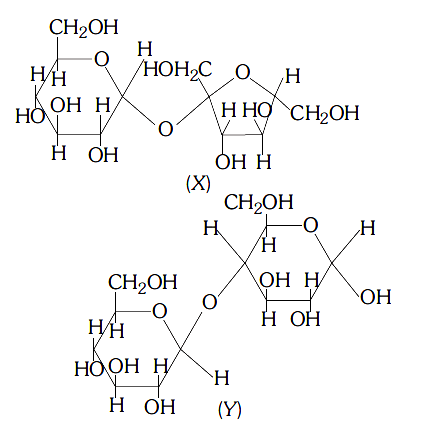
- The correct statement(s) about the following sugars \(X\) and \(Y\) is (are)
 JEE Advanced 2009 Hard
 - Let RS be the diameter of the circle where, is the point. Let be a variable point (other than ) on the circle and tangents to the circle at meet at the point. The normal to the circle at P intersects a line drawn through parallel to at point . Then, the locus of passes through the point (s):JEE Advanced 2016 Medium
- Let for Suppose are in Arithmetic Progression (A.P.) with the common difference Suppose are in A.P. such that and If and thenJEE Advanced 2016 Hard
- Paragraph:
In a mixture of \(\mathrm{H}-\mathrm{H}^{+}\)gas \(\left(\mathrm{He}^{+}\right.\)is singly ionised \(\mathrm{He}\) atom), \(\mathrm{H}\) atoms and \(\mathrm{He}^{+}\)ions are excited to their respective first excited states. Subsequently, \(\mathrm{H}\) atoms transfer their total excitation energy to \(\mathrm{He}^{+}\)ions (by collisions). Assume that the Bohr model of atom is exactly valid.
Question:
The ratio of the kinetic energy of the \(n=2\) electron for the \(\mathrm{H}\) atom to that of \(\mathrm{He}^{+}\) ion isJEE Advanced 2008 Easy - A block is moving on an inclined plane making an angle \(45^{\circ}\) with the horizontal and the coefficient of friction is \(\mu\). The force required to just push it up the inclined plane is 3 times the force required to just prevent it from sliding down. If we define \(N=10 \mu\), then \(N\) isJEE Advanced 2011 Easy
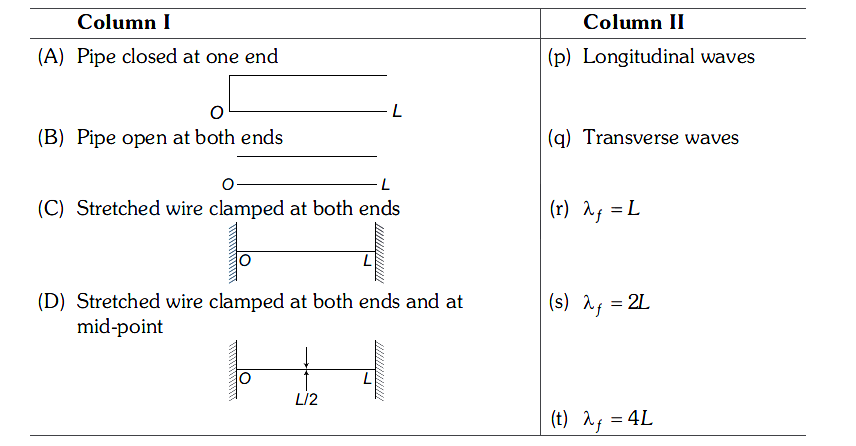
- Column I showns four systems, each of the same length \(L\), for producing standing waves. The lowest possible natural frequency of a system is called its fundamental frequency, whose wavelength is denoted as \(\lambda_f\). Match each system with statements given in Column II describing the nature and wave length of the standing waves.
 JEE Advanced 2011 Hard