


JEE Advanced · Mathematics · 25. AOD
Paragraph:
Let \(\psi_{1}:[0, \infty) \rightarrow \mathbb{R}, \psi_{2}:[0, \infty) \rightarrow \mathbb{R}, f:[0, \infty) \rightarrow \mathbb{R}\) and \(g:[0, \infty) \rightarrow \mathbb{R}\) be functions such that \(f(0)=g(0)=0\),
\(\psi_{1}(x)=e^{-x}+x, \quad x \geq 0\),
\(\psi_{2}(x)=x^{2}-2 x-2 e^{-x}+2, \quad x \geq 0\),
\(f(x)=\int_{-x}^{x}\left(|t|-t^{2}\right) e^{-t^{2}} d t, \quad x>0\)
and \(g(x)=\int_{0}^{x^{2}} \sqrt{t} e^{-t} d t, \quad x>0\)
Question:
Which of the following statements is TRUE ?
- A
- B For every , there exists an such that
- C For every , there exists a such that
- D is an increasing function on the interval
Answer & Solution
Correct Answer
(C) For every , there exists a such that
Step-by-step Solution
Detailed explanation
(A) Given
See the Complete Solution
Get step-by-step explanations for this and 2.5 Lakh+ more JEE, NEET & CET questions.
- Unlock all solutions
- Practice the full chapter
- Track accuracy across PYQs
4.8 rated on Google Play · 14,000+ reviews
More questions from Mathematics
- Let \(A_n=\left(\frac{3}{4}\right)-\left(\frac{3}{4}\right)^2+\left(\frac{3}{4}\right)^3+\ldots+(-1)^{n-1}\)\(\left(\frac{3}{4}\right)^n\) and \(B_n=1-A_n\). Find a least odd natural number \(n_0\), so that \(B_n>A_n, \forall n \geq n_0\).JEE Advanced 2006 Medium
- The set of values of \(\theta\) satisfying the inequation \(2 \sin ^2 \theta-5 \sin \theta+2>0\), where \(0 < \theta < 2 \pi\), isJEE Advanced 2006 Easy
- Paragraph:
Let \(O\) be the origin, and \(\overrightarrow{O X}, \overrightarrow{O Y}, \overrightarrow{O Z}\) be three unit vectors in the directions of the sides \(\overrightarrow{Q R}, \overrightarrow{R P}\), \(\overrightarrow{P Q}\), respectively, of a triangle \(P Q R\).
Question:
If the triangle \(P Q R\) varies, then the minimum value of
\(\cos (P+Q)+\cos (Q+R)+\cos (R+P)\) isJEE Advanced 2017 Easy - Three boys and two girls stand in a queue. The probability that the number of boys ahead of every girl is atleast one more than the number of girls ahead of her isJEE Advanced 2014 Easy
- Paragraph:
Consider the lines: \(L_1: \frac{x+1}{3}=\frac{y+2}{1}=\frac{z+1}{2}, L_2: \frac{x-2}{1}=\frac{y+2}{2}=\frac{z-3}{3}\)Question:
The unit vector perpendicular to both \(L_1\) and \(L_2\) isJEE Advanced 2008 Easy - Let \(\mathbf{a}, \mathbf{b}, \mathbf{c}\) be unit vectors such that \(\mathbf{a}+\mathbf{b}+\mathbf{c}=\mathbf{0}\). Which one of the following is correct?JEE Advanced 2007 Easy
More PYQs from JEE Advanced
- Look at the drawing given in the figure, which has been drawn with ink of uniform line-thickness.
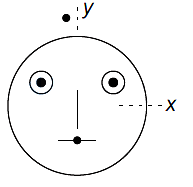
The mass of ink used to draw each of the two inner circles, and each of the two line segments is \(m\). The mass of the ink used to draw the outer circle is \(6 \mathrm{~m}\). The coordinates of the centres of the different parts are, outer circle 10 , \(0)\), left inner circle \((0,0)\), right inner circle \((a, a)\), vertical line \((0,0)\) and horizontal line \((0,-a)\). The \(y\)-coordinate of the centre of mass of the ink in this drawing isJEE Advanced 2009 Medium - Paragraph:
Consider an evacuated cylindrical chamber of height \(h\) having rigid conducting plates at the ends and an insulating curved surface as shown in the figure. A number of spherical balls made of a light weight and soft material and coated with a conducting material are placed on the bottom plate. The balls have a radius \(r \ll h\). Now a high voltage source \((HV)\) is connected across the conducting plates such that the bottom plate is at \(+V_{0}\) and the top plate at \(-V_{0} .\) Due to their conducting surface, the balls will get charged, will become equipotential with the plate and are repelled by it. The balls will eventually collide with the top plate, where the coefficient of restitution can be taken to be zero due to the soft nature of the material of the balls. The electric field in the chamber can be considered to be that of a parallel plate capacitor. Assume that there are no collisions between the balls and the interaction between them is negligible. (Ignore gravity)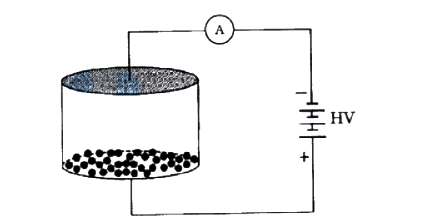
Question:
The average current in the steady state registered by the ammeter in the circuit will beJEE Advanced 2016 Medium - Paragraph:
The coordination number of \(\mathrm{Ni}^{2+}\) is 4 .
\(\mathrm{NiCl}_2+\mathrm{KCN}\) (excess) \(\rightarrow A\) (cyano complex)
\(\mathrm{NiCl}_2+\) conc. \(\mathrm{HCl}\) (excess) \(\rightarrow B\) (chloro complex)
Question:
The hybridization of \(A\) and \(B\) areJEE Advanced 2006 Medium - A uniform circular disc of mass and radius is rotating with an angular velocity of about its own axis, which is vertical. Two uniform circular rings, each of mass and radius , are gently placed symmetrically on the disc in such a manner that they are touching each other along the axis of the disc and are horizontal. Assume that the friction is large enough such that the rings are at rest relative to the disc and the system rotates about the original axis. The new angular velocity of the system isJEE Advanced 2013 Medium
- Match the complexes in Column I with their properties listed in Column II. Indicate your answer by darkening the appropriate bubbles of the \(4 \times 4\) matrix given in the ORS.
Column I Column II A. \(\text O _2^{-} \longrightarrow \text{O} _2\) \(+~\text O _2^{2-}\) P. Redox reaction B. \(\text{CrO} _4^{2-}+\text H ^{+} \longrightarrow\) Q. One of the products has trigonal planar structure C. \(\text{MnO} _4^{-}+ \text{NO} _2^{-}\) \(+~ \text H ^{+} \longrightarrow\) R. Dimeric bridged tetrahedral metal ion D. \(\text{NO} _3^{-}+ \text H _2 \text{SO} _4\) \(+~ \text{Fe} ^{2+} \longrightarrow\) S. Disproportionation JEE Advanced 2007 Hard - The graph between object distance \(u\) and image distance \(v\) for a lens is given below. The focal length of the lens is
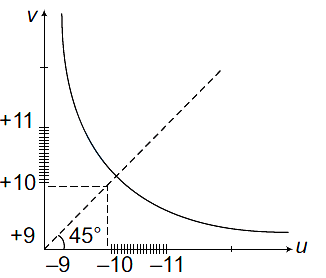 JEE Advanced 2006 Hard