


JEE Advanced · Mathematics · 30. Vector Algebra
Paragraph:
Consider the lines: \(L_1: \frac{x+1}{3}=\frac{y+2}{1}=\frac{z+1}{2}, L_2: \frac{x-2}{1}=\frac{y+2}{2}=\frac{z-3}{3}\)Question:
The unit vector perpendicular to both \(L_1\) and \(L_2\) is
- A
\(\frac{-\hat{\mathbf{i}}+7 \hat{\mathbf{j}}+7 \hat{\mathbf{k}}}{\sqrt{99}}\)
- B
\(\frac{-\hat{\mathbf{i}}-7 \hat{\mathbf{j}}+5 \hat{\mathbf{k}}}{5 \sqrt{3}}\)
- C
\(\frac{-\hat{\mathbf{i}}+7 \hat{\mathbf{j}}+5 \hat{\mathbf{k}}}{5 \sqrt{3}}\)
- D
\(\frac{7 \hat{\mathbf{i}}-7 \hat{\mathbf{j}}-\hat{\mathbf{k}}}{\sqrt{99}}\)
Answer & Solution
Correct Answer
(B)
\(\frac{-\hat{\mathbf{i}}-7 \hat{\mathbf{j}}+5 \hat{\mathbf{k}}}{5 \sqrt{3}}\)
Step-by-step Solution
Detailed explanation
The equations of given lines in vector form may be written as
\[
L_1: \mathbf{r}(-\hat{\mathbf{i}}-2 \hat{\mathbf{j}}-\hat{\mathbf{k}})+\lambda(3 \hat{\mathbf{i}}+\hat{\mathbf{j}}+2 \hat{\mathbf{k}})
\]
and \(L_2: \mathbf{r}=(2 \hat{\mathbf{i}}-2 \hat{\mathbf{j}}+3 \hat{\mathbf{k}})+\mu(\hat{\mathbf{i}}+2 \hat{\mathbf{j}}+3 \hat{\mathbf{k}})\)
\(\therefore\) The vector perpendicular to both \(L_1\) and \(L_2\) is
\[
\left|\begin{array}{rrr}
\hat{\mathbf{i}} & \hat{\mathbf{j}} & \hat{\mathbf{k}} \\
3 & 1 & 2 \\
1 & 2 & 3
\end{array}\right|=-\hat{\mathbf{i}}-7 \hat{\mathbf{j}}+5 \hat{\mathbf{k}}
\]
\[
\begin{aligned}
\therefore \text { Required unit vector } & =\frac{(-\hat{\mathbf{i}}-7 \hat{\mathbf{j}}+5 \hat{\mathbf{k}})}{\sqrt{(-1)^2+(-7)^2+(5)^2}} \\
& =\frac{1}{5 \sqrt{3}}(-\hat{\mathbf{i}}-7 \hat{\mathbf{j}}+5 \hat{\mathbf{k}})
\end{aligned}
\]
\[
L_1: \mathbf{r}(-\hat{\mathbf{i}}-2 \hat{\mathbf{j}}-\hat{\mathbf{k}})+\lambda(3 \hat{\mathbf{i}}+\hat{\mathbf{j}}+2 \hat{\mathbf{k}})
\]
and \(L_2: \mathbf{r}=(2 \hat{\mathbf{i}}-2 \hat{\mathbf{j}}+3 \hat{\mathbf{k}})+\mu(\hat{\mathbf{i}}+2 \hat{\mathbf{j}}+3 \hat{\mathbf{k}})\)
\(\therefore\) The vector perpendicular to both \(L_1\) and \(L_2\) is
\[
\left|\begin{array}{rrr}
\hat{\mathbf{i}} & \hat{\mathbf{j}} & \hat{\mathbf{k}} \\
3 & 1 & 2 \\
1 & 2 & 3
\end{array}\right|=-\hat{\mathbf{i}}-7 \hat{\mathbf{j}}+5 \hat{\mathbf{k}}
\]
\[
\begin{aligned}
\therefore \text { Required unit vector } & =\frac{(-\hat{\mathbf{i}}-7 \hat{\mathbf{j}}+5 \hat{\mathbf{k}})}{\sqrt{(-1)^2+(-7)^2+(5)^2}} \\
& =\frac{1}{5 \sqrt{3}}(-\hat{\mathbf{i}}-7 \hat{\mathbf{j}}+5 \hat{\mathbf{k}})
\end{aligned}
\]
See the Complete Solution
Get step-by-step explanations for this and 2.5 Lakh+ more JEE, NEET & CET questions.
- Unlock all solutions
- Practice the full chapter
- Track accuracy across PYQs
4.8 rated on Google Play · 14,000+ reviews
More questions from Mathematics
- Let \(\mathbb{N}\) denote the set of all natural numbers, and \(\mathbb{Z}\) denote the set of all integers. Consider the functions \(f: \mathbb{N} \rightarrow \mathbb{Z}\) and \(g: \mathbb{Z} \rightarrow \mathbb{N}\) defined by
\(f(n)= \begin{cases}(n+1) / 2 & \text { if } n \text { is odd } \\ (4-n) / 2 & \text { if } n \text { is even }\end{cases}\) And
\(g(n)=\left\{\begin{array}{cc}3+2 n & \text { if } n \geq 0 \\ -2 n & \text { if } n <0\end{array}\right.\)
Define \((g \circ f)(n)=g(f(n))\) for all \(n \in \mathbb{N}\), and \((f \circ g)(n)=f(g(n))\) for all \(n \in \mathbb{Z}\).
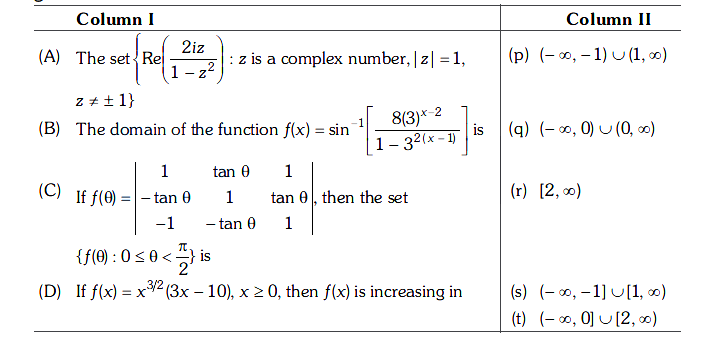
Then which of the following statements is (are) TRUE?JEE Advanced 2025 Hard - Match the statements given in Column I with the intervals/union of intervals given in Column II.
 JEE Advanced 2011 Medium
 - Let \(f(x)=(1-x)^{2} \sin ^{2} x+x^{2}\) for all \(x \in I R\) and let \(g(x)=\int_{1}^{x}\left(\frac{2(t-1)}{t+1}-\ln t\right) f(t) d t\) for all \(x \in(1, \infty)\).
Question: Which of the following is true?JEE Advanced 2012 Hard - If \(f(x)\) is cubic polynomial which has local maximum at \(x=-1\). If \(f(2)=18, f(1)=-1\) and \(f^{\prime}(x)\) has local minimum at \(x=0\), thenJEE Advanced 2006 Hard
- Paragraph:
Football teams \(T_{1}\) and \(T_{2}\) have to play two games against each other. It is assumed that the outcomes of the two games are independent. The probabilities of \(T_{1}\) winning, drawing and losing a game against \(T_{2}\) are \(\frac{1}{2}, \frac{1}{6}\) and \(\frac{1}{3}\), respectively. Each team gets \(3\) points for a win, \(1\) point for a draw and \(0\) point for a loss in a game. Let \(X\) and \(Y\) denote the total points scored by teams \(T_{1}\) and \(T_{2}\), respectively, after two games.
Question:
\(P(X>Y)\) isJEE Advanced 2016 Easy - Consider an obtuse angled triangle in which the difference between the largest and the smallest angle is and whose sides are in arithmetic progression. Suppose that the vertices of this triangle lie on a circle of radius .
(There are two questions based on , the question given below is one of them)
Then the inradius of the triangle isJEE Advanced 2023 Medium
More PYQs from JEE Advanced
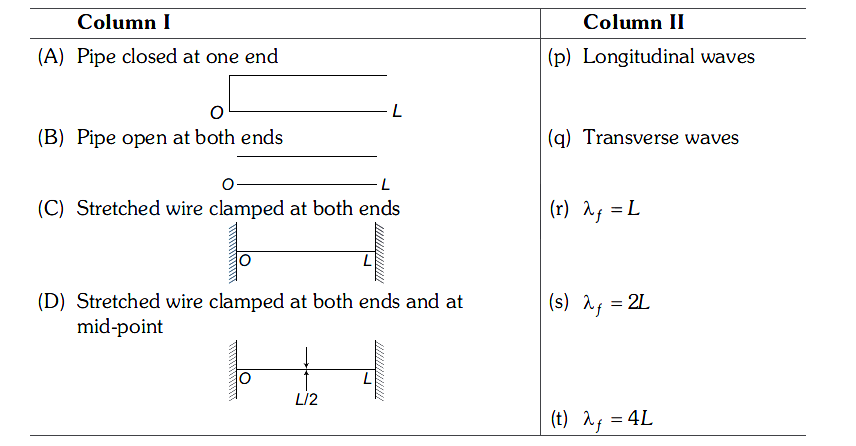
- Column I showns four systems, each of the same length \(L\), for producing standing waves. The lowest possible natural frequency of a system is called its fundamental frequency, whose wavelength is denoted as \(\lambda_f\). Match each system with statements given in Column II describing the nature and wave length of the standing waves.
 JEE Advanced 2011 Hard
 - A plot of the number of neutrons against the number of protons of the stable nuclei exhibits upwards deviation from linearity for atomic number, . For an unstable nucleus having ratio less than , the possible mode(s) of decay is (are):JEE Advanced 2016 Medium
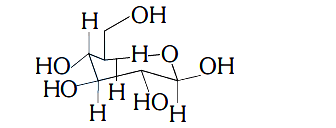
- The following carbohydrate is
 JEE Advanced 2011 Medium
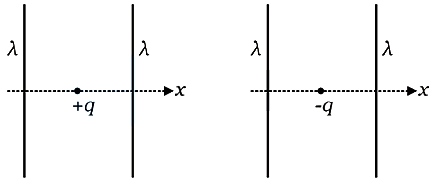
 - The figures below depict two situations in which two infinitely long static line charges of constant positive line charge density are kept parallel to each other. In their resulting electric field, point charges and are kept in equilibrium between them. The point charges are confined to move in the direction only. If they are given a small displacement about their equilibrium positions, then the correct statements(s) is (are)
 JEE Advanced 2015 Medium
 - Consider the following lists:
List- List- has two elements has three elements has four elements has five elements has six elements
The correct option is:JEE Advanced 2022 Medium - Paragraph:
A tertiary alcohol \(H\) upon acid catalysed dehydration gives a product \(I\). Ozonolysis of I leads to compounds \(\mathrm{J}\) and \(\mathrm{K}\). Compound \(\mathrm{J}\) upon reaction with
\(\mathrm{KOH}\) gives benzyl alcohol and a compound \(\mathrm{L}\), where \(\mathrm{K}\) on reaction with \(\mathrm{KOH}\) gives only \(M\).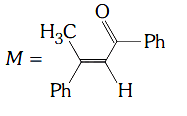
Question:
The structures of compounds \(J, K\) and \(L\), respectively, areJEE Advanced 2008 Medium