


JEE Advanced · Mathematics · 30. Vector Algebra
\[
\text { Match the statements of Column I with values of Column II. }
\]
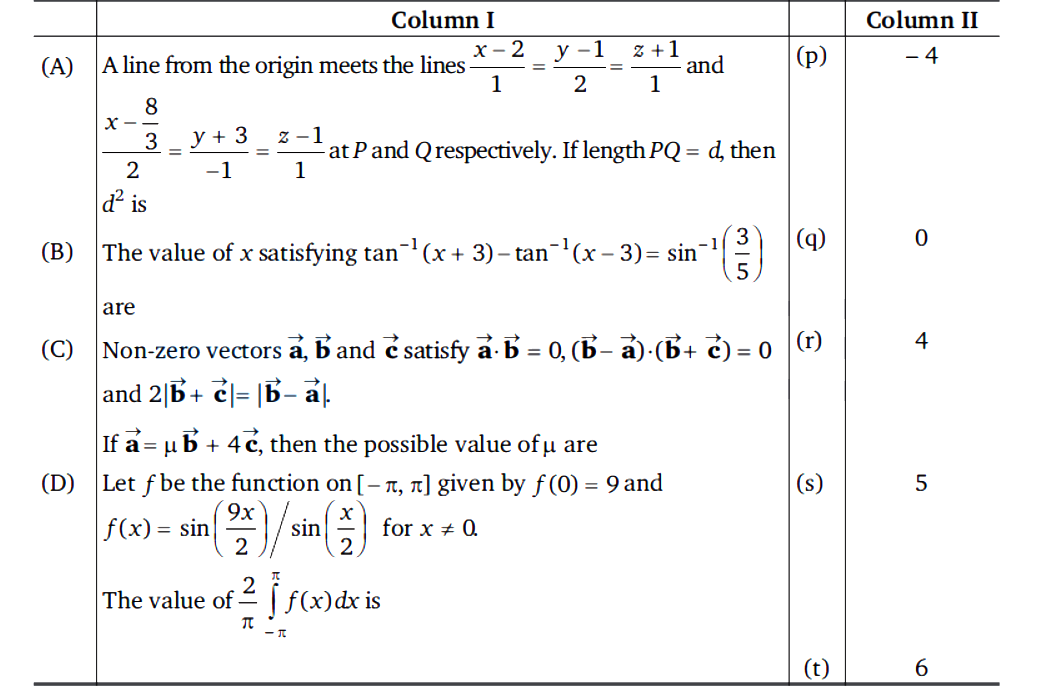
- A
(A) t, (B) p,r, (C) p, (D) r
- B
(A) q,r,t, (B) p,r, (C) p,s, (D) q,r
- C
(A) t, (B) q,r, (C) p,s, (D) r
- D
(A) q,r,t, (B) q,r, (C) p, (D) q,r
Answer & Solution
Correct Answer
(A)
(A) t, (B) p,r, (C) p, (D) r
Step-by-step Solution
Detailed explanation
(A) Equation of the line passing through origin is
\[
\begin{aligned}
& \frac{x}{a}=\frac{y}{b}=\frac{z}{c} \\
& \therefore \quad\left|\begin{array}{ccc}
2 & 1 & -1 \\
1 & -2 & 1 \\
a & b & c
\end{array}\right|=0 \\
& \Rightarrow \quad a(-1)-b(3)+c(-5)=0 \\
& \Rightarrow \quad-a-3 b-5 c=0 \\
& \Rightarrow \quad a+3 b+5 c=0 \\
& \text { Also, } \quad\left|\begin{array}{ccc}
\frac{8}{3} & -3 & 1 \\
2 & -1 & 1 \\
a & b & c
\end{array}\right|=0
\end{aligned}
\]
\[
\begin{aligned}
& \therefore \quad a(-2)-b\left(\frac{2}{3}\right)+c\left(\frac{10}{3}\right)=0 \\
& \Rightarrow \quad 2 a+\frac{2 b}{3}-\frac{10 c}{3}=0 \\
& 3 a+b-5 c=0 \\
&
\end{aligned}
\]
From Eqs. (i) and (ii),
\[
\begin{aligned}
\frac{a}{-20} & =\frac{b}{20}=\frac{c}{-8} \\
\frac{a}{5} & =\frac{b}{-5}=\frac{c}{4}
\end{aligned}
\]
Equation of line is
\[
\frac{x}{5}=\frac{y}{-5}=\frac{z}{4}=\lambda \text { (say) }
\]
Also, \(\frac{x-2}{1}=\frac{y-1}{2}=\frac{z+1}{1}=k_1\) (say)
Now, \(\frac{x-\frac{8}{3}}{2}=\frac{y+3}{-1}=\frac{z-1}{1}=k_2\) (say)
Point on (iii) is \((5 \lambda,-5 \lambda,+4 \lambda)\) Point on (iv) is
\[
\left(2+k_1, 1-2 k_1,-1+k_1\right)
\]
Point on \((\mathrm{v})\) is
\[
\left(\frac{8}{3}+2 k_2,-3-k_2, 1+k_2\right)
\]
On solving, \(2+k_1+1-2 k_1=0\)
\[
-k_1+3=0
\]
\[
\begin{aligned}
k_1 & =3 \\
P & \equiv(5,-5,2)
\end{aligned}
\]
Again, for \(Q\)
\[
\begin{array}{r}
\frac{8}{3}+2 k_2-3-k_2=0 \\
k_2-\frac{1}{3}=0 \\
k_2=\frac{1}{3} \\
Q \equiv\left(\frac{10}{3}, \frac{-10}{3}, \frac{4}{3}\right)
\end{array}
\]
\[
\text { Now, } \begin{aligned}
P Q & =\sqrt{\left(\frac{5}{3}\right)^2+\left(\frac{5}{3}\right)^2+\left(\frac{2}{3}\right)^2} \\
& =\frac{\sqrt{54}}{3}
\end{aligned}
\]
\[
P Q^2=d^2=\frac{54}{9}=6
\]
(B) \(\tan ^{-1}\left(\frac{x+3-x+3}{1+\left(x^2-9\right)}\right)=\tan ^{-1}\left(\frac{3}{4}\right)\)
\[
\begin{array}{rlrl}
\Rightarrow & & \frac{6}{x^2-8} & =\frac{3}{4} \\
\Rightarrow & & 3 x^2 & =48 \\
\Rightarrow & x & =\pm 4
\end{array}
\]
(C)
\[
\begin{aligned}
& (\overrightarrow{\mathbf{b}}-\overrightarrow{\mathbf{a}}) \cdot\left(\overrightarrow{\mathbf{b}}+\frac{\overrightarrow{\mathbf{a}}-\mu \overrightarrow{\mathbf{b}}}{4}\right)=0 \\
& \Rightarrow \quad(\overrightarrow{\mathbf{b}}-\overrightarrow{\mathbf{a}}) \cdot(4 \overrightarrow{\mathbf{b}}+\overrightarrow{\mathbf{a}}-\mu \overrightarrow{\mathbf{b}})=0 \\
& \text { Also, } 2\left|\overrightarrow{\mathbf{b}}+\frac{\overrightarrow{\mathbf{a}}-\mu \overrightarrow{\mathbf{b}}}{4}\right|=|\overrightarrow{\mathbf{b}}-\overrightarrow{\mathbf{a}}| \\
& \Rightarrow \quad 2\left|\frac{(4-\mu) \overrightarrow{\mathbf{b}}^2-\overrightarrow{\mathbf{a}}^2=0}{4}\right|=|\overrightarrow{\mathbf{b}}-\overrightarrow{\mathbf{a}}|
\end{aligned}
\]
\[
\begin{aligned}
& \Rightarrow \frac{(4-\mu)^2 \overrightarrow{\mathbf{b}}^2}{4}+\frac{\overrightarrow{\mathbf{a}}^2}{4}=\overrightarrow{\mathbf{b}}^2+\overrightarrow{\mathbf{a}}^2 \\
& \Rightarrow \quad \frac{3 \overrightarrow{\mathbf{a}}^2}{4}=\frac{(4-\mu)^2-4}{4} \cdot \overrightarrow{\mathbf{a}}^2 \\
& 3 \overrightarrow{\mathbf{a}}^2=C(4-\mu)^2-4 \overrightarrow{\mathbf{b}}^2
\end{aligned}
\]
From Eqs. (i) and (ii)
\[
\begin{aligned}
& 3(4-\mu)=(4-\mu)^2-4 \\
& (4-\mu)^2-3(4-\mu)-4=0 \\
& \Rightarrow \quad \mu=0,5 \\
& \mu=5 \text { is not admissible. }
\end{aligned}
\]
(D) \(f(0)=9\),
\[
\begin{aligned}
& f(x)=\frac{\sin \left(\frac{9 x}{2}\right)}{\sin \frac{x}{2}} \\
& =\left(3-4 \sin ^2 \frac{x}{2}\right)\left(3-4 \sin ^2 \frac{3 x}{2}\right)
\end{aligned}
\]
\[
\begin{aligned}
& =9-12 \sin ^2 \frac{x}{2}-12 \sin ^2 \frac{3 x}{2} \\
& \quad+16 \sin ^2 \frac{x}{2} \cdot \sin ^2 \frac{3 x}{2} \\
& =9-6(1-\cos x)-6(1-\cos 3 x) \\
& \quad+4(1-\cos x)(1-\cos 3 x) \\
& =1+6 \cos x+6 \cos 3 x-4 \cos x \\
& \quad-4 \cos 3 x+4 \cos x \cos 3 x \\
& \text { Let } \quad I=\frac{2}{\pi} \int_{-\pi}^\pi \frac{\sin \frac{9 x}{2}}{2} d x \\
& =\frac{4}{\pi} \int_0^\pi 1+2 \cos x+2 \cos 3 x \\
& =\frac{4}{\pi} \times \pi \quad+2(\cos 4 x+\cos x) d x \\
& =4
\end{aligned}
\]
\[
\begin{aligned}
& \frac{x}{a}=\frac{y}{b}=\frac{z}{c} \\
& \therefore \quad\left|\begin{array}{ccc}
2 & 1 & -1 \\
1 & -2 & 1 \\
a & b & c
\end{array}\right|=0 \\
& \Rightarrow \quad a(-1)-b(3)+c(-5)=0 \\
& \Rightarrow \quad-a-3 b-5 c=0 \\
& \Rightarrow \quad a+3 b+5 c=0 \\
& \text { Also, } \quad\left|\begin{array}{ccc}
\frac{8}{3} & -3 & 1 \\
2 & -1 & 1 \\
a & b & c
\end{array}\right|=0
\end{aligned}
\]
\[
\begin{aligned}
& \therefore \quad a(-2)-b\left(\frac{2}{3}\right)+c\left(\frac{10}{3}\right)=0 \\
& \Rightarrow \quad 2 a+\frac{2 b}{3}-\frac{10 c}{3}=0 \\
& 3 a+b-5 c=0 \\
&
\end{aligned}
\]
From Eqs. (i) and (ii),
\[
\begin{aligned}
\frac{a}{-20} & =\frac{b}{20}=\frac{c}{-8} \\
\frac{a}{5} & =\frac{b}{-5}=\frac{c}{4}
\end{aligned}
\]
Equation of line is
\[
\frac{x}{5}=\frac{y}{-5}=\frac{z}{4}=\lambda \text { (say) }
\]
Also, \(\frac{x-2}{1}=\frac{y-1}{2}=\frac{z+1}{1}=k_1\) (say)
Now, \(\frac{x-\frac{8}{3}}{2}=\frac{y+3}{-1}=\frac{z-1}{1}=k_2\) (say)
Point on (iii) is \((5 \lambda,-5 \lambda,+4 \lambda)\) Point on (iv) is
\[
\left(2+k_1, 1-2 k_1,-1+k_1\right)
\]
Point on \((\mathrm{v})\) is
\[
\left(\frac{8}{3}+2 k_2,-3-k_2, 1+k_2\right)
\]
On solving, \(2+k_1+1-2 k_1=0\)
\[
-k_1+3=0
\]
\[
\begin{aligned}
k_1 & =3 \\
P & \equiv(5,-5,2)
\end{aligned}
\]
Again, for \(Q\)
\[
\begin{array}{r}
\frac{8}{3}+2 k_2-3-k_2=0 \\
k_2-\frac{1}{3}=0 \\
k_2=\frac{1}{3} \\
Q \equiv\left(\frac{10}{3}, \frac{-10}{3}, \frac{4}{3}\right)
\end{array}
\]
\[
\text { Now, } \begin{aligned}
P Q & =\sqrt{\left(\frac{5}{3}\right)^2+\left(\frac{5}{3}\right)^2+\left(\frac{2}{3}\right)^2} \\
& =\frac{\sqrt{54}}{3}
\end{aligned}
\]
\[
P Q^2=d^2=\frac{54}{9}=6
\]
(B) \(\tan ^{-1}\left(\frac{x+3-x+3}{1+\left(x^2-9\right)}\right)=\tan ^{-1}\left(\frac{3}{4}\right)\)
\[
\begin{array}{rlrl}
\Rightarrow & & \frac{6}{x^2-8} & =\frac{3}{4} \\
\Rightarrow & & 3 x^2 & =48 \\
\Rightarrow & x & =\pm 4
\end{array}
\]
(C)
\[
\begin{aligned}
& (\overrightarrow{\mathbf{b}}-\overrightarrow{\mathbf{a}}) \cdot\left(\overrightarrow{\mathbf{b}}+\frac{\overrightarrow{\mathbf{a}}-\mu \overrightarrow{\mathbf{b}}}{4}\right)=0 \\
& \Rightarrow \quad(\overrightarrow{\mathbf{b}}-\overrightarrow{\mathbf{a}}) \cdot(4 \overrightarrow{\mathbf{b}}+\overrightarrow{\mathbf{a}}-\mu \overrightarrow{\mathbf{b}})=0 \\
& \text { Also, } 2\left|\overrightarrow{\mathbf{b}}+\frac{\overrightarrow{\mathbf{a}}-\mu \overrightarrow{\mathbf{b}}}{4}\right|=|\overrightarrow{\mathbf{b}}-\overrightarrow{\mathbf{a}}| \\
& \Rightarrow \quad 2\left|\frac{(4-\mu) \overrightarrow{\mathbf{b}}^2-\overrightarrow{\mathbf{a}}^2=0}{4}\right|=|\overrightarrow{\mathbf{b}}-\overrightarrow{\mathbf{a}}|
\end{aligned}
\]
\[
\begin{aligned}
& \Rightarrow \frac{(4-\mu)^2 \overrightarrow{\mathbf{b}}^2}{4}+\frac{\overrightarrow{\mathbf{a}}^2}{4}=\overrightarrow{\mathbf{b}}^2+\overrightarrow{\mathbf{a}}^2 \\
& \Rightarrow \quad \frac{3 \overrightarrow{\mathbf{a}}^2}{4}=\frac{(4-\mu)^2-4}{4} \cdot \overrightarrow{\mathbf{a}}^2 \\
& 3 \overrightarrow{\mathbf{a}}^2=C(4-\mu)^2-4 \overrightarrow{\mathbf{b}}^2
\end{aligned}
\]
From Eqs. (i) and (ii)
\[
\begin{aligned}
& 3(4-\mu)=(4-\mu)^2-4 \\
& (4-\mu)^2-3(4-\mu)-4=0 \\
& \Rightarrow \quad \mu=0,5 \\
& \mu=5 \text { is not admissible. }
\end{aligned}
\]
(D) \(f(0)=9\),
\[
\begin{aligned}
& f(x)=\frac{\sin \left(\frac{9 x}{2}\right)}{\sin \frac{x}{2}} \\
& =\left(3-4 \sin ^2 \frac{x}{2}\right)\left(3-4 \sin ^2 \frac{3 x}{2}\right)
\end{aligned}
\]
\[
\begin{aligned}
& =9-12 \sin ^2 \frac{x}{2}-12 \sin ^2 \frac{3 x}{2} \\
& \quad+16 \sin ^2 \frac{x}{2} \cdot \sin ^2 \frac{3 x}{2} \\
& =9-6(1-\cos x)-6(1-\cos 3 x) \\
& \quad+4(1-\cos x)(1-\cos 3 x) \\
& =1+6 \cos x+6 \cos 3 x-4 \cos x \\
& \quad-4 \cos 3 x+4 \cos x \cos 3 x \\
& \text { Let } \quad I=\frac{2}{\pi} \int_{-\pi}^\pi \frac{\sin \frac{9 x}{2}}{2} d x \\
& =\frac{4}{\pi} \int_0^\pi 1+2 \cos x+2 \cos 3 x \\
& =\frac{4}{\pi} \times \pi \quad+2(\cos 4 x+\cos x) d x \\
& =4
\end{aligned}
\]
See the Complete Solution
Get step-by-step explanations for this and 2.5 Lakh+ more JEE, NEET & CET questions.
- Unlock all solutions
- Practice the full chapter
- Track accuracy across PYQs
4.8 rated on Google Play · 14,000+ reviews
More questions from Mathematics
- Paragraph:
Let \(F_{1}\left(x_{1}, 0\right)\) and \(F_{2}\left(x_{2}, 0\right)\), for \(x_{1}<0\) and \(x_{2}>0\), be the foci of the ellipse \(\frac{x^{2}}{9}+\frac{y^{2}}{8}=1 .\) Suppose a parabola having vertex at the origin and focus at \(F_{2}\) intersects the ellipse at point \(M\) in the first quadrant and at point \(N\) in the fourth quadrant.
Question:
The orthocentre of the triangle \(F_{1} M N\) isJEE Advanced 2016 Medium - Consider three planes
\[
P_1: x-y+z=1, P_2: x+y-z=-1
\]
and \(P_3: x-3 y+3 z=2\)
Let \(L_1, L_2\) and \(L_3\) be the lines of intersection of the planes \(P_2\) and \(P_3, P_3\) and \(P_1, P_1\) and \(P_2\), respectively.
Statement 1 Atleast two of the lines \(L_1, L_2\) and \(L_3\) are non-parallel.
Statement 2 The three planes do not have a common point.JEE Advanced 2008 Medium - For a point P in the plane, let and be the distances of the point P from the lines and respectively. The area of the region R consisting of all points P lying in the first quadrant of the plane and satisfying is ________JEE Advanced 2014 Easy
- Two parallel chords of a circle of radius 2 are at a distance \(\sqrt{3}+1\) apart. If the chords subtend at the centre, angles of \(\frac{\pi}{k}\) and \(\frac{2 \pi}{k}\), where \(k>0\), then the value of \([k]\) is
[Note : \([k]\) denotes the largest integer less than or equal to \(k\) ]JEE Advanced 2010 Hard - If the normal of the parabola drawn at the end points of its latus rectum are tangents to the circle then the value of isJEE Advanced 2015 Easy
- Paragraph:
Let \(A_1, G_1, H_1\) denote the arithmetic, geometric and harmonic means respectively, of two distinct positive numbers. For \(n \geq 2\), let \(A_{n-1}\) and \(H_{n-1}\) has arithmetic, geometric and harmonic means as \(A_n, G_n, H_n\), respectively.
Question:
Which one of the following statements is correct?JEE Advanced 2007 Medium
More PYQs from JEE Advanced
- To an evacuated vessel with movable piston under external pressure of \(1 \mathrm{~atm}\), \(0.1\) mole of He and \(1.0\) mole of an unknown compound (vapour pressure \(0.68 mathrm{~atm}\) at \(0^{\circ} \mathrm{C}\) ) are introduced. Considering the ideal gas behaviour, the total volume (in litre) of the gases at \(0^{\circ} \mathrm{C}\) is close toJEE Advanced 2011 Easy
- A solid sphere of radius \(R\) has a charge \(Q\) distributed in its volume with a charge density \(\rho=k r^a\), where \(k\) and \(a\) are constants and \(r\) is the distance from its centre. If the electric field at \(r=\frac{R}{2}\) is \(\frac{1}{8}\) times that at \(r=R\), find the value of \(a\).JEE Advanced 2009 Medium
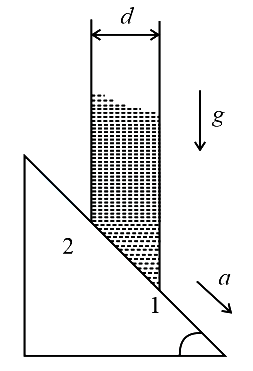
- A cylindrical tube, with its base as shown in the figure., is filled with water. It is moving down with a constant acceleration along a fixed inclined plane with angle . and are pressures at point and , respectively, located at the base of the tube. Let , where is density of water, is the inner diameter of the tube and is the acceleration due to gravity. Which of the following statement(s) is (are) correct?
 JEE Advanced 2021 Hard
 - The total number of real solutions of the equation \(\theta=\tan ^{-1}(2 \tan \theta)-\frac{1}{2} \sin ^{-1}\left(\frac{6 \tan \theta}{9+\tan ^2 \theta}\right)\) is (Here, the inverse trigonometric functions \(\sin ^{-1} x\) and \(\tan ^{-1} x\) assume values in \(\left[-\frac{\pi}{2}, \frac{\pi}{2}\right]\) and \(\left(-\frac{\pi}{2}, \frac{\pi}{2}\right)\), respectively.)JEE Advanced 2025 Easy
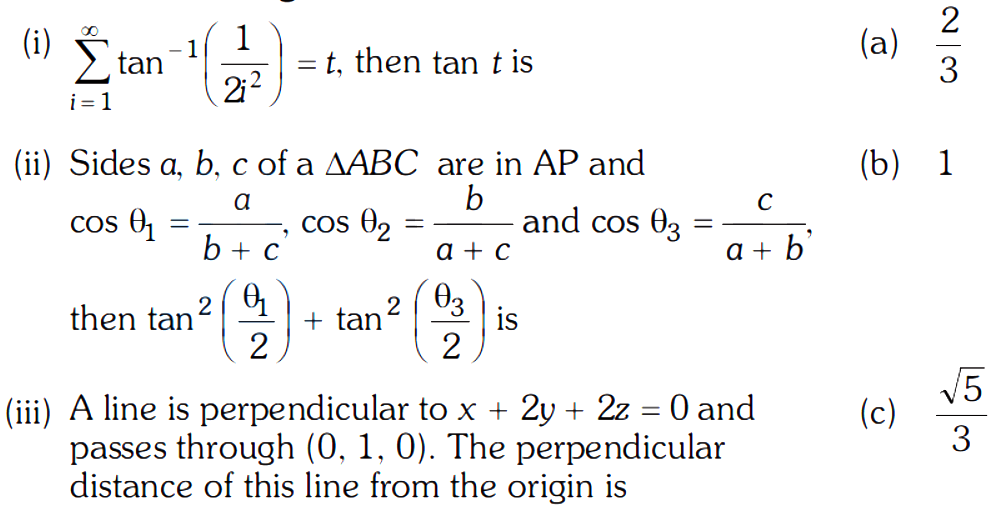
- Match the following.
 JEE Advanced 2006 Medium
 - Let \(\alpha\) and \(\beta\) be the roots of \(x^2-6 x-2=0\) with \(\alpha>\beta\). If \(a_n=\alpha^n-\beta^n\) for \(n \geq 1\), then the value of \(\frac{a_{10}-2 a_8}{2 a_9}\) isJEE Advanced 2011 Medium