


JEE Advanced · Mathematics · 2. Quadratic Equations
Let \(\alpha\) and \(\beta\) be the roots of \(x^2-6 x-2=0\) with \(\alpha>\beta\). If \(a_n=\alpha^n-\beta^n\) for \(n \geq 1\), then the value of \(\frac{a_{10}-2 a_8}{2 a_9}\) is
- A 1
- B 2
- C 3
- D 4
Answer & Solution
Correct Answer
(C) 3
Step-by-step Solution
Detailed explanation
\(\frac{a_{10}-2 a_8}{2 a_9}=\frac{\left(\alpha^{10}-\beta^{10}\right)-2\left(\alpha^8-\beta^8\right)}{2\left(\alpha^9-\beta^9\right)}\) \(=\frac{\alpha^8\left(\alpha^2-2\right)-\beta^8\left(\beta^2-2\right)}{2\left(\alpha^9-\beta^9\right)}\) \(\left[\because \alpha\right.\) is root of \(x^2-6 x-2=0\) \(\left.\alpha^2-2=6 \alpha\right]\)
Also, \(\beta\) is root of \(x^2-6 x-2=0\)
\(\Rightarrow \beta^2-2=6 \beta \)
\( =\frac{\alpha^8(6 \alpha)-\beta^8(6 \beta)}{2\left(\alpha^9-\beta^9\right)}=\frac{6\left(\alpha^9-\beta^9\right)}{2\left(\alpha^9-\beta^9\right)}=3\)
Also, \(\beta\) is root of \(x^2-6 x-2=0\)
\(\Rightarrow \beta^2-2=6 \beta \)
\( =\frac{\alpha^8(6 \alpha)-\beta^8(6 \beta)}{2\left(\alpha^9-\beta^9\right)}=\frac{6\left(\alpha^9-\beta^9\right)}{2\left(\alpha^9-\beta^9\right)}=3\)
See the Complete Solution
Get step-by-step explanations for this and 2.5 Lakh+ more JEE, NEET & CET questions.
- Unlock all solutions
- Practice the full chapter
- Track accuracy across PYQs
4.8 rated on Google Play · 14,000+ reviews
More questions from Mathematics
- Let and be the roots of with For all positive integers define
and
Then which of the following options is/are correct?JEE Advanced 2019 Hard - Let be positive integers such that . Then the number of such distinct arrangements is _________JEE Advanced 2014 Hard
- The common tangents to the circle and the parabola touch the circle at the points P, and Q the parabola at the points R, S. Then the area of the quadrilateral PQRS isJEE Advanced 2014 Easy
- Let \(\alpha(a)\) and \(\beta(a)\) be the roots of the equation \((\sqrt[3]{1+a}-1) x^{2}+(\sqrt{1+a}-1) x+(\sqrt[6]{1+a}-1)=0\) where \(a\) \(>-1\). Then \(\lim _{a \rightarrow 0^{+}} \alpha(a)\) and \(\lim _{x \rightarrow 0^{+}} \beta(a)\) areJEE Advanced 2012 Medium
- Let be a triangle. Let If and then which of the following is (are) true ?JEE Advanced 2015 Medium
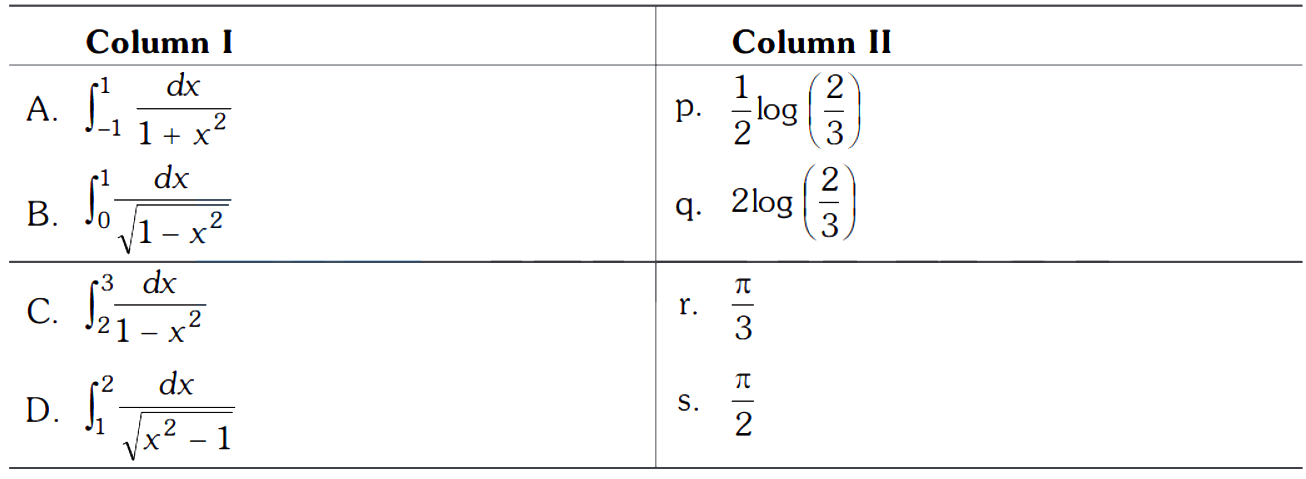
- Match the integrals in Column I with the values in Column II.
 JEE Advanced 2007 Medium
More PYQs from JEE Advanced
- Paragraph:
The hydrogen-like species \(\mathrm{Li}^{2+}\) is in a spherically symmetric state \(S_1\) with one radial node. Upon absorbing light the ion undergoes transition to a state \(S_2\). The state \(S_2\) has one radial node and its energy is equal to the ground state energy of the hydrogen atom.
Question:
The orbtial angular momentum quantum number of the state \(S_2\) isJEE Advanced 2010 Medium - The electrochemical cell shown below is a concentration cell. \(\mathrm{M} \mid \mathrm{M}^{2+}\) (saturated solution of a sparingly soluble salt, \(\left.\mathrm{MX}_{2}\right) \| \mathrm{M}^{2 \perp}\left(0.001 \mathrm{~mol} \mathrm{dm}^{-3}\right) \mid \mathrm{M}\).
The emf of the cell depends on the difference in concentrations of \(\mathrm{M}^{2+}\) ions at the two electrodes. The emf of the cell at \(298 \mathrm{~K}\) is \(0.059 \mathrm{~V}\).
Question:
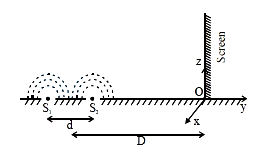
The solubility product \(\left(\mathrm{K}_{s p} ; \mathrm{mol}^{3} \mathrm{dm}^{-9}\right)\) of \(\mathrm{MX}_{2}\) at \(298 \mathrm{~K}\) based on the information available for the given concentration cell is (take \(2.303 \times \mathrm{R} \times 298 / \mathrm{F}=0.059 \mathrm{~V}\) )JEE Advanced 2012 Medium - While conducting the Young's double slit experiment, a student replaced the two slits with a large opaque plate in the x-y plane containing two small holes that act as two coherent point sources emitting light of wavelength 600 nm. The student mistakenly placed the screen parallel to the x-z plane (for z > 0) at a distance D = 3m from the mid-point of , as shown schematically in the figure. The distance between the sources d = 0.6003 mm. The origin O is at the intersection of the screen and the line joining . Which of the following is (are) true of the intensity pattern on the screen?
 JEE Advanced 2016 Medium
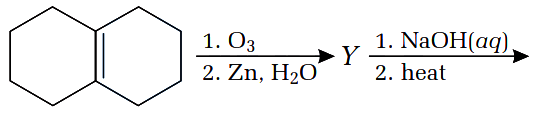
 - In the scheme given below, the total number of intramolecular aldol condensation products formed from ' \(Y\) ' is
 JEE Advanced 2010 Hard
 - Paragraph:
When a particle is restricted to move along \(x\)-axis between \(x=0\) and \(x=a\), where \(a\) is of nanometer dimension, its energy can take only certain specific values. The allowed energies of the particle moving in such a restricted region, correspond to the formation of standing waves with nodes at its ends \(x=0\) and \(x=a\). The wavelength of this standing wave is related to the liner momentum \(p\) of the particle according to the de Broglie relation. The energy of the particle of mass \(m\) is related to its linear momentum as \(E=\frac{p^2}{2 m}\). Thus, the energy of the particle can be denoted by a quantum number \(n\) taking values \(1,2,3, \ldots(n=1\), called the ground state) corresponding to the number of loops in the standing wave.
Use the model described above to answer the following three questions for a particle moving in the line \(x=0\) to \(x=a\) [Take \(h=6.6 \times 10^{-34} \mathrm{Js}\) and \(e=1.6 \times 10^{-19} \mathrm{C}\) ]
Question:
If the mass of the particle is \(m=1.0 \times 10^{-30} \mathrm{~kg}\) and \(a=6.6 \mathrm{~nm}\), the energy of the particle in its ground state is closest toJEE Advanced 2009 Medium - Statement I Alkali metals dissolve in liquid ammonia to give blue solutions. Statement II Alkali metals in liquid ammonia give solvated species of the type \(\left(M\left(\mathrm{NH}_3\right)_n\right]^{+}(M=\) alkali metals \()\).JEE Advanced 2007 Hard