


JEE Advanced · Mathematics · 17. Properties of Triangles
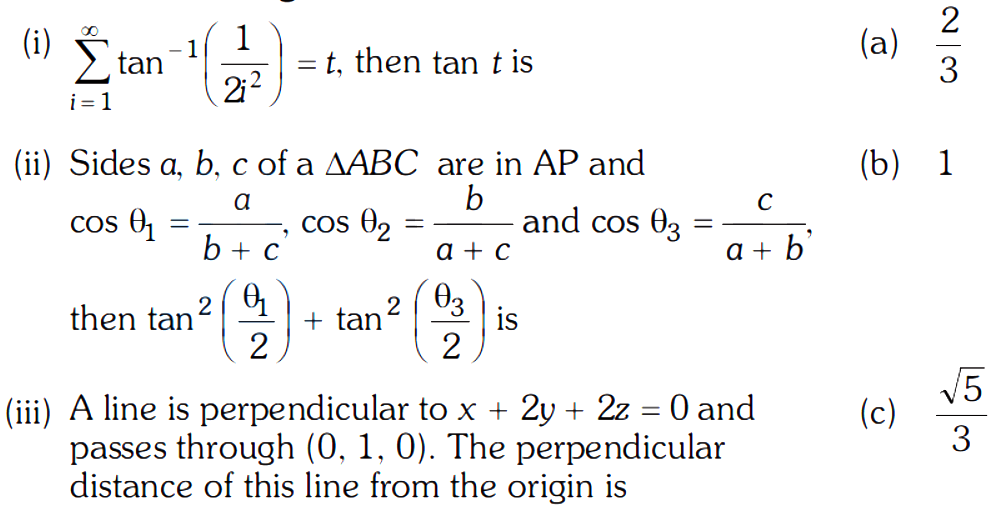
Match the following.
- A
(i) (a), (ii) (b), (iii) (c)
- B
(i) (b), (ii) (a), (iii) (c)
- C
(i) (a), (ii) (c), (iii) (b)
- D
(i) (b), (ii) (c), (iii) (a)
Answer & Solution
Correct Answer
(B)
(i) (b), (ii) (a), (iii) (c)
Step-by-step Solution
Detailed explanation
\[
\begin{aligned}
& \text { (i) } \sum_{i=1}^{\infty} \tan ^{-1}\left(\frac{1}{2 i^2}\right)=t \Rightarrow \sum_{i=1}^{\infty} \tan ^{-1}\left(\frac{2}{4 i^2-1+1}\right) \\
& \Rightarrow \sum_{i=1}^{\infty} \tan ^{-1}\left\{\frac{(2 i+1)-(2 i-1)}{1+(2 i-1)(2 i+1)}\right\} \\
& \Rightarrow\left(\tan ^{-1} 3-\tan ^{-1} 1\right)+\left(\tan ^{-1} 5-\tan ^{-1} 3\right)+\ldots+\left\{\tan ^{-1}(2 n+1)-\tan ^{-1}(2 n-1)\right\} \\
& \therefore \quad \quad t=\lim _{n \rightarrow \infty}\left(\tan ^{-1}(2 n+1)-\tan ^{-1} 1\right)=\lim _{n \rightarrow \infty} \tan ^{-1}\left(\frac{2 n}{1+2 n+1}\right)=\frac{\pi}{4} \\
& \therefore \quad \tan t=1 .
\end{aligned}
\]
(ii) We have, \(\cos \theta_1=\frac{1-\tan ^2 \frac{\theta_1}{2}}{1+\tan ^2 \frac{\theta_2}{2}}=\frac{a}{b+c}\)
\[
\Rightarrow \quad \tan ^2 \frac{\theta}{2}=\frac{b+c-a}{b+c+a}
\]
Also, \(\quad \cos \theta_3=\frac{1-\tan ^2 \frac{\theta_3}{2}}{1+\tan ^2 \frac{\theta_3}{2}}=\frac{c}{a+b}\)
\[
\Rightarrow \quad \tan ^2 \frac{\theta_3}{2}=\frac{a+b-c}{a+b+c}
\]
\(\Rightarrow \tan ^2 \frac{\theta_1}{2}+\tan ^2 \frac{\theta_3}{2}=\frac{2 b}{a+b+c}=\frac{2 b}{3 b}=\frac{2}{3}, \quad\) [as, \(a, b, c\) are in AP \(\Rightarrow 2 b=a+c\) ]
(iii) Line through \((0,1,0)\) and perpendicular to plane \(x+2 y+2 z=0\) is given by \(\frac{x-0}{1}=\frac{y-1}{2}=\frac{z-0}{2}=r\)
\(\therefore P(r, 2 r+1,2 r)\) be the foot of perpendicular on the straight line, then
\[
\begin{array}{ll}
& r \cdot 1+(2 r+1) \cdot 2+(2 r) \cdot 2=0 \\
\Rightarrow \quad r= & \quad r\left(-\frac{2}{9}, \frac{5}{9},-\frac{4}{9}\right) \\
\therefore & \quad P(r) \\
\therefore & \text { Required perpendicular distance }=\sqrt{\frac{4+25+16}{81}}=\frac{\sqrt{5}}{3} \text { unit. }
\end{array}
\]
\begin{aligned}
& \text { (i) } \sum_{i=1}^{\infty} \tan ^{-1}\left(\frac{1}{2 i^2}\right)=t \Rightarrow \sum_{i=1}^{\infty} \tan ^{-1}\left(\frac{2}{4 i^2-1+1}\right) \\
& \Rightarrow \sum_{i=1}^{\infty} \tan ^{-1}\left\{\frac{(2 i+1)-(2 i-1)}{1+(2 i-1)(2 i+1)}\right\} \\
& \Rightarrow\left(\tan ^{-1} 3-\tan ^{-1} 1\right)+\left(\tan ^{-1} 5-\tan ^{-1} 3\right)+\ldots+\left\{\tan ^{-1}(2 n+1)-\tan ^{-1}(2 n-1)\right\} \\
& \therefore \quad \quad t=\lim _{n \rightarrow \infty}\left(\tan ^{-1}(2 n+1)-\tan ^{-1} 1\right)=\lim _{n \rightarrow \infty} \tan ^{-1}\left(\frac{2 n}{1+2 n+1}\right)=\frac{\pi}{4} \\
& \therefore \quad \tan t=1 .
\end{aligned}
\]
(ii) We have, \(\cos \theta_1=\frac{1-\tan ^2 \frac{\theta_1}{2}}{1+\tan ^2 \frac{\theta_2}{2}}=\frac{a}{b+c}\)
\[
\Rightarrow \quad \tan ^2 \frac{\theta}{2}=\frac{b+c-a}{b+c+a}
\]
Also, \(\quad \cos \theta_3=\frac{1-\tan ^2 \frac{\theta_3}{2}}{1+\tan ^2 \frac{\theta_3}{2}}=\frac{c}{a+b}\)
\[
\Rightarrow \quad \tan ^2 \frac{\theta_3}{2}=\frac{a+b-c}{a+b+c}
\]
\(\Rightarrow \tan ^2 \frac{\theta_1}{2}+\tan ^2 \frac{\theta_3}{2}=\frac{2 b}{a+b+c}=\frac{2 b}{3 b}=\frac{2}{3}, \quad\) [as, \(a, b, c\) are in AP \(\Rightarrow 2 b=a+c\) ]
(iii) Line through \((0,1,0)\) and perpendicular to plane \(x+2 y+2 z=0\) is given by \(\frac{x-0}{1}=\frac{y-1}{2}=\frac{z-0}{2}=r\)
\(\therefore P(r, 2 r+1,2 r)\) be the foot of perpendicular on the straight line, then
\[
\begin{array}{ll}
& r \cdot 1+(2 r+1) \cdot 2+(2 r) \cdot 2=0 \\
\Rightarrow \quad r= & \quad r\left(-\frac{2}{9}, \frac{5}{9},-\frac{4}{9}\right) \\
\therefore & \quad P(r) \\
\therefore & \text { Required perpendicular distance }=\sqrt{\frac{4+25+16}{81}}=\frac{\sqrt{5}}{3} \text { unit. }
\end{array}
\]
See the Complete Solution
Get step-by-step explanations for this and 2.5 Lakh+ more JEE, NEET & CET questions.
- Unlock all solutions
- Practice the full chapter
- Track accuracy across PYQs
4.8 rated on Google Play · 14,000+ reviews
More questions from Mathematics
- Three boys and two girls stand in a queue. The probability that the number of boys ahead of every girl is atleast one more than the number of girls ahead of her isJEE Advanced 2014 Easy
- Let denote the number of elements in set Let be a sample space, where each element is equally likely to occur. If and are independent events associated with then the number of ordered pairs such that equalsJEE Advanced 2019 Hard
- Let . Let be the function defined by . Then, which of the following statements is/are TRUE?JEE Advanced 2022 Hard
- Let \(\mathbb{R}^2\) denote \(\mathbb{R} \times \mathbb{R}\). Let \(S=\left\{(a, b, c): a, b, c \in \mathbb{R} \text { and } a x^2+2 b x y+c y^2>0 \text { for all }(x, y) \in \mathbb{R}^2-\{(0,0)\}\right\} .\)
Then which of the following statements is (are) TRUE?JEE Advanced 2024 Easy - Let be the sample space of all matrices with entries from the set Let the events and be given by
and
sum of entries of is
If a matrix is chosen at random from then the conditional probability equals____JEE Advanced 2019 Medium - Two players, and , play a game against each other. In every round of the game, each player rolls a fair die once, where the six faces of the die have six distinct numbers. Let and denote the readings on the die rolled by and , respectively. If , then scores points and scores point. If , then each player scores points. If , then scores point and scores points. Let and be the total scores of and , respectively, after playing the round.
The correct option is:List- List- Probability of is Probability of is Probability of is Probability of is JEE Advanced 2022 Hard
More PYQs from JEE Advanced
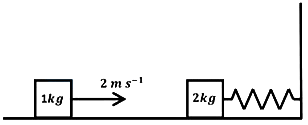
- A spring - block system is resting on a frictionless floor as shown in the figure. The spring constant is and the mass of the block is . Ignore the mass of the spring. Initially the spring is in an unstretched condition. Another block of mass 1.0kg moving with a speed of collides elastically with the first block. The collision is such that the 2.0kg block does not hit the wall. The distance, in metres, between the two blocks when the spring returns to its unstretched position for the first time after the collision is _________.
 JEE Advanced 2018 Medium
 - Statement 1 There is a natural asymmetry between converting work to heat and converting heat to work.
Statement 2 No process is possible in which the sole result in the absorption of heat from a reservoir and its complete conversion into work.JEE Advanced 2008 Hard - At the reaction of with produces a xenon compound The total number of lone pair(s) of electrons present on the whole molecule of is __________JEE Advanced 2019 Medium
- Let and be twice differentiable functions such that and are continuous functions on . Suppose and thenJEE Advanced 2016 Medium
- The integral \(\int \frac{\sec ^{2} x}{(\sec x+\tan x)^{\frac{9}{2}}} d x\) equals (for some arbitrary constant \(\mathrm{K}\) )JEE Advanced 2012 Hard
- Considering only the principal values of the inverse trigonometric functions, the value of \(\tan \left(\sin ^{-1}\left(\frac{3}{5}\right)-2 \cos ^{-1}\left(\frac{2}{\sqrt{5}}\right)\right)\) isJEE Advanced 2024 Easy