


JEE Advanced · Mathematics · 31. 3D Geometry
Let \(\mathbb{R}^3\) denote the three-dimensional space. Take two points \(P=(1,2,3)\) and \(Q=(4,2,7)\). Let \(\operatorname{dist}(X, Y)\) denote the distance between two points \(X\) and \(Y\) in \(\mathbb{R}^3\). Let
\(\begin{gathered}S=\left\{X \in \mathbb{R}^3:(\operatorname{dist}(X, P))^2-(\operatorname{dist}(X, Q))^2=50\right\} \text { and } \\T=\left\{Y \in \mathbb{R}^3:(\operatorname{dist}(Y, Q))^2-(\operatorname{dist}(Y, P))^2=50\right\} .\end{gathered}\)
Then which of the following statements is (are) TRUE?
- A There is a triangle whose area is 1 and all of whose vertices are from \(S\).
- B There are two distinct points \(L\) and \(M\) in \(T\) such that each point on the line segment \(L M\) is also in \(T\).
- C There are infinitely many rectangles of perimeter 48 , two of whose vertices are from \(S\) and the other two vertices are from \(T\).
- D There is a square of perimeter 48 , two of whose vertices are from \(S\) and the other two vertices are from \(T\).
Answer & Solution
Correct Answer
(A) There is a triangle whose area is 1 and all of whose vertices are from \(S\).
Step-by-step Solution
Detailed explanation
\(\begin{aligned}& \mathrm{S}=\left\{\mathrm{X}:(\mathrm{XP})^2-(\mathrm{XQ})^2=50\right\} \\& \mathrm{T}=\left\{\mathrm{Y}:(\mathrm{YQ})^2-(\mathrm{YP})^2=50\right\}\end{aligned}\)
for finding \(S \equiv X(x, y, z)\) and for \(T \equiv Y(x, y, z)\)
\(\begin{aligned}&\left((x-1)^2+(y-1)^2+(\mathrm{z}-1)^2\right)-\left((\mathrm{x}-4)^2+(\mathrm{y}-2)^2+(\mathrm{z}-7)^2\right)=50 \\& \Rightarrow \quad \mathrm{S}=\{(\mathrm{x}, \mathrm{y}, \mathrm{z}): 6 \mathrm{x}+8 \mathrm{z}=105\} \\& \mathrm{T}=\{(\mathrm{x}, \mathrm{y}, \mathrm{z}): 6 \mathrm{x}+8 \mathrm{z}=5\}\end{aligned}\)
Since \(\mathrm{S}\) and \(\mathrm{T}\) both are plane ;
(1) There exist a triangle in plane \(\mathrm{S}\) whose area \(=1\) (always)
(2) \(\mathrm{L} ~\&~ \mathrm{M}\) lies on plane \(\mathrm{T}\), hence line segment joining \(\mathrm{L} \& \mathrm{M}\) will lie on plane \(\mathrm{T}\).
(3) Distance between \(\mathrm{S} \& \mathrm{~T}\)
\(\mathrm{d}=\left|\frac{105-5}{10}\right|=10\)
Hence for rectangle of perimeter 48 can exist.
(4) For Square
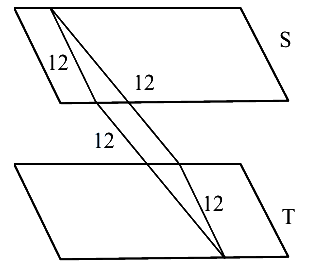
There will be infinite such rectangle possible.
Hence Answers 1,2,3,4 are correct.
for finding \(S \equiv X(x, y, z)\) and for \(T \equiv Y(x, y, z)\)
\(\begin{aligned}&\left((x-1)^2+(y-1)^2+(\mathrm{z}-1)^2\right)-\left((\mathrm{x}-4)^2+(\mathrm{y}-2)^2+(\mathrm{z}-7)^2\right)=50 \\& \Rightarrow \quad \mathrm{S}=\{(\mathrm{x}, \mathrm{y}, \mathrm{z}): 6 \mathrm{x}+8 \mathrm{z}=105\} \\& \mathrm{T}=\{(\mathrm{x}, \mathrm{y}, \mathrm{z}): 6 \mathrm{x}+8 \mathrm{z}=5\}\end{aligned}\)
Since \(\mathrm{S}\) and \(\mathrm{T}\) both are plane ;
(1) There exist a triangle in plane \(\mathrm{S}\) whose area \(=1\) (always)
(2) \(\mathrm{L} ~\&~ \mathrm{M}\) lies on plane \(\mathrm{T}\), hence line segment joining \(\mathrm{L} \& \mathrm{M}\) will lie on plane \(\mathrm{T}\).
(3) Distance between \(\mathrm{S} \& \mathrm{~T}\)
\(\mathrm{d}=\left|\frac{105-5}{10}\right|=10\)
Hence for rectangle of perimeter 48 can exist.
(4) For Square
There will be infinite such rectangle possible.
Hence Answers 1,2,3,4 are correct.
See the Complete Solution
Get step-by-step explanations for this and 2.5 Lakh+ more JEE, NEET & CET questions.
- Unlock all solutions
- Practice the full chapter
- Track accuracy across PYQs
4.8 rated on Google Play · 14,000+ reviews
More questions from Mathematics
- Let denote the set of all the terms of an infinite arithmetic progression with first term a and common difference If then equals ____JEE Advanced 2019 Medium
- Equation of common tangent of \(y=x^2, y=-x^2+4 x-4\) isJEE Advanced 2006 Medium
- For a complex number , let denote the real part of . Let be the set of all complex numbers satisfying where . Then the minimum possible value of where with and is _______JEE Advanced 2020 Medium
- Let be a continuous odd function, which vanishes exactly at one point and Suppose that for all and for all If then the value of isJEE Advanced 2015 Medium
- Let \(z_1\) and \(z_2\) be two distinct complex numbers and let \(z=(1-t) z_1+t z_2\) for some real number \(t\) with \(0 < t < 1\). If \(\arg (w)\) denotes the principal argument of a non-zero complex number \(w\), thenJEE Advanced 2010 Hard
- Perpendiculars are drawn from points on the line to the plane . The feet of perpendiculars lie on the lineJEE Advanced 2013 Easy
More PYQs from JEE Advanced
- For a double strand DNA, one strand is given below:

The amount of energy required to split the double strand DNA into two single strands is _______ kcal \(\mathrm{mol}^{-1}.\)
[Given: Average energy per \(\mathrm{H}\)-bond for A-T base pair \(=1.0 \mathrm{kcal} \mathrm{mol}^{-1}, \mathrm{G}-\mathrm{C}\) base pair \(=1.5 \mathrm{kcal}\) \(\mathrm{mol}^{-1}\), and A-U base pair \(=1.25 \mathrm{kcal} \mathrm{mol}^{-1}.\) Ignore electrostatic repulsion between the phosphate groups.]JEE Advanced 2024 Hard - Four combinations of two thin lenses are given in List I. The radius of curvature of all curved surfaces is r and the refractive index of all the lenses is 1.5. Match lens combinations in List I with their focal length in List II and select the correct answer using the code given below the lists.
List I List II A. 
B. 
C. 
D. 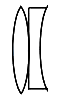 JEE Advanced 2014 Medium
 - The function has a local minimum or a local maximum atJEE Advanced 2013 Hard
- Consider one mole of helium gas enclosed in a container at initial pressure and volume . It expands isothermally to volume . After this, the gas expands adiabatically and its volume becomes . The work done by the gas during isothermal and adiabatic expansion processes are and , then is _________ .JEE Advanced 2020 Medium
- The total number of ways in which 5 balls of different colours can be distributed among 3 persons so that each person gets at least one ball isJEE Advanced 2012 Hard
- A student performed the experiment to measure the speed of sound in air using resonance air-column method. Two resonances in the air-column were obtained by lowering the water level. The resonance with the shorter air-column is the first resonance and that with the longer air column is the second resonance. Then,JEE Advanced 2009 Medium