


JEE Advanced · Mathematics · 25. AOD
Let \(\mathbb{R}\) denote the set of all real numbers. Define the function \(f: \mathbb{R \rightarrow \mathbb { R }}\) by
\(f(\mathrm{x})=\left\{\begin{array}{cc}2-2 x^2-x^2 \sin \frac{1}{x} & \text { if } x \neq 0 \\ 2 & \text { if } x=0\end{array}\right.\)
Then which one of the following statements is TRUE ?
- A \(\text { The function } f \text { is NOT differentiable at } x=0\)
- B There is a positive real number \(\delta\), such that \(f\) is a decreasing function on the interval \((0, \delta)\)
- C For any positive real number \(\delta\), the function \(f\) is NOT an increasing function on the interval \((-\delta, 0)\)
- D \(x=0\) is a point of local minima of \(f\)
Answer & Solution
Correct Answer
(C) For any positive real number \(\delta\), the function \(f\) is NOT an increasing function on the interval \((-\delta, 0)\)
Step-by-step Solution
Detailed explanation
(A)
RHD at \(x=0: \lim _{h \rightarrow 0} \frac{\left(2-2 h^2-h^2 \sin \frac{1}{h}\right)-2}{h}=0\)
Similarly LHD at \(\mathrm{x}=0\) is also equal to 0 .
\(\therefore\) Differentiable at \(\mathrm{x}=0\)
(B) \(f^{\prime}(x)=-4 x-2 x \sin \frac{1}{x}-x^2\left(\cos \frac{1}{x}\right)\left(\frac{-1}{x^2}\right)\)
\(\begin{aligned}
& f^{\prime}(x)=-\left(4 x+2 x \sin \frac{1}{x}\right)+\cos \frac{1}{x} \\
& f^{\prime}(x)=-\left(2 x\left(4-\sin \frac{1}{x}\right)\right)+\cos \frac{1}{x}
\end{aligned}\)
for \(\mathrm{x} \in(0, \delta)\)
\(\Rightarrow\) We can't say \(f(x)\) is decreasing on \((0, \delta)\) as \(\cos \frac{1}{x}\) oscillates.
(C) for \(x \in(-\delta, 0)\), for any \(\delta>0\)
\(\Rightarrow f(x)\) is not increasing on \((-\delta, 0)\) as \(\cos \frac{1}{x}\) oscillates from -1 to 1.
(D) \(f(0)=2\)
\(\begin{aligned}
& f(0+h) <2 \\
& f(0-h) <2
\end{aligned}\)
\(\therefore \mathrm{x}=0\) is local maxima
RHD at \(x=0: \lim _{h \rightarrow 0} \frac{\left(2-2 h^2-h^2 \sin \frac{1}{h}\right)-2}{h}=0\)
Similarly LHD at \(\mathrm{x}=0\) is also equal to 0 .
\(\therefore\) Differentiable at \(\mathrm{x}=0\)
(B) \(f^{\prime}(x)=-4 x-2 x \sin \frac{1}{x}-x^2\left(\cos \frac{1}{x}\right)\left(\frac{-1}{x^2}\right)\)
\(\begin{aligned}
& f^{\prime}(x)=-\left(4 x+2 x \sin \frac{1}{x}\right)+\cos \frac{1}{x} \\
& f^{\prime}(x)=-\left(2 x\left(4-\sin \frac{1}{x}\right)\right)+\cos \frac{1}{x}
\end{aligned}\)
for \(\mathrm{x} \in(0, \delta)\)
\(\Rightarrow\) We can't say \(f(x)\) is decreasing on \((0, \delta)\) as \(\cos \frac{1}{x}\) oscillates.
(C) for \(x \in(-\delta, 0)\), for any \(\delta>0\)
\(\Rightarrow f(x)\) is not increasing on \((-\delta, 0)\) as \(\cos \frac{1}{x}\) oscillates from -1 to 1.
(D) \(f(0)=2\)
\(\begin{aligned}
& f(0+h) <2 \\
& f(0-h) <2
\end{aligned}\)
\(\therefore \mathrm{x}=0\) is local maxima
See the Complete Solution
Get step-by-step explanations for this and 2.5 Lakh+ more JEE, NEET & CET questions.
- Unlock all solutions
- Practice the full chapter
- Track accuracy across PYQs
4.8 rated on Google Play · 14,000+ reviews
More questions from Mathematics
- If the angles \(A, B\) and \(C\) of a triangle are in an arithmetic progression and if \(a, b\) and \(c\) denote the lengths of the sides opposite to \(A, B\) and \(C\) respectively, then the value of the expression \(\frac{a}{c} \sin 2 C+\frac{c}{a} \sin 2 A\) isJEE Advanced 2010 Medium
- Let be a function which is continuous on and is differentiable on . Let for If for all then equalsJEE Advanced 2014 Easy
- An ellipse intersects the hyperbola \(2 x^2-2 y^2=1\) orthogonally. The eccentricity of the ellipse is reciprocal to that of the hyperbola. If the axes of the ellipse are along the coordinate axes, thenJEE Advanced 2009 Hard
- Let be a circle of radius . Let be circles of equal radius . Suppose each of the circles touches the circle externally. Also, for , the circle touches externally, and touches externally. Then, which of the following statements is/are TRUE?JEE Advanced 2022 Easy
- Let \(f(x)\) be a continuously differentiable function on the interval \((0, \infty)\) such that \(f(1)=2\) and \(\underset{t \rightarrow x}{\lim} \frac{t^{10} f(x)-x^{10} f(t)}{t^9-x^9}=1\) for each \(x>0\). Then, for all \(x>0, f(x)\) is equal toJEE Advanced 2024 Medium
- Let \(P(3,2,6)\) be a point in space and \(Q\) be a point on the line \(\mathbf{r}=(\hat{\mathbf{i}}-\hat{\mathbf{j}}+2 \hat{\mathbf{k}})+\mu(-3 \hat{\mathbf{i}}+\hat{\mathbf{j}}+5 \hat{\mathbf{k}})\).
Then, the value of \(\mu\) for which the vector \(\mathbf{P Q}\) is parallel to the plane \(x-4 y+3 z=1\) isJEE Advanced 2009 Medium
More PYQs from JEE Advanced
- If the function \(f(x)=x^3+e^{\frac{x}{2}}\) and \(g(x)=f^{-1}(x)\), then the value of \(g^{\prime}(1)\) isJEE Advanced 2009 Easy
- A charged particle is introduced at the origin with a given initial velocity . A uniform electric field and a uniform magnetic field exist everywhere. The velocity , electric field and a uniform magnetic field are given in the columns below
In which case would the particle move in a straight line along the negative direction of y axisColumn 1 Column 2 Column 3 1. Electron with (i) (P) 2. Electron with (ii) (Q) 3.Proton with =0 (iii) (R) 4. Proton with (iv) (S) JEE Advanced 2017 Medium - The image of an object, formed by a plano - convex lens at a distance of 8 m behind the lens, is real and is one-third the size of the object. The wavelength of light inside the lens is times the wavelength in free space. The radius of the curved surface of the lens isJEE Advanced 2013 Medium
- The correct statement(s) concerning the structures E, F and G is are
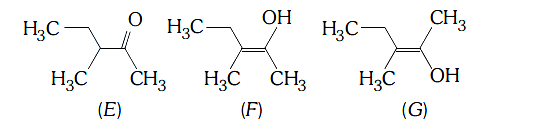 JEE Advanced 2008 Easy
 - Let and . Suppose where If and then lies onJEE Advanced 2016 Medium
- If \(r, s, t\) are prime numbers and \(p, q\) are the positive integers such that LCM of \(p, q\) is \(r^2 s^4 t^2\), then the number of ordered pairs \((p, q)\) isJEE Advanced 2006 Hard