


JEE Advanced · Mathematics · 14. Ellipse
An ellipse intersects the hyperbola \(2 x^2-2 y^2=1\) orthogonally. The eccentricity of the ellipse is reciprocal to that of the hyperbola. If the axes of the ellipse are along the coordinate axes, then
- A
equation of ellipse is \(x^2+2 y^2=2\)
- B
the foci of ellipse are \((\pm 1,0)\)
- C
equation of ellipse is \(x^2+2 y^2=4\)
- D
the foci of ellipse are \((\pm \sqrt{2}, 0)\)
Answer & Solution
Correct Answer
(B)
the foci of ellipse are \((\pm 1,0)\)
Step-by-step Solution
Detailed explanation
Given, \(2 x^2-2 y^2=1\)
\[
\Rightarrow \quad \frac{x^2}{\left(\frac{1}{2}\right)}-\frac{y^2}{\left(\frac{1}{2}\right)}=1
\]
Eccentricity of hyperbola \(=\sqrt{2}\)
So, eccentricity of ellipse \(=1 / \sqrt{2}\)
Let equation of ellipse be
\[
\begin{aligned}
& \frac{x^2}{a^2}+\frac{y^2}{b^2}=1(a>b) \Rightarrow \frac{1}{\sqrt{2}}=\sqrt{1-\frac{b^2}{a^2}} \\
& \Rightarrow \quad \frac{b^2}{a^2}=\frac{1}{2} \Rightarrow a^2=2 b^2 \\
& \therefore \quad x^2+2 y^2=2 b^2 \\
&
\end{aligned}
\]
Let ellipse and hyperbola intersect at
\[
A\left(\frac{1}{\sqrt{2}} \sec \theta, \frac{1}{\sqrt{2}} \tan \theta\right)
\]
On differentiating Eq. (i),
\[
4 x-4 y \frac{d y}{d x}=0 \Rightarrow \frac{d y}{d x}=\frac{x}{y}
\]
\[
\therefore \quad\left(\frac{d y}{d x}\right)_{\text {at } A}=\frac{\sec \theta}{\tan \theta}=\operatorname{cosec} \theta
\]
On differentiating Eq. (ii),
\[
2 x+4 y \frac{d y}{d x}=0
\]
\[
\therefore \quad\left(\frac{d y}{d x}\right)_{\text {at } A}=-\frac{x}{2 y}=-\frac{1}{2} \operatorname{cosec} \theta
\]
Since, ellipse and hyperbola are orthogonal.
\[
\begin{aligned}
& \therefore \quad-\frac{1}{2} \operatorname{cosec}^2 \theta=-1 \\
& \Rightarrow \quad \operatorname{cosec}^2 \theta=2 \Rightarrow \theta=\pm \frac{\pi}{4} \\
& \therefore A\left(1, \frac{1}{\sqrt{2}}\right) \text { or }\left(1,-\frac{1}{\sqrt{2}}\right)
\end{aligned}
\]
From Eq. (i), \(1+2\left(\frac{1}{\sqrt{2}}\right)^2=2 b^2\) \(\Rightarrow \quad b^2=1\)
Equation of ellipse is \(x^2+2 y^2=2\)
Coordinate of foci \((\pm a e, 0)\)
\[
=\left(\pm \sqrt{2} \cdot \frac{1}{\sqrt{2}}, 0\right)=(\pm 1,0)
\]
Hence, options (a) and (b) are correct. If major axis is along \(Y\)-axis, then
\[
\begin{aligned}
& \frac{1}{\sqrt{2}}=\sqrt{1-\frac{a^2}{b^2}} \Rightarrow b^2=2 a^2 \\
& \therefore 2 x^2+y^2=2 a^2 \Rightarrow y^{\prime}=-\frac{2 x}{y} \\
& \Rightarrow \quad y^{\prime}\left(\frac{1}{\sqrt{2}} \sec \theta \frac{1}{\sqrt{2}} \tan \theta\right)=\frac{-2}{\sin \theta} \\
&
\end{aligned}
\]
As ellipse and hyperbola are orthogonal.
\[
\begin{array}{ll}
\therefore & -\frac{2}{\sin \theta} \cdot \operatorname{cosec} \theta=-1 \\
\Rightarrow & \operatorname{cosec}^2 \theta=1 \Rightarrow \theta=\pm \frac{\pi}{4} \\
\therefore & 2 x^2+y^2=2 a^2 \Rightarrow 2+\frac{1}{2}=2 a^2 \\
\Rightarrow & a^2=\frac{5}{4} \Rightarrow 2 x^2+y^2=\frac{5}{2}
\end{array}
\]
Corresponding foci are \((0, \pm 1)\).
\[
\Rightarrow \quad \frac{x^2}{\left(\frac{1}{2}\right)}-\frac{y^2}{\left(\frac{1}{2}\right)}=1
\]
Eccentricity of hyperbola \(=\sqrt{2}\)
So, eccentricity of ellipse \(=1 / \sqrt{2}\)
Let equation of ellipse be
\[
\begin{aligned}
& \frac{x^2}{a^2}+\frac{y^2}{b^2}=1(a>b) \Rightarrow \frac{1}{\sqrt{2}}=\sqrt{1-\frac{b^2}{a^2}} \\
& \Rightarrow \quad \frac{b^2}{a^2}=\frac{1}{2} \Rightarrow a^2=2 b^2 \\
& \therefore \quad x^2+2 y^2=2 b^2 \\
&
\end{aligned}
\]
Let ellipse and hyperbola intersect at
\[
A\left(\frac{1}{\sqrt{2}} \sec \theta, \frac{1}{\sqrt{2}} \tan \theta\right)
\]
On differentiating Eq. (i),
\[
4 x-4 y \frac{d y}{d x}=0 \Rightarrow \frac{d y}{d x}=\frac{x}{y}
\]
\[
\therefore \quad\left(\frac{d y}{d x}\right)_{\text {at } A}=\frac{\sec \theta}{\tan \theta}=\operatorname{cosec} \theta
\]
On differentiating Eq. (ii),
\[
2 x+4 y \frac{d y}{d x}=0
\]
\[
\therefore \quad\left(\frac{d y}{d x}\right)_{\text {at } A}=-\frac{x}{2 y}=-\frac{1}{2} \operatorname{cosec} \theta
\]
Since, ellipse and hyperbola are orthogonal.
\[
\begin{aligned}
& \therefore \quad-\frac{1}{2} \operatorname{cosec}^2 \theta=-1 \\
& \Rightarrow \quad \operatorname{cosec}^2 \theta=2 \Rightarrow \theta=\pm \frac{\pi}{4} \\
& \therefore A\left(1, \frac{1}{\sqrt{2}}\right) \text { or }\left(1,-\frac{1}{\sqrt{2}}\right)
\end{aligned}
\]
From Eq. (i), \(1+2\left(\frac{1}{\sqrt{2}}\right)^2=2 b^2\) \(\Rightarrow \quad b^2=1\)
Equation of ellipse is \(x^2+2 y^2=2\)
Coordinate of foci \((\pm a e, 0)\)
\[
=\left(\pm \sqrt{2} \cdot \frac{1}{\sqrt{2}}, 0\right)=(\pm 1,0)
\]
Hence, options (a) and (b) are correct. If major axis is along \(Y\)-axis, then
\[
\begin{aligned}
& \frac{1}{\sqrt{2}}=\sqrt{1-\frac{a^2}{b^2}} \Rightarrow b^2=2 a^2 \\
& \therefore 2 x^2+y^2=2 a^2 \Rightarrow y^{\prime}=-\frac{2 x}{y} \\
& \Rightarrow \quad y^{\prime}\left(\frac{1}{\sqrt{2}} \sec \theta \frac{1}{\sqrt{2}} \tan \theta\right)=\frac{-2}{\sin \theta} \\
&
\end{aligned}
\]
As ellipse and hyperbola are orthogonal.
\[
\begin{array}{ll}
\therefore & -\frac{2}{\sin \theta} \cdot \operatorname{cosec} \theta=-1 \\
\Rightarrow & \operatorname{cosec}^2 \theta=1 \Rightarrow \theta=\pm \frac{\pi}{4} \\
\therefore & 2 x^2+y^2=2 a^2 \Rightarrow 2+\frac{1}{2}=2 a^2 \\
\Rightarrow & a^2=\frac{5}{4} \Rightarrow 2 x^2+y^2=\frac{5}{2}
\end{array}
\]
Corresponding foci are \((0, \pm 1)\).
See the Complete Solution
Get step-by-step explanations for this and 2.5 Lakh+ more JEE, NEET & CET questions.
- Unlock all solutions
- Practice the full chapter
- Track accuracy across PYQs
4.8 rated on Google Play · 14,000+ reviews
More questions from Mathematics
- Let be positive valued angles (in radian) such that . Define the complex numbers for , where . Consider the statements and given below:
\(P:\left|z_2-z_1\right|+\left|z_3-z_2\right|+\cdots+\left|z_{10}-z_9\right|\) \(+\left|z_1-z_{10}\right| \leq 2 \pi \)
\( Q:\left|z_2^2-z_1^2\right|+\left|z_3^2-z_2^2\right|+\cdots+\left|z_{10}^2-z_9^2\right|\) \(+\left|z_1^2-z_{10}^2\right| \leq 4 \pi\)JEE Advanced 2021 Medium - If \(y(x)\) satisfies the differential equation \(y^{\prime}-y \tan x\) \(=2 x \sec x\) and \(y(0)=0\), thenJEE Advanced 2012 Medium
- Let \(A_n=\left(\frac{3}{4}\right)-\left(\frac{3}{4}\right)^2+\left(\frac{3}{4}\right)^3+\ldots+(-1)^{n-1}\)\(\left(\frac{3}{4}\right)^n\) and \(B_n=1-A_n\). Find a least odd natural number \(n_0\), so that \(B_n>A_n, \forall n \geq n_0\).JEE Advanced 2006 Medium
- Which of the following values of satisfy the equation ?JEE Advanced 2015 Medium
- Let the eccentricity of the hyperbola \(\frac{x^2}{a^2}-\frac{y^2}{b^2}=1\) be reciprocal to that of the ellipse \(x^2+4 y^2=4\). If the hyperbola passes through a focus of the ellipse, thenJEE Advanced 2011 Medium
- Paragraph:
Read the following passage and answer the questions.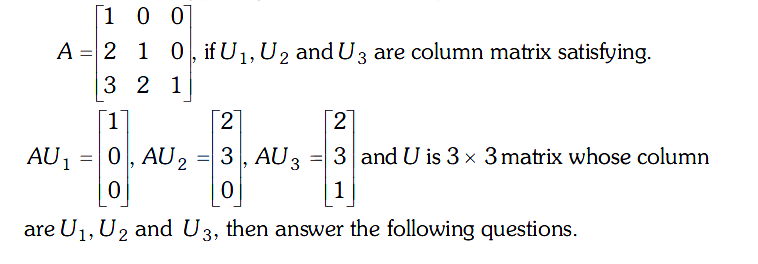
Question:
The value of \(|U|\) isJEE Advanced 2006 Medium
More PYQs from JEE Advanced
- Among the triatomic molecules/ions, and , the total number of linear molecule(s)/ion(s) where the hybridization of the central atom does not have contribution from the d-orbital(s) is
[Atomic number: S = 16, Cl = 17, I = 53 and Xe = 54]JEE Advanced 2015 Medium - For each positive integer , let . If then the value of (where is the greatest integer less than or equal to ) is ____JEE Advanced 2018 Medium
- Suppose four distinct positive numbers \(a_1, a_2, a_3\) and \(a_4\) are in GP. Let \(b_1=a_1\), \(b_2=b_1+a_2, b_3=b_2+a_3\) and \(b_4=b_3+a_4\).
Statement 1 The numbers \(b_1, b_2, b_3\) and \(b_4\) are neither in AP nor in GP.
Statement 2 The numbers \(b_1, b_2, b_3\) and \(b_4\) are in HP.JEE Advanced 2008 Easy - A metal rod \(A B\) of length \(10 x\) has its one end \(A\) in ice at \(0^{\circ} \mathrm{C}\) and the other end \(B\) in water at \(100^{\circ} \mathrm{C}\). If a point \(P\) on the rod is maintained at \(400^{\circ} \mathrm{C}\), then it is found that equal amounts of water and ice evaporate and melt per unit time. The latent heat of evaporation of water is \(540 \mathrm{calg}^{-1}\) and latent heat of melting of ice is \(80 \mathrm{calg}^{-1}\). If the point \(P\) is at a distance of \(\lambda x\) from the ice end \(A\), find the value of \(\lambda\). [Neglect any heat loss to the surrounding.]JEE Advanced 2009 Medium
- Paragraph:
Redox reaction play a pivotal role in chemistry and biology. The values of standard redox potential \(\left(E^{\circ}\right)\) of two half-cell reactions decide which way the reaction is expected to proceed. A simple example is a Daniel cell in which zinc goes into solution and copper gets deposited. Given below are a set of half-cell reactions (acidic medium) along with their \(E^{\circ}(V\) with respect to normal hydrogen electrode) values. Using this data obtain the correct explanations to Questions 14-19.
\(\mathrm{I}_2+2 e^{-} \longrightarrow 2 \mathrm{I}^{-} E^{\circ}=0.54 \)
\( \mathrm{Cl}_2+2 e^{-} \longrightarrow 2 \mathrm{Cl}^{-} E^{\circ}=1.36 \)
\( \mathrm{Mn}^{3+}+e^{-} \longrightarrow \mathrm{Mn}^{2+} E^{\circ}=1.50 \)
\( \mathrm{Fe}^{3+}+e^{-} \longrightarrow \mathrm{Fe}^{2+} E^{\circ}=0.77 \)
\( \mathrm{O}_2+4 \mathrm{H}^{+}+4 e^{-} \longrightarrow 2 \mathrm{H}_2 \mathrm{O} E^{\circ}=1.23\)
Question:
While \(\mathrm{Fe}^{3+}\) is stable, \(\mathrm{Mn}^{3+}\) is not stable in acid solution becauseJEE Advanced 2007 Hard - Let \(A B C D\) be a quadrilateral with area 18 , with side \(A B\) parallel to the side \(C D\) and \(A B=2 C D\). Let \(A D\) be perpendicular to \(A B\) and \(C D\). If a circle is drawn inside the quadrilateral \(A B C D\) touching all the sides, then its radius isJEE Advanced 2007 Hard