


JEE Advanced · Mathematics · 24. Differentiation
If the function \(f(x)=x^3+e^{\frac{x}{2}}\) and \(g(x)=f^{-1}(x)\), then the value of \(g^{\prime}(1)\) is
- A 1
- B 2
- C 3
- D 4
Answer & Solution
Correct Answer
(B) 2
Step-by-step Solution
Detailed explanation
Given, \(g\{f(x)\}=x\)
\[
\begin{array}{lc}
\Rightarrow & g^{\prime}\{f(x)\} f^{\prime}(x)=1 \\
\text { If } & f(x)=1 \Rightarrow x=0, f(0)=1
\end{array}
\]
Substitute \(x=0\) in Eq. (i), we get
\[
\begin{aligned}
& g^{\prime}(1)=\frac{1}{f^{\prime}(0)} \\
& \Rightarrow \quad g^{\prime}(1)=2 \\
& {\left[\because f^{\prime}(x)=3 x^2+\frac{1}{2} e^{x / 2} \Rightarrow f^{\prime}(0)=\frac{1}{2}\right]} \\
&
\end{aligned}
\]
\[
\begin{array}{lc}
\Rightarrow & g^{\prime}\{f(x)\} f^{\prime}(x)=1 \\
\text { If } & f(x)=1 \Rightarrow x=0, f(0)=1
\end{array}
\]
Substitute \(x=0\) in Eq. (i), we get
\[
\begin{aligned}
& g^{\prime}(1)=\frac{1}{f^{\prime}(0)} \\
& \Rightarrow \quad g^{\prime}(1)=2 \\
& {\left[\because f^{\prime}(x)=3 x^2+\frac{1}{2} e^{x / 2} \Rightarrow f^{\prime}(0)=\frac{1}{2}\right]} \\
&
\end{aligned}
\]
See the Complete Solution
Get step-by-step explanations for this and 2.5 Lakh+ more JEE, NEET & CET questions.
- Unlock all solutions
- Practice the full chapter
- Track accuracy across PYQs
4.8 rated on Google Play · 14,000+ reviews
More questions from Mathematics
- The set of values of \(\theta\) satisfying the inequation \(2 \sin ^2 \theta-5 \sin \theta+2>0\), where \(0 < \theta < 2 \pi\), isJEE Advanced 2006 Easy
- Let \(f\) be a function defined on \(R\) (the set of all real numbers) such that \(f^{\prime}(x)=2010(x-2009)\) \((x-2010)^2(x-2011)^3(x-2012)^4\), for all \(x \in R\). If \(g\) is a function defined on \(R\) with values in the interval \((0, \infty)\) such that \(f(x)=\ln (g(x))\), for all \(x \in R\), then the number of points in \(R\) at which \(g\) has a local maximum isJEE Advanced 2010 Hard
- Paragraph:
Read the following passage and answer the questions.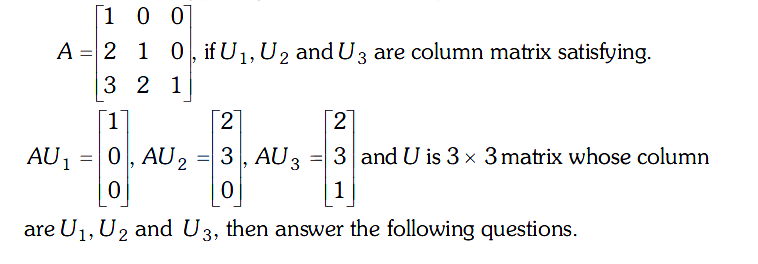
Question:
The value of \(|U|\) isJEE Advanced 2006 Medium - Let \(\mathbf{A}\) be vector parallel to line of intersection of planes \(P_1\) and \(P_2\) through origin. \(P_1\) is parallel to the vectors \(2 \hat{\mathbf{j}}+3 \hat{\mathbf{k}}\) and \(4 \hat{\mathbf{j}}-3 \hat{\mathbf{k}}\) and \(P_2\) is parallel to \(\hat{\mathbf{j}}-\hat{\mathbf{k}}\) and \(3 \hat{\mathbf{i}}+3 \hat{\mathbf{j}}\), then the angle between vector \(\mathbf{A}\) and \(2 \hat{\mathbf{i}}+\hat{\mathbf{j}}-2 \hat{\mathbf{k}}\) isJEE Advanced 2006 Easy
- The value of isJEE Advanced 2013 Medium
- Paragraph:
Box \(1\) contains three cards bearing numbers \(1,2,3\); box \(2\) contains five cards bearing numbers \(1,2,3,4,5\); and box \(3\) contains seven cards bearing numbers \(1,2,3,4,5,6,7\). A card is drawn from each of the boxes. Let \(x_{i}\) be the number on the card drawn from the \(i^{t h}\) box, \(i=1,2,3\).
Question:
The probability that \(x_{1}+x_{2}+x_{3}\) is odd, isJEE Advanced 2014 Medium
More PYQs from JEE Advanced
- Let be a real number. Consider the matrix . If is a singular matrix, then the value of is _____ .JEE Advanced 2022 Medium
- Paragraph:
Let \(p, q\) be integers and let \(\alpha, \beta\) be the roots of the equation, \(x^{2}-x-1=0\), where \(\alpha \neq \beta\). For \(n=0,1,2, \ldots\), let \(a_{n}=p \alpha^{n}+q \beta^{n}\)
FACT: If \(a\) and \(b\) are rational numbers and \(a+b \sqrt{5}=0\), then \(a=0=b\).
Question:
\(a_{12}=\)JEE Advanced 2017 Medium - Let and be functions defined by
(i)
(ii) , where the inverse trigonometric function assumes values in
(iii) , where, for denotes the greatest integer less than or equal to ,
(iv)
The correct option is :LIST-I LIST-II A. the function is P. NOT continuous at B. The function is Q. continuous at and NOT differentiable at C. The function is R. differentiable at and its derivative is NOT continuous at D. The function is S. differentiable at and its derivative is continuous at JEE Advanced 2018 Medium - The function is the solution of the differential equation in (- 1 , 1) satisfying Then isJEE Advanced 2014 Medium
- If \(\mathbf{a}, \mathbf{b}, \mathbf{c}\) and \(\mathbf{d}\) are the unit vectors such that \((\mathbf{a} \times \mathbf{b}) \cdot(\mathbf{c} \times \mathbf{d})=1\) and \(\mathbf{a} \cdot \mathbf{c}=\frac{1}{2}\), thenJEE Advanced 2009 Hard
- Let \(\alpha, \beta\) be the roots of the equation \(x^2-p x+r=0\) and \(\frac{\alpha}{2}, 2 \beta\) be the roots of the equation \(x^2-q x+r=0\). Then, the value of \(r\) isJEE Advanced 2007 Easy