


JEE Advanced · Chemistry · 31. Practical Chemistry
The correct match of the group reagents in List-I for precipitating the metal ion given in List-II from solutions, is
| List - I | List - II |
| (P) Passing \(H _2 S\) in the presence of \(NH _4 OH\) | (1) \(Cu ^{2+}\) |
| (Q) \(\left( NH _4\right)_2 CO _3\) in the presence of \(NH _4 OH\) | (2) \(Al ^{3+}\) |
| (R) \(NH _4 OH\) in the presence of \(NH _4 Cl\) | (3) \(Mn ^{2+}\) |
| (S) Passing \(H _2 S\) in the presence of dilute HCl | (4) \(Ba ^{2+}\) |
| (5) \(Mg ^{2+}\) |
- A \(\mathrm{P} \rightarrow 3 ; \mathrm{Q} \rightarrow 4 ; \mathrm{R} \rightarrow 2 ; \mathrm{S} \rightarrow 1\)
- B \(\mathrm{P} \rightarrow 4 ; \mathrm{Q} \rightarrow 2 ; \mathrm{R} \rightarrow 3 ; \mathrm{S} \rightarrow 1\)
- C \(\mathrm{P} \rightarrow 3 ; \mathrm{Q} \rightarrow 4 ; \mathrm{R} \rightarrow 1 ; \mathrm{S} \rightarrow 5\)
- D \(\mathrm{P} \rightarrow 5 ; \mathrm{Q} \rightarrow 3 ; \mathrm{R} \rightarrow 2 ; \mathrm{S} \rightarrow 4\)
Answer & Solution
Correct Answer
(A) \(\mathrm{P} \rightarrow 3 ; \mathrm{Q} \rightarrow 4 ; \mathrm{R} \rightarrow 2 ; \mathrm{S} \rightarrow 1\)
Step-by-step Solution
Detailed explanation
\(\mathrm{Mn}^{+2} \xrightarrow{\mathrm{H}_2 \mathrm{~S}+\mathrm{NH}_4 \mathrm{OH}} \underset{\text { Pink/buff ppt. }}{\mathrm{MnS} \downarrow}\)
\(\mathrm{Ba}^{+2} \xrightarrow{\left(\mathrm{NH}_4\right)_2 \mathrm{CO}_3+\mathrm{NH}_4 \mathrm{OH}} \underset{\text { White ppt. }}{\mathrm{BaCO}_3 \downarrow}\)
\(\mathrm{Al}^{+3} \xrightarrow{\mathrm{NH}_4 \mathrm{Cl}+\mathrm{NH}_4 \mathrm{OH}} \underset{\text { White ppt. }}{\mathrm{Al}(\mathrm{OH})_3 \downarrow}\)
\(\mathrm{Cu}^{+2} \xrightarrow{\mathrm{H}_2 \mathrm{~S}+\mathrm{HCl} \text { (dil.) }} \underset{\text { Black ppt. }}{\mathrm{CuS} \downarrow}\)
\(\mathrm{Ba}^{+2} \xrightarrow{\left(\mathrm{NH}_4\right)_2 \mathrm{CO}_3+\mathrm{NH}_4 \mathrm{OH}} \underset{\text { White ppt. }}{\mathrm{BaCO}_3 \downarrow}\)
\(\mathrm{Al}^{+3} \xrightarrow{\mathrm{NH}_4 \mathrm{Cl}+\mathrm{NH}_4 \mathrm{OH}} \underset{\text { White ppt. }}{\mathrm{Al}(\mathrm{OH})_3 \downarrow}\)
\(\mathrm{Cu}^{+2} \xrightarrow{\mathrm{H}_2 \mathrm{~S}+\mathrm{HCl} \text { (dil.) }} \underset{\text { Black ppt. }}{\mathrm{CuS} \downarrow}\)
See the Complete Solution
Get step-by-step explanations for this and 2.5 Lakh+ more JEE, NEET & CET questions.
- Unlock all solutions
- Practice the full chapter
- Track accuracy across PYQs
4.8 rated on Google Play · 14,000+ reviews
More questions from Chemistry
- Statement I In water, orthoboric acid behaves as a weak monobasic acid.
Statement II In water, orthoboric acid acts as proton donor.JEE Advanced 2007 Easy - If the reaction sequence given below is carried out with moles of acetylene, the amount of the product formed (in ) is
 The yields of and are given in parentheses. [Given: Atomic mass of ]JEE Advanced 2022 Medium
 - The number of isomeric tetraenes (NOT containing sp-hybridized carbon atoms) that can be formed from the following reaction sequence is _____ .
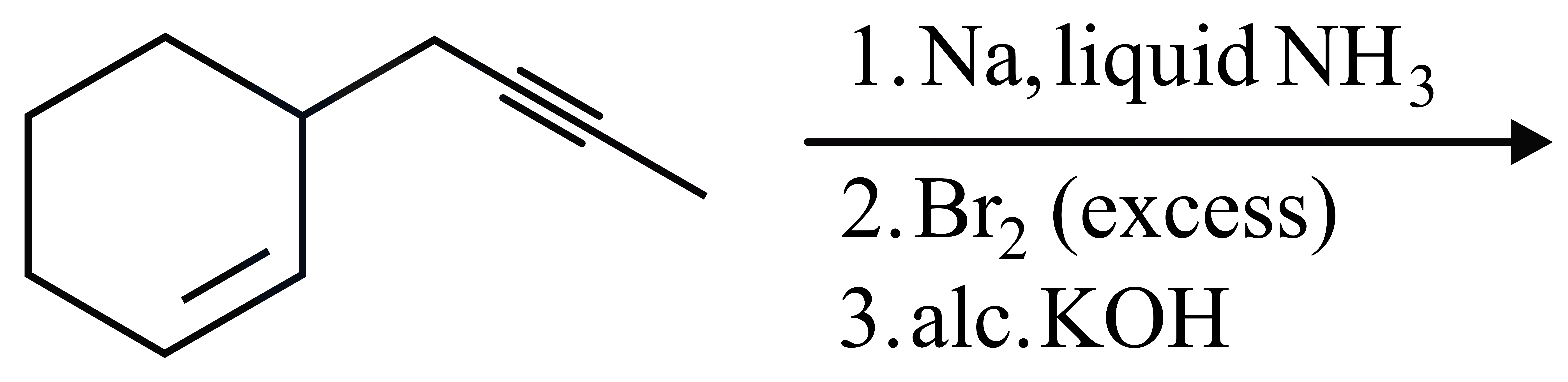 JEE Advanced 2022 Hard
 - The reagent(s) for the following conversion,

is/areJEE Advanced 2007 Easy - For a dilute solution containing \(2.5 \mathrm{~g}\) of a non-volatile non-electrolyte solute in \(100 \mathrm{~g}\) of water, the elevation in boiling point at 1 atm pressure is \(2^{\circ} \mathrm{C}\). Assuming concentration of solute is much lower than the concentration of solvent, the vapour pressure ( \(\mathrm{mm}\) of \(\mathrm{Hg}\) ) of the solution is (take \(K_{b}=0.76 \mathrm{~K} \mathrm{~kg} \mathrm{~mol}^{-1}\) )JEE Advanced 2012 Medium
- Consider the following cell reaction,
\(2 \mathrm{Fe}(\mathrm{s})+\mathrm{O}_2(g)+4 \mathrm{H}^{+}(a q) \longrightarrow \)
\( 2 \mathrm{Fe}^{2+}(a q)+2 \mathrm{H}_2 \mathrm{O}(l), E^{\circ}=1.67 \mathrm{~V} \)
\( \text {At } {\left[\mathrm{Fe}^{2+}\right]=10^{-3} \mathrm{M}, \mathrm{P}\left(\mathrm{O}_2\right)=0.1 \mathrm{~atm}}\)
and \(\mathrm{pH}=3\), the cell potential at \(25^{\circ} \mathrm{C}\) isJEE Advanced 2011 Easy
More PYQs from JEE Advanced
- The work done on a particle of mass m by a force (K being a constant of appropriate dimensions, when the particle is taken from the point (a,0) to the point (0,a) along a circular path of radius a about the origin in the x-y plane isJEE Advanced 2013 Medium
- For the following compounds the correct statement(s) with respect to nucleophilic substitution reactions is(are)
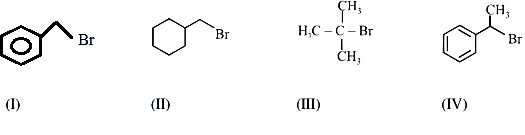 JEE Advanced 2017 Medium
 - The number of hydroxyl group(s) in Q is
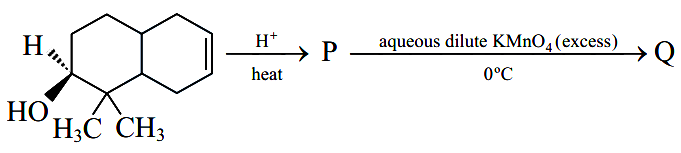 JEE Advanced 2015 Medium
 - Two conducting cylinders of equal length but different radii are connected in series between two heat baths kept at temperatures as shown in the figure. The radius of the bigger cylinder is twice that of the smaller one and the thermal conductivities of the materials of the smaller and the larger cylinders are , respectively. If the temperature at the junction of the two cylinders in the steady state is , then is
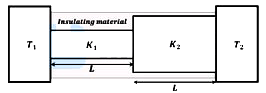 JEE Advanced 2018 Easy
 - A decapeptide (molecular weight 796) on complete hydrolysis gives glycine (molecular weight 75), alanine and phenylalanine. Glycine contributes \(47.0 \%\) to the total weight of the hydrolysed products. The number of glycine units present in the decapeptide isJEE Advanced 2011 Hard
- Let \(f(x)\) be a non-constant twice differentiable function defined on \((-\infty, \infty)\), such that \(f(x)=f(1-x)\) and \(f^{\prime}\left(\frac{1}{4}\right)=0\). Then,JEE Advanced 2008 Hard