


JEE Advanced · Physics · 27. Atomic Physics
A hydrogen atom, initially at rest in its ground state, absorbs a photon of frequency \(v_1\) and ejects the electron with a kinetic energy of 10 eV . The electron then combines with a positron at rest to form a positronium atom in its ground state and simultaneously emits a photon of frequency \(v_2\). The center of mass of the resulting positronium atom moves with a kinetic energy of 5 eV . It is given that positron has the same mass as that of electron and the positronium atom can be considered as a Bohr atom, in which the electron and the positron orbit around their center of mass. Considering no other energy loss during the whole process, the difference between the two photon energies (in eV ) is \(\qquad\)
- A 11.7
- B 11.8
- C 11.9
- D 12.2
Answer & Solution
Correct Answer
(B) 11.8
Step-by-step Solution
Detailed explanation
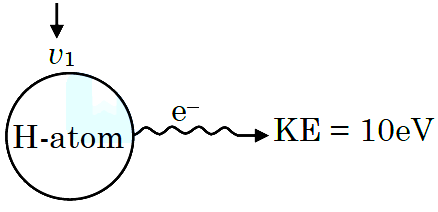
\(\mathrm{h} v_1=13.6+10=23.6 \mathrm{eV} \qquad ....(1)\)
Energy of positronium in ground state
\(\begin{aligned} & =-13.6 \frac{\mu}{m}\left(\frac{z}{n}\right)^2 \mathrm{eV} \\ & =-13.6 \times \frac{1}{2} \mathrm{eV}=-6.8 \mathrm{eV}\end{aligned}\)
So to make positronium 6.8 eV must release \& 5 eV is the KE of COM . So total energy of photon released \(\left(h v_2\right)\) will be :
\(\mathrm{h} v_2=(10-5)+6.8=11.8 \mathrm{eV} \qquad ....(2)\)
\(\therefore \quad\) Difference in energy \(=23.6-11.8=11.8 \mathrm{eV}\)
See the Complete Solution
Get step-by-step explanations for this and 2.5 Lakh+ more JEE, NEET & CET questions.
- Unlock all solutions
- Practice the full chapter
- Track accuracy across PYQs
4.8 rated on Google Play · 14,000+ reviews
More questions from Physics
- Two identical non-conducting solid spheres of same mass and charge are suspended in air from a common point by two non-conducting, massless strings of same length. At equilibrium, the angle between the strings is . The spheres are now immersed in a dielectric liquid of density and dielectric constant . If the angle between the strings remains the same after the immersion, thenJEE Advanced 2020 Hard
- Paragraph:
Scientists are working hard to develop nuclear fusion reactor. Nuclei of heavy hydrogen, \({ }_1^2 \mathrm{H}\) known as deuteron and denoted by \(D\) can be thought of as a candidate for fusion reactor. The \(D\) - \(D\) reaction is \({ }_1^2 \mathrm{H}+{ }_1^2 \mathrm{H} \rightarrow{ }_2^3 \mathrm{He}+n+\) energy. In the core of fusion reactor. A gas of heavy hydrogen is fully ionized into deuteron nuclei and electrons. This collection of \({ }_1^4 \mathrm{H}\) nuclei and electrons is known as plasma. The nuclei move randomly in the reactor core and occasionally come close enough for nuclear fusion to take place. Usually, the temperatures in the reactor core are too high and no material wall can be used to confine the plasma. Special techniques are used which confine the plasma for a time \(t_0\) before the particles fly away from the core. If n is the density (number/volume) of deutrons, the product t \(_0\) is called Lawson number. In one of the criteria, \(a\) reactor is termed successful if Lawson number is greater than \(5 \times 10^{14} \mathrm{scm}^{-3}\).
It may be helpful to use the following : Boltzmann constant \(k=8.6 \times 10^{-5} \mathrm{eV} / \mathrm{K}\); \(\frac{e^2}{4 \pi \varepsilon_0}=1.44 \times 10^{-9} \mathrm{eVm}\)
Question:
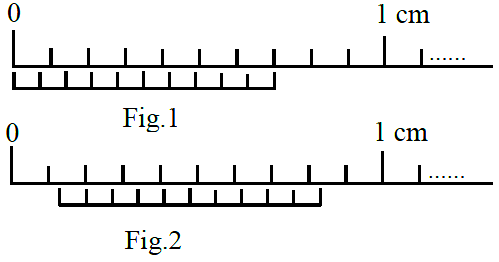
Results of calculations for four different designs of a fusion reactor using D-D reaction are given below. Which of these is most promising based on Lawson criterion?JEE Advanced 2009 Easy - Figure 1 shows the configuration of main scale and Vernier scale before measurement. Fig. 2 shows the configuration corresponding to the measurement of diameter \(D\) of a tube. The measured value of \(D\) is:
 JEE Advanced 2025 Easy
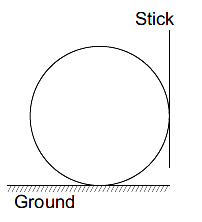
 - A boy is pushing a ring of mass \(2 \mathrm{~kg}\) and radius \(0.5 \mathrm{~m}\) with a stick as shown in the figure. The stick applies a force of \(2 \mathrm{~N}\) on the ring and rolls it without slipping with an acceleration of \(0.3 \mathrm{~m} / \mathrm{s}^2\). The coefficient of friction between the ground and the ring is large enough that rolling always occurs and the coefficient of friction between the stick and the ring is \(\frac{P}{10}\). The value of \(P\) is
 JEE Advanced 2011 Hard
 - The specific heat capacity of a substance is temperature dependent and is given by the formula \(C=k T\), where \(k\) is a constant of suitable dimensions in SI units, and \(T\) is the absolute temperature. If the heat required to raise the temperature of \(1 \mathrm{~kg}\) of the substance from \(-73^{\circ} \mathrm{C}\) to \(27^{\circ} \mathrm{C}\) is \(n k\), the value of \(n\) is _____
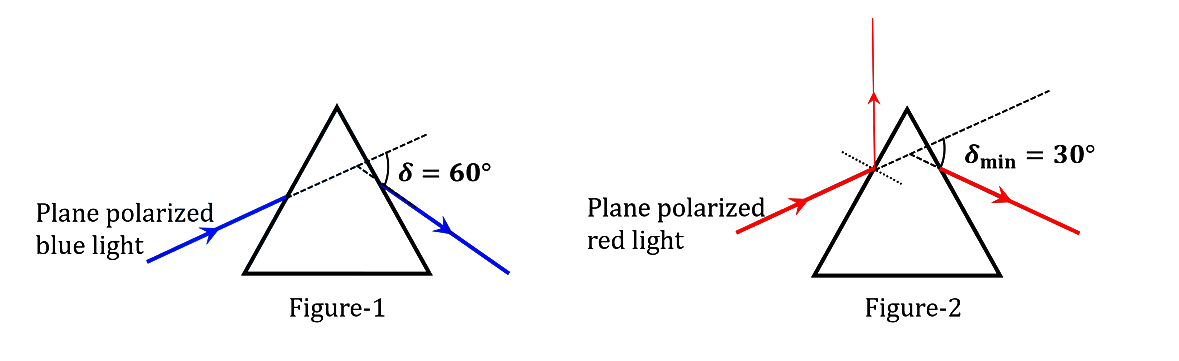
[Given: \(0 \mathrm{~K}=-273^{\circ} \mathrm{C}\).]JEE Advanced 2024 Easy - A plane polarized blue light ray is incident on a prism such that there is no reflection from the surface of the prism. The angle of deviation of the emergent ray is (see Figure-). The angle of minimum deviation for red light from the same prism is (see Figure-). The refractive index of the prism material for blue light is . Which of the following statement(s) is(are) correct?
 JEE Advanced 2023 Medium
More PYQs from JEE Advanced
- The heating of \(\mathrm{NH}_4 \mathrm{NO}_2\) at \(60-70^{\circ} \mathrm{C}\) and \(\mathrm{NH}_4 \mathrm{NO}_3\) at \(200-250^{\circ} \mathrm{C}\) is associated with the formation of nitrogen containing compounds \(\mathbf{X}\) and \(\mathbf{Y}\), respectively. \(\mathbf{X}\) and \(\mathbf{Y}\), respectively, areJEE Advanced 2025 Easy
- A free hydrogen atom after absorbing a photon of wavelength gets excited from the state to the state Immediately after that the electron jumps to state by emitting a photon of wavelength Let the change in momentum of atom due to the absorption and the emission are and respectively. If Which of the option(s) is/are correct?
[Use and are Planck's constant and speed of light, respectively]JEE Advanced 2019 Medium - Let \(X\) and \(Y\) be two events such that \(P(X \mid Y)=\frac{1}{2}\), \(P(Y / X)=\frac{1}{3}\) and \(P(X \cap Y)=\frac{1}{6}\). Which of the following is (are) correct?JEE Advanced 2012 Medium
- You are given many resistances, capacitors and inductors. These are connected to a variable DC voltage source (the first two circuits) or an AC voltage source of \(50 \mathrm{~Hz}\) frequency (the next three circuits) in different ways as shown in Column II. When a current \(I\) (steady state for DC or rms for \(A C\) ) flows through the circuit, the corresponding voltage \(V_1\) and \(V_2\) (indicated in circuits) are related as shown in Column I. Match the two
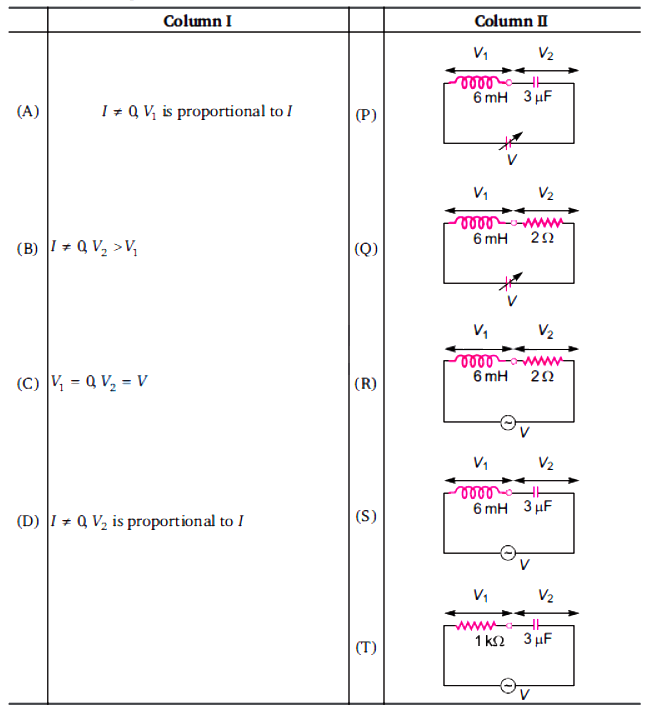 JEE Advanced 2010 Hard
 - Let . The sum of all distinct solution of the equation , in the set S is equal toJEE Advanced 2016 Medium
- Considering ideal gas behavior, the expansion work done (in kJ) when 144 g of water is electrolyzed completely under constant pressure at 300 K is _____
Use: Universal gas constant \((\mathrm{R})=8.3 \mathrm{~J} \mathrm{~K}^{-1} \mathrm{~mol}^{-1}\); Atomic mass (in amu): \(\mathrm{H}=1, \mathrm{O}=16\) (mark absolute value as answer)JEE Advanced 2025 Hard