


JEE Advanced · Mathematics · 14. Ellipse
Let \(P\left(x_1, y_1\right)\) and \(Q\left(x_2, y_2\right)\) be two distinct points on the ellipse
\(\frac{x^2}{9}+\frac{y^2}{4}=1\)
such that \(y_1>0\), and \(y_2>0\). Let C denote the circle \(x^2+y^2=9\), and \(M\) be the point \((3,0)\).
Suppose the line \(x=x_1\) intersects \(C\) at \(R\), and the line \(x=x_2\) intersects \(C\) at \(S\), such that the \(y\)-coordinates of \(R\) and \(S\) are positive. Let \(\angle R O M=\frac{\pi}{6}\) and \(\angle S O M=\frac{\pi}{3}\), where \(O\) denotes the origin \((0,0)\). Let \(|X Y|\) denote the length of the line segment \(X Y\).
Then which of the following statements is (are) TRUE?
- A The equation of the line joining \(P\) and \(Q\) is \(2 x+3 y=3(1+\sqrt{3})\)
- B The equation of the line joining \(P\) and \(Q\) is \(2 x+y=3(1+\sqrt{3})\)
- C If \(N_2=\left(x_2, 0\right)\), then \(3\left|N_2 Q\right|=2\left|N_2 S\right|\)
- D If \(N_1=\left(x_1, 0\right)\), then \(9\left|N_1 P\right|=4\left|N_1 R\right|\)
Answer & Solution
Correct Answer
(C) If \(N_2=\left(x_2, 0\right)\), then \(3\left|N_2 Q\right|=2\left|N_2 S\right|\)
Step-by-step Solution
Detailed explanation
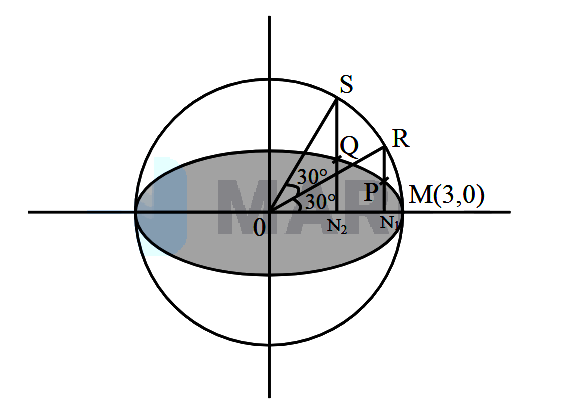
\(\begin{aligned} & \mathrm{P} \equiv\left(3 \cos 30^{\circ}, 2 \sin 30^{\circ}\right) \equiv\left(\frac{3 \sqrt{3}}{2}, 1\right) \\ & \mathrm{Q} \equiv\left(3 \cos 60^{\circ}, 2 \sin 60^{\circ}\right) \equiv\left(\frac{3}{2}, \sqrt{3}\right) \\ & \mathrm{R}\left(\frac{3 \sqrt{3}}{2}, \frac{3}{2}\right), \mathrm{S}\left(\frac{3}{2}, \frac{3 \sqrt{3}}{2}\right)\end{aligned}\)
Slope of \(\mathrm{PQ}=\mathrm{m}_{\mathrm{PQ}}=\frac{\sqrt{3}-1}{\frac{3}{2}-\frac{3 \sqrt{3}}{2}}=-\frac{2}{3}\)
Equation of line PQ
\(\mathrm{y}-\sqrt{3}=-\frac{2}{3}\left(\mathrm{x}-\frac{3}{2}\right)\)
\(\Rightarrow 2 x+3 y=3(\sqrt{3}+1) \quad\) option (A) is correct
Now
\(\begin{aligned} & \text { if } \mathrm{N}_2=\left(\mathrm{x}_2, 0\right)=\left(\frac{3}{2}, 0\right) \\ & \left|\mathrm{N}_2 \mathrm{Q}\right|=\sqrt{3} \text { and }\left|\mathrm{N}_2 \mathrm{~S}\right|=\frac{3 \sqrt{3}}{2}\end{aligned}\)
\(\Rightarrow 3\left|\mathrm{~N}_2 \mathrm{Q}\right|=2\left|\mathrm{~N}_2 \mathrm{~S}\right| \quad\) option (C) is correct
Now, if \(\mathrm{N}_1=\left(\mathrm{x}_1, 0\right) \Rightarrow \mathrm{N}_1=\left(\frac{3 \sqrt{3}}{2}, 0\right)\)
\(\Rightarrow\left|\mathrm{N}_1 \mathrm{P}\right|=1,\left|\mathrm{~N}_1 \mathrm{R}\right|=\frac{3}{2} \quad\) option (D) is incorrect
See the Complete Solution
Get step-by-step explanations for this and 2.5 Lakh+ more JEE, NEET & CET questions.
- Unlock all solutions
- Practice the full chapter
- Track accuracy across PYQs
4.8 rated on Google Play · 14,000+ reviews
More questions from Mathematics
- The quadratic equation with real coefficients has purely imaginary roots. Then the equation hasJEE Advanced 2014 Medium
- For , let be a solution of the differential equation such that . Then the maximum value of the function isJEE Advanced 2023 Medium
- For \(x>0, \lim _{x \rightarrow 0}\left((\sin x)^{1 / x}+\left(\frac{1}{x}\right)^{\sin x}\right)\) isJEE Advanced 2006 Medium
- Let \(\overrightarrow{O P}=\frac{\alpha-1}{\alpha} \hat{i}+\hat{j}+\hat{k}, \overrightarrow{O Q}=\hat{i}+\frac{\beta-1}{\beta} \hat{j}+\hat{k}\) and \(\overrightarrow{O R}=\hat{i}+\hat{j}+\frac{1}{2} \hat{k}\) be three vectors, where \(\alpha, \beta \in \mathbb{R}-\{0\}\) and \(O\) denotes the origin. If \((\overrightarrow{O P} \times \overrightarrow{O Q}) \cdot \overrightarrow{O R}=0\) and the point \((\alpha, \beta, 2)\) lies on the plane \(3 x+3 y-z+l=0\), then the value of \(l\) is ____JEE Advanced 2024 Medium
- The maximum value of the expression \(\frac{1}{\sin ^2 \theta+3 \sin \theta \cos \theta+5 \cos ^2 \theta}\) isJEE Advanced 2010 Easy
- Paragraph: Let be the circle in the – plane defined by the equation
Question : Let be a point on the circle with both coordinates being positive. Let the tangent to at intersect the coordinate axes at the points and Then, the mid-point of the line segment must lie on the curveJEE Advanced 2018 Medium
More PYQs from JEE Advanced
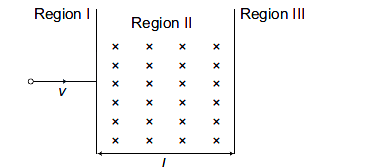
- A particle of mass \(m\) and charge \(q\), moving with velocity \(v\) enters Region II normal to the boundary as shown in the figure. Region II has a uniform magnetic field \(B\) perpendicular to the plane of the paper. The length of the Region II is \(l\). Choose the correct choice(s)
 JEE Advanced 2008 Hard
 - A current carrying wire heats a metal rod. The wire provides a constant power to the rod. The metal rod is enclosed in an insulated container. It is observed that the temperature in the metal rod changes with time as:
where is a constant with appropriate dimension while is a constant with dimension of temperature. The heat capacity of the metal is:JEE Advanced 2019 Hard - A \(0.1 \mathrm{~kg}\) mass is suspended from a wire of negligible mass. The length of the wire is \(1 \mathrm{~m}\) and its cross-sectional area is \(4.9 \times 10^{-7} \mathrm{~m}^2\). If the mass is pulled a little in the vertically downward direction and released, it performs simple harmonic motion of angular frequency \(140 \mathrm{rad} \mathrm{s}^{-1}\). If the Young's modulus of the material of the wire is \(n \times 10^9 \mathrm{Nm}^{-2}\), the value of \(n\) isJEE Advanced 2010 Easy
- Let and be distinct points on the parabola such that a circle with as diameter passes through the vertex of the parabola. If lies in the first quadrant and the area of the triangle is then which of the following is (are) the coordinates of ?JEE Advanced 2015 Medium
- For any matrix , let denote the determinant of . Let be the identity matrix. Let and be two matrices such that is invertible. If , then which of the following statements is (are) TRUE ?JEE Advanced 2021 Medium
- Let \(f_{1}:(0, \infty) \rightarrow \mathbb{R}\) and \(f_{2}:(0, \infty) \rightarrow \mathbb{R}\) be defined by
\[
f_{1}(x)=\int_{0}^{x} \prod_{j=1}^{21}(t-j)^{j} d t, \quad x > 0
\(
and
\]
f_{2}(x)=98(x-1)^{50}-600(x-1)^{49}+2450, \quad x > 0
\)
where, for any positive integer \(n\) and real numbers \(a_{1}, a_{2}, \ldots, a_{n}, \prod_{i=1}^{n} a_{i}\) denotes the product of \(a_{1}, a_{2}, \ldots, a_{n} .\) Let \(m_{i}\) and \(n_{i}\), respectively, denote the number of points of local minima and the number of points of local maxima of function \(f_{i}, i=1,2\), in the interval \((0, \infty)\).
The value of is ____.JEE Advanced 2021 Medium