


JEE Advanced · Mathematics · 30. Vector Algebra
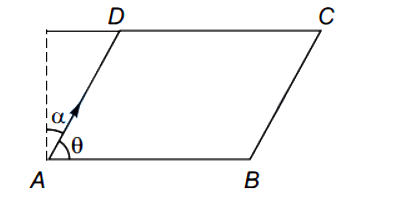
Two adjacent sides of a parallelogram \(A B C D\) are given by \(\overrightarrow{\mathbf{A B}}=2 \hat{\mathbf{i}}+10 \hat{\mathbf{j}}+11 \hat{\mathbf{k}}\) and \(\overrightarrow{\mathbf{A D}}=-\hat{\mathbf{i}}+2 \hat{\mathbf{j}}+2 \hat{\mathbf{k}}\). The side \(A D\) is rotated by an acute angle \(\alpha\) in the plane of the parallelogram so that \(A D\) becomes \(A D^{\prime}\). If \(A D^{\prime}\) makes a right angle with the side \(A B\), then the cosine of the angle \(\alpha\) is given by
- A
\(\frac{8}{9}\)
- B
\(\frac{\sqrt{17}}{9}\)
- C
\(\frac{1}{9}\)
- D
\(\frac{4 \sqrt{5}}{9}\)
Answer & Solution
Correct Answer
(B)
\(\frac{\sqrt{17}}{9}\)
Step-by-step Solution
Detailed explanation
\[
\overrightarrow{\mathbf{A B}}=2 \hat{\mathbf{i}}+10 \hat{\mathbf{j}}+11 \hat{\mathbf{k}}
\]
\[
\overrightarrow{\mathbf{A D}}=-\hat{\mathbf{i}}+2 \hat{\mathbf{j}}+2 \hat{\mathbf{k}}
\]
Angle ' \(\theta\) ' between \(\overrightarrow{\mathbf{A B}}\) and \(\overrightarrow{\mathbf{A D}}\) is
\[
\begin{aligned}
& \cos (\theta)=\left|\begin{array}{l}
\overrightarrow{\mathbf{A B}} \cdot \overrightarrow{\mathbf{A D}} \\
\mid \overrightarrow{\mathbf{A B}}\|\overrightarrow{\mathbf{A D}}\|
\end{array}\right| \\
& =\left|\frac{-2+20+22}{(15)(3)}\right|=\frac{8}{9} \\
& \Rightarrow \quad \sin (\theta)=\frac{\sqrt{17}}{9} \\
& \text { Since, } \quad \alpha+\theta=90^{\circ} \\
& \therefore \quad \cos (\alpha)=\cos \left(90^{\circ}-\theta\right) \\
& =\sin (\theta)=\frac{\sqrt{17}}{9} \\
&
\end{aligned}
\]
\overrightarrow{\mathbf{A B}}=2 \hat{\mathbf{i}}+10 \hat{\mathbf{j}}+11 \hat{\mathbf{k}}
\]
\[
\overrightarrow{\mathbf{A D}}=-\hat{\mathbf{i}}+2 \hat{\mathbf{j}}+2 \hat{\mathbf{k}}
\]
Angle ' \(\theta\) ' between \(\overrightarrow{\mathbf{A B}}\) and \(\overrightarrow{\mathbf{A D}}\) is
\[
\begin{aligned}
& \cos (\theta)=\left|\begin{array}{l}
\overrightarrow{\mathbf{A B}} \cdot \overrightarrow{\mathbf{A D}} \\
\mid \overrightarrow{\mathbf{A B}}\|\overrightarrow{\mathbf{A D}}\|
\end{array}\right| \\
& =\left|\frac{-2+20+22}{(15)(3)}\right|=\frac{8}{9} \\
& \Rightarrow \quad \sin (\theta)=\frac{\sqrt{17}}{9} \\
& \text { Since, } \quad \alpha+\theta=90^{\circ} \\
& \therefore \quad \cos (\alpha)=\cos \left(90^{\circ}-\theta\right) \\
& =\sin (\theta)=\frac{\sqrt{17}}{9} \\
&
\end{aligned}
\]
See the Complete Solution
Get step-by-step explanations for this and 2.5 Lakh+ more JEE, NEET & CET questions.
- Unlock all solutions
- Practice the full chapter
- Track accuracy across PYQs
4.8 rated on Google Play · 14,000+ reviews
More questions from Mathematics
- For any integer let The value of the expression isJEE Advanced 2015 Easy
- Let \(y^{\prime}(x)+y(x) g^{\prime}(x)=g(x) g^{\prime}(x) y(0)=0, x \in R\), where \(f^{\prime}(x)\) denotes \(\frac{d f(x)}{d x}\) and \(g(x)\) is a given non-constant differentiable function on \(R\) with \(g(0)=g(2)=0\). Then, the value of \(y\) (2) is...JEE Advanced 2011 Easy
- Let be the sample space of all matrices with entries from the set Let the events and be given by
and
sum of entries of is
If a matrix is chosen at random from then the conditional probability equals____JEE Advanced 2019 Medium - Let and be two distinct common tangents to the ellipse and the parabola . Suppose that the tangent touches and at the points and , respectively and the tangent touches and at the points and , respectively. Then which of the following statements is(are) true?JEE Advanced 2023 Medium
- For every pair of continuous functions such that then the correct statement (s) is (are)JEE Advanced 2014 Hard
- The number of points in , for which , is:JEE Advanced 2013 Hard
More PYQs from JEE Advanced
- For any complex number , let , where . Let and be real numbers such that for all complex numbers satisfying , the ordered pair lies on the circle
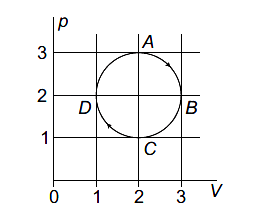
Then which of the following statements is(are) TRUE?JEE Advanced 2021 Hard - The figure shows the \(p-V\) plot of an ideal gas taken through a cycle \(A B C D A\). The part \(A B C\) is a semi-circle and \(C D A\) is half of an ellipse. Then,
 JEE Advanced 2009 Medium
 - Let the vectors \(\mathbf{P Q}, \mathbf{Q R}, \mathbf{R S}, \mathbf{S T}, \mathbf{T U}\) and UP represent the sides of a regular hexagon.
Statement I PQ \(\times(\mathbf{R S}+\mathbf{S T}) \neq \mathbf{0}\)
Statement II \(\mathbf{P Q} \times \mathbf{R S}=\mathbf{0}\) and \(\mathbf{P Q} \times \mathbf{S Q} \neq \mathbf{0}\)JEE Advanced 2007 Medium - A bar of mass and length is lying on a horizontal frictionless surface. One end of the bar is pivoted at a point about which it is free to rotate. A small mass is moving on the same horizontal surface with speed on a path perpendicular to the bar. It hits the bar at a distance from the pivoted end and returns back on the same path with speed . After this elastic collision, the bar rotates with an angular velocity . Which of the following statement is correct?JEE Advanced 2023 Hard
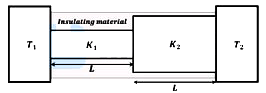
- Two conducting cylinders of equal length but different radii are connected in series between two heat baths kept at temperatures as shown in the figure. The radius of the bigger cylinder is twice that of the smaller one and the thermal conductivities of the materials of the smaller and the larger cylinders are , respectively. If the temperature at the junction of the two cylinders in the steady state is , then is
 JEE Advanced 2018 Easy
 - Paragraph:
A thermal power plant produces electric power of \(600 \mathrm{~kW}\) at \(4000 \mathrm{~V}\), which is to be transported to a place \(20 \mathrm{~km}\) away from the power plant for consumers' usage. It can be transported either directly with a cable of large current carrying capacity or by using a combination of step-up and step-down transformers at the two ends. The drawback of the direct transmission is the large energy dissipation. In the method using transformers, the dissipation is much smaller. In this method, a step-up transformer is used at the plant side so that the current is reduced to a smaller value. At the consumers' end, a step-down transformer is used to supply power to the consumers at the specified lower voltage. It is reasonable to assume that the power cable is purely resistive and the transformers are ideal with a power factor unity. All the currents and voltages mentioned are rms values.
Question:
If the direct transmission method with a cable of resistance \(0.4 \Omega \mathrm{km}^{-1}\) is used, the power dissipation (in %) during transmission isJEE Advanced 2013 Medium