


JEE Advanced · Mathematics · 27. Definite Integration
\[
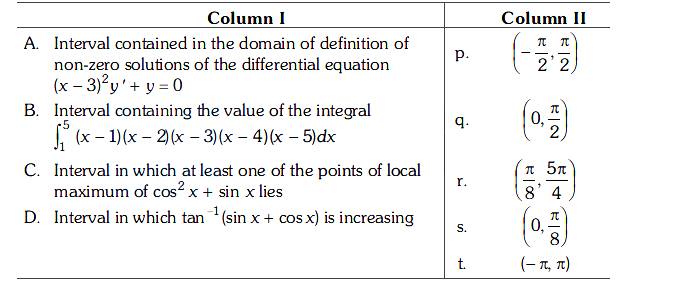
\text { Match the statements/expressions in Column I with the open intervals in Column II. }
\]
- A
(A) p,q,t, (B) q,t, (C) r,s, (D) p,s
- B
(A) p,q,s, (B) p,t, (C) p,q,r,t, (D) s
- C
(A) p,q,s, (B) q,t, (C) r,s,t, (D) p,s
- D
(A) p,q,t, (B) p,t, (C) p,q,r,t, (D) s
Answer & Solution
Correct Answer
(B)
(A) p,q,s, (B) p,t, (C) p,q,r,t, (D) s
Step-by-step Solution
Detailed explanation
(a) Given, \((x-3)^2 \cdot y^{\prime}+y=0\)
\[
\begin{array}{rlrl}
\Rightarrow & \frac{d y}{d x} & =-\frac{y}{(x-3)^2} \\
\Rightarrow & & \int \frac{d y}{y} & =-\int \frac{d x}{(x-3)^3} \\
\Rightarrow & & \ln y & =\frac{1}{(x-3)}+\ln C \\
\Rightarrow & & y & =C e^{\frac{1}{x-3}}, C \neq 0
\end{array}
\]
\(\therefore\) Domain of \(y\) is \(x \in R-\{3\}\)
Aliter Given differential equation is homogeneous linear differential equation and has \(x=3\) as a singular point, hence \(x=3\) cannot be in domain of solution.
(b) Let \(I=\int_1^5(x-1)(x-2)(x-3)(x-4)\) \((x-5) d x\)
Let \(x-3=t \Rightarrow d x=d t\)
\(\therefore I=\int_{-2}^2(t+2)(t+1) t(t-1)(t-2) d t\)
\(\because\) Integrand is an odd function.
\(\therefore \quad I=0\)
Aliter Let
\(I=\int_1^5(x-1)(x-2)(x-3)(x-4)\)
\((x-5) d x\)
Using, \(\int_a^b f(x) d x=\int_a^b f(a+b-x) d x\) \(I=\int_1^5(5-x)(4-x)(3-x)(2-x)\) \((1-x) d x\)
On adding Eqs. (i) and (ii) we get 2I \(=0 \Rightarrow I=0\)
(c) Let \(f(x)=\cos ^2 x+\sin x\)
\(\Rightarrow f^{\prime}(x)=-2 \cos x \sin x+\cos x\) \(=\cos x(1-2 \sin x)=0\) (say)
Sign scheme for first derivative
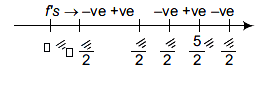
Points of local maxima are \(\frac{\pi}{6}, \frac{5 \pi}{6}\).
Aliter \(y=\cos ^2 x+\sin x\)
\[
\Rightarrow \quad y=\frac{5}{4}-\left(\sin x-\frac{1}{2}\right)^2
\]
For \(y\) to be maximum,
\[
\begin{aligned}
& \left(\sin x-\frac{1}{2}\right)^2=0 \Rightarrow \sin x=\frac{1}{2} \\
\Rightarrow \quad & x=n \pi+(-1)^n \frac{\pi}{6}, n \in I
\end{aligned}
\]
(d) Let \(y=\tan ^{-1}(\sin x+\cos x)\)
\[
\Rightarrow \quad \frac{d y}{d x}=\frac{\cos x-\sin x}{1+(\sin x+\cos x)^2}
\]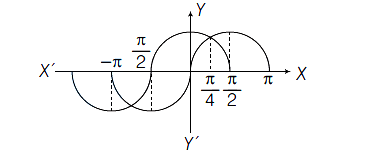
Clearly, by graph, \(\cos x>\sin x\) is true for option(s).
\[
\begin{array}{rlrl}
\Rightarrow & \frac{d y}{d x} & =-\frac{y}{(x-3)^2} \\
\Rightarrow & & \int \frac{d y}{y} & =-\int \frac{d x}{(x-3)^3} \\
\Rightarrow & & \ln y & =\frac{1}{(x-3)}+\ln C \\
\Rightarrow & & y & =C e^{\frac{1}{x-3}}, C \neq 0
\end{array}
\]
\(\therefore\) Domain of \(y\) is \(x \in R-\{3\}\)
Aliter Given differential equation is homogeneous linear differential equation and has \(x=3\) as a singular point, hence \(x=3\) cannot be in domain of solution.
(b) Let \(I=\int_1^5(x-1)(x-2)(x-3)(x-4)\) \((x-5) d x\)
Let \(x-3=t \Rightarrow d x=d t\)
\(\therefore I=\int_{-2}^2(t+2)(t+1) t(t-1)(t-2) d t\)
\(\because\) Integrand is an odd function.
\(\therefore \quad I=0\)
Aliter Let
\(I=\int_1^5(x-1)(x-2)(x-3)(x-4)\)
\((x-5) d x\)
Using, \(\int_a^b f(x) d x=\int_a^b f(a+b-x) d x\) \(I=\int_1^5(5-x)(4-x)(3-x)(2-x)\) \((1-x) d x\)
On adding Eqs. (i) and (ii) we get 2I \(=0 \Rightarrow I=0\)
(c) Let \(f(x)=\cos ^2 x+\sin x\)
\(\Rightarrow f^{\prime}(x)=-2 \cos x \sin x+\cos x\) \(=\cos x(1-2 \sin x)=0\) (say)
Sign scheme for first derivative
Points of local maxima are \(\frac{\pi}{6}, \frac{5 \pi}{6}\).
Aliter \(y=\cos ^2 x+\sin x\)
\[
\Rightarrow \quad y=\frac{5}{4}-\left(\sin x-\frac{1}{2}\right)^2
\]
For \(y\) to be maximum,
\[
\begin{aligned}
& \left(\sin x-\frac{1}{2}\right)^2=0 \Rightarrow \sin x=\frac{1}{2} \\
\Rightarrow \quad & x=n \pi+(-1)^n \frac{\pi}{6}, n \in I
\end{aligned}
\]
(d) Let \(y=\tan ^{-1}(\sin x+\cos x)\)
\[
\Rightarrow \quad \frac{d y}{d x}=\frac{\cos x-\sin x}{1+(\sin x+\cos x)^2}
\]
Clearly, by graph, \(\cos x>\sin x\) is true for option(s).
See the Complete Solution
Get step-by-step explanations for this and 2.5 Lakh+ more JEE, NEET & CET questions.
- Unlock all solutions
- Practice the full chapter
- Track accuracy across PYQs
4.8 rated on Google Play · 14,000+ reviews
More questions from Mathematics
- Let \(f\) be a non-negative function defined on the interval \([0,1]\). If \(\int_0^x \sqrt{1-\left\{f^{\prime}(t)\right\}^2} d t=\int_0^x f(t) d t, \quad 0 \leq x \leq 1\)
\[
\text { and } f(0)=0 \text {, then }
\]JEE Advanced 2009 Hard - For the function \(f(x)=x \cos \frac{1}{x}, x \geq 1\),JEE Advanced 2009 Hard
- Let \(\alpha, \beta\) and \(\gamma\) be real numbers such that the system of linear equations
\[
\begin{array}{c}
x+2 y+3 z=\alpha \\
4 x+5 y+6 z=\beta \\
7 x+8 y+9 z=\gamma-1
\end{array}
\]
is consistent. Let \(|M|\) represent the determinant of the matrix
\[
M=\left[\begin{array}{ccc}
\alpha & 2 & \gamma \\
\beta & 1 & 0 \\
-1 & 0 & 1
\end{array}\right]
\]
Let \(P\) be the plane containing all those \((\alpha, \beta, \gamma)\) for which the above system of linear equations is consistent, and \(D\) be the square of the distance of the point \((0,1,0)\) from the plane \(P\).
The value of isJEE Advanced 2021 Medium - Paragraph:
Let \(A, B, C\) be three sets of complex numbers as defined below.
\(A=\{z ; \operatorname{lm} z \geq 1\} ; B=\{z:|z-2-i|=3\} ;\) \(C=\{z: \operatorname{Re}((1-i) z)=\sqrt{2}\}\).
Question:
Let \(z\) be any point in \(A \cap B \cap C\) and let \(w\) be any point satisfying \(|w-2-i| < 3\). Then, \(|z|-|w|+3\) lies betweenJEE Advanced 2008 Medium - Let S be the set of all non - zero real numbers such that the quadratic equation has two distinct real roots satisfying the inequality Which of the following intervals is(are) a subset(s) of S?JEE Advanced 2015 Medium
- Let and let and
Then which of the following options is/are correct?JEE Advanced 2019 Hard
More PYQs from JEE Advanced
- In an insulated vessel, \(0.05 \mathrm{~kg}\) steam at \(373 \mathrm{~K}\) and \(0.45 \mathrm{~kg}\) of ice at \(253 \mathrm{~K}\) are mixed. Find the final temperature of the mixture (in kelvin).
\( \text { Given, }L_{\text {fusion }} =80 \mathrm{cal} / \mathrm{g}=336 \mathrm{~J} / \mathrm{g},\) \( L_{\text {vaporization }}=540 \mathrm{cal} / \mathrm{g}=2268 \mathrm{~J} / \mathrm{g}, \)
\( S_{\text {ice }} =2100 \mathrm{~J} / \mathrm{kg}, K=0.5 \mathrm{cal} / \mathrm{gK} \text { and } S_{\text {water }}=\) \(4200 \mathrm{~J} / \mathrm{kg}, K=1 \mathrm{cal} / \mathrm{gK} .\)JEE Advanced 2006 Easy - Three lines are given by
and
Let the lines cut the plane at the points and respectively. If the area of the triangle is then the value of equals_________JEE Advanced 2019 Easy - The boiling point of water in a \(0.1\) molal silver nitrate solution (solution \(\mathbf{A}\) ) is \(\mathbf{x}^{\circ} \mathrm{C}\). To this solution \(\mathbf{A}\), an equal volume of \(0.1\) molal aqueous barium chloride solution is added to make a new solution B. The difference in the boiling points of water in the two solutions \(\mathbf{A}\) and \(\mathbf{B}\) is \(\mathbf{y} \times 10^{-2}{ }^{\circ} \mathrm{C}\).
(Assume: Densities of the solutions \(\mathbf{A}\) and \(\mathbf{B}\) are the same as that of water and the soluble salts dissociate completely.
Use: Molal elevation constant (Ebullioscopic Constant), \(K_{b}=0.5 \mathrm{~K} \mathrm{~kg} \mathrm{~mol}^{-1}\); Boiling point of pure water as \(100^{\circ} \mathrm{C}\).)
The value of is ___.JEE Advanced 2021 Hard - Let the curve C be the mirror image of the parabola with respect to the line If A and B are the points of intersection of C with the line then the distance between A and B isJEE Advanced 2015 Medium
- Let be a natural number and be the function defined by
If is such that the area of the region bounded by the curves and is , then the maximum value of the function isJEE Advanced 2023 Medium - A positive, singly ionized atom of mass number \(A_{\mathrm{M}}\) is accelerated from rest by the voltage \(192 \mathrm{~V}\). Thereafter, it enters a rectangular region of width \(w\) with magnetic field \(\vec{B}_0=0.1 \hat{k}\) Tesla, as shown in the figure. The ion finally hits a detector at the distance \(x\) below its starting trajectory.
[Given: Mass of neutron/proton \(=(5 / 3) \times 10^{-27} \mathrm{~kg}\), charge of the electron \(=1.6 \times 10^{-19} \mathrm{C}\).]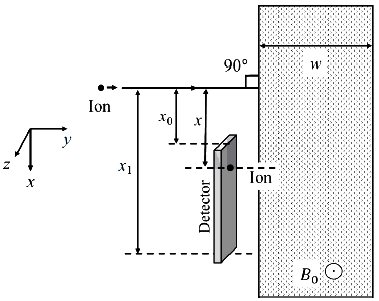
Which of the following option(s) is(are) correct?JEE Advanced 2024 Hard