


JEE Advanced · Physics · 27. Atomic Physics
Paragraph:
When a particle is restricted to move along \(x\)-axis between \(x=0\) and \(x=a\), where \(a\) is of nanometer dimension, its energy can take only certain specific values. The allowed energies of the particle moving in such a restricted region, correspond to the formation of standing waves with nodes at its ends \(x=0\) and \(x=a\). The wavelength of this standing wave is related to the liner momentum \(p\) of the particle according to the de Broglie relation. The energy of the particle of mass \(m\) is related to its linear momentum as \(E=\frac{p^2}{2 m}\). Thus, the energy of the particle can be denoted by a quantum number \(n\) taking values \(1,2,3, \ldots(n=1\), called the ground state) corresponding to the number of loops in the standing wave.
Use the model described above to answer the following three questions for a particle moving in the line \(x=0\) to \(x=a\) [Take \(h=6.6 \times 10^{-34} \mathrm{Js}\) and \(e=1.6 \times 10^{-19} \mathrm{C}\) ]
Question:
If the mass of the particle is \(m=1.0 \times 10^{-30} \mathrm{~kg}\) and \(a=6.6 \mathrm{~nm}\), the energy of the particle in its ground state is closest to
- A \(0.8 \mathrm{meV}\)
- B \(8 \mathrm{meV}\)
- C \(80 \mathrm{meV}\)
- D \(800 \mathrm{meV}\)
Answer & Solution
Correct Answer
(B) \(8 \mathrm{meV}\)
Step-by-step Solution
Detailed explanation
From Eq. (i)
\(E=\frac{n^2 h^2}{8 a^2 m}\)
In ground state \(n=1\)
\(\therefore E_1=\frac{h^2}{8 m a^2}\)
Substituting the values, we get
\(E_1=8 \mathrm{meV}\)
\(E=\frac{n^2 h^2}{8 a^2 m}\)
In ground state \(n=1\)
\(\therefore E_1=\frac{h^2}{8 m a^2}\)
Substituting the values, we get
\(E_1=8 \mathrm{meV}\)
See the Complete Solution
Get step-by-step explanations for this and 2.5 Lakh+ more JEE, NEET & CET questions.
- Unlock all solutions
- Practice the full chapter
- Track accuracy across PYQs
4.8 rated on Google Play · 14,000+ reviews
More questions from Physics
- The image of an object, formed by a plano - convex lens at a distance of 8 m behind the lens, is real and is one-third the size of the object. The wavelength of light inside the lens is times the wavelength in free space. The radius of the curved surface of the lens isJEE Advanced 2013 Medium
- In a particular system of units, a physical quantity can be expressed in terms of the electric charge , electron mass . Planck's constant , and Coulomb's constant , where is the permittivity of vacuum. In terms of these physical constants, the dimension of the magnetic field is . The value of is _______.JEE Advanced 2022 Medium
- Consider two solid spheres P and Q each of density 8 gm and diameters 1 cm and 0.5 cm, respectively. Sphere P is dropped into a liquid of density 0.8 gm and viscosity poiseulles. Sphere Q is dropped into a liquid of density 1.6 gm and viscosity poiseulles. the ratio of the terminal velocities of P and Q is.JEE Advanced 2016 Hard
- Paragraph:
Consider an evacuated cylindrical chamber of height \(h\) having rigid conducting plates at the ends and an insulating curved surface as shown in the figure. A number of spherical balls made of a light weight and soft material and coated with a conducting material are placed on the bottom plate. The balls have a radius \(r \ll h\). Now a high voltage source \((HV)\) is connected across the conducting plates such that the bottom plate is at \(+V_{0}\) and the top plate at \(-V_{0} .\) Due to their conducting surface, the balls will get charged, will become equipotential with the plate and are repelled by it. The balls will eventually collide with the top plate, where the coefficient of restitution can be taken to be zero due to the soft nature of the material of the balls. The electric field in the chamber can be considered to be that of a parallel plate capacitor. Assume that there are no collisions between the balls and the interaction between them is negligible. (Ignore gravity)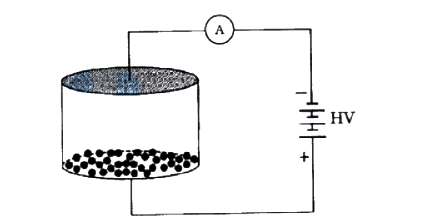
Question:
The average current in the steady state registered by the ammeter in the circuit will beJEE Advanced 2016 Medium - A pendulum consists of a bob of mass \(m=0.1 \mathrm{~kg}\) and a massless inextensible string of length \(L=1.0 \mathrm{~m}\). It is suspended from a fixed point at height \(H=0.9 \mathrm{~m}\) above a frictionless horizontal floor. Initially, the bob of the pendulum is lying on the floor at rest vertically below the point of suspension. A horizontal impulse \(P=0.2 \mathrm{~kg}-\mathrm{m} / \mathrm{s}\) is imparted to the bob at some instant. After the bob slides for some distance, the string becomes taut and the bob lifts off the floor. The magnitude of the angular momentum of the pendulum about the point of suspension just before the bob lifts off is \(J \mathrm{~kg}-\mathrm{m}^{2} / \mathrm{s}\). The kinetic energy of the pendulum just after the liftoff is \(K\) Joules.
The value of is ____.JEE Advanced 2021 Hard - A uniform circular disc of mass and radius is rotating with an angular velocity of about its own axis, which is vertical. Two uniform circular rings, each of mass and radius , are gently placed symmetrically on the disc in such a manner that they are touching each other along the axis of the disc and are horizontal. Assume that the friction is large enough such that the rings are at rest relative to the disc and the system rotates about the original axis. The new angular velocity of the system isJEE Advanced 2013 Medium
More PYQs from JEE Advanced
- Three students \(S_1, S_2\) and \(S_1\) are given a problem to solve. Consider the following events :
\(U:\) At least one of \(S_1, S_2\) and \(S_3\) can solve the problem,
\(V: S_1\) can solve the problem, given that neither \(\mathrm{S}_2\) nor \(\mathrm{S}_3\) can solve the problem,
\(W: S_2\) can solve the problem and \(S_3\) cannot solve the problem,
\(T: S_3\) can solve the problem.
For any event \(E\), let \(P(E)\) denote the probability of \(E\).
If \(P(U)=\frac{1}{2}, P(V)=\frac{1}{10}\) and \(P(W)=\frac{1}{12}\), then \(P(T)\) is equal toJEE Advanced 2025 Medium - Paragraph:
Let \(P Q\) be a focal chord of the parabola \(y^{2}=4 a x\). The tangents to the parabola at \(P\) and \(Q\) meet at a point lying on the line \(y=2 x+a, a>0\).
Question:
Length of chord \(P Q\) isJEE Advanced 2013 Medium - Coefficient of in the expansion of isJEE Advanced 2014 Hard
- Let \(M\) and \(N\) be two \(3 \times 3\) non-singular skew-symmetric matrices such that \(M N=N M\). If \(P^T\) denotes the transpose of \(P\), then \(M^2 N^2\left(M^T N\right)^{-1}\left(M N^{-1}\right)^T\) is equal toJEE Advanced 2011 Hard
- A spherical soap bubble inside an air chamber at pressure \(P_0=10^5 \mathrm{~Pa}\) has a certain radius so that the excess pressure inside the bubble is \(\Delta P=144 \mathrm{~Pa}\). Now, the chamber pressure is reduced to \(8 P_0 / 27\) so that the bubble radius and its excess pressure change. In this process, all the temperatures remain unchanged. Assume air to be an ideal gas and the excess pressure \(\Delta P\) in both the cases to be much smaller than the chamber pressure. The new excess pressure \(\Delta P\) in \(\mathrm{Pa}\) is ________ .JEE Advanced 2024 Medium
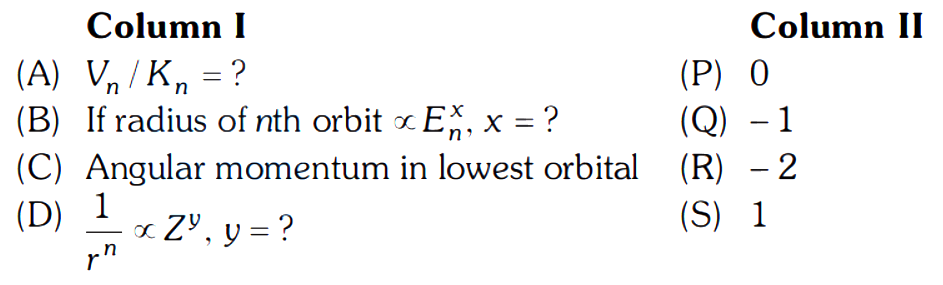
- According to Bohr's theory \(E_n=\) Total energy, \(K_n=\) Kinetic energy, \(V_n=\) Potential energy, \(r_n=\) Radius of \(n\)th orbit
 JEE Advanced 2006 Easy