


JEE Advanced · Mathematics · 16. Limits
Let \(\alpha(a)\) and \(\beta(a)\) be the roots of the equation \((\sqrt[3]{1+a}-1) x^{2}+(\sqrt{1+a}-1) x+(\sqrt[6]{1+a}-1)=0\) where \(a\) \(>-1\). Then \(\lim _{a \rightarrow 0^{+}} \alpha(a)\) and \(\lim _{x \rightarrow 0^{+}} \beta(a)\) are
- A \(-\frac{5}{2}\) and 1
- B \(-\frac{1}{2}\) and \(-1\)
- C \(-\frac{7}{2}\) and 2
- D \(-\frac{9}{2}\) and 3
Answer & Solution
Correct Answer
(B) \(-\frac{1}{2}\) and \(-1\)
Step-by-step Solution
Detailed explanation
\((\sqrt[3]{1+a}-1) x^{2}+(\sqrt{1+a}-1) x+(\sqrt[6]{1+a}-1)=0\)
Let \(a+1=y\), then equation reduces to \(\left(y^{1 / 3}-1\right) x^{2}+\left(y^{1 / 2}-1\right) x+\left(y^{1 / 6}-1\right)=0\)
On dividing both sides by \(y-1\), we get \(\left(\frac{y^{1 / 3}-1}{y-1}\right) x^{2}+\left(\frac{y^{1 / 2}-1}{y-1}\right) x+\left(\frac{y^{1 / 6}-1}{y-1}\right)=0\)
On taking limit as \(y \rightarrow 1\) i.e. \(a \rightarrow 0\) on both sides, we get \(\frac{1}{3} x^{2}+\frac{1}{2} x+\frac{1}{6}=0 \Rightarrow 2 x^{2}+3 x+1=0\)
\(\Rightarrow x=-1,-\frac{1}{2}\) (roots of the equation)
\(\therefore \quad \lim _{a \rightarrow 0^{+}} \alpha(a)=-1, \lim _{a \rightarrow 0^{+}} \beta(a)=-\frac{1}{2}\)
Let \(a+1=y\), then equation reduces to \(\left(y^{1 / 3}-1\right) x^{2}+\left(y^{1 / 2}-1\right) x+\left(y^{1 / 6}-1\right)=0\)
On dividing both sides by \(y-1\), we get \(\left(\frac{y^{1 / 3}-1}{y-1}\right) x^{2}+\left(\frac{y^{1 / 2}-1}{y-1}\right) x+\left(\frac{y^{1 / 6}-1}{y-1}\right)=0\)
On taking limit as \(y \rightarrow 1\) i.e. \(a \rightarrow 0\) on both sides, we get \(\frac{1}{3} x^{2}+\frac{1}{2} x+\frac{1}{6}=0 \Rightarrow 2 x^{2}+3 x+1=0\)
\(\Rightarrow x=-1,-\frac{1}{2}\) (roots of the equation)
\(\therefore \quad \lim _{a \rightarrow 0^{+}} \alpha(a)=-1, \lim _{a \rightarrow 0^{+}} \beta(a)=-\frac{1}{2}\)
See the Complete Solution
Get step-by-step explanations for this and 2.5 Lakh+ more JEE, NEET & CET questions.
- Unlock all solutions
- Practice the full chapter
- Track accuracy across PYQs
4.8 rated on Google Play · 14,000+ reviews
More questions from Mathematics
- For any complex number , let , where . Let and be real numbers such that for all complex numbers satisfying , the ordered pair lies on the circle
Then which of the following statements is(are) TRUE?JEE Advanced 2021 Hard - Let the function \(f:[1, \infty) \rightarrow \mathbb{R}\) be defined by
\(f(t)=\left\{\begin{array}{cc}(-1)^{n+1} 2, & \text { if } t=2 n-1, n \in \mathbb{N}, \\ \frac{(2 n+1-t)}{2} f(2 n-1)+\frac{(t-(2 n-1))}{2} f(2 n+1), & \text { if } 2 n-1 < t < 2 n+1, n \in \mathbb{N} .\end{array}\right.\)
Define \(g(x)=\int_1^x f(t) d t, x \in(1, \infty)\). Let \(\alpha\) denote the number of solutions of the equation \(g(x)=0\) in the interval \((1,8]\) and \(\beta=\lim _{x \rightarrow 1^+} \frac{g(x)}{x-1}\). Then the value of \(\alpha+\beta\) is equal to ________.JEE Advanced 2024 Medium - Let \(M\) and \(N\) be two \(3 \times 3\) non-singular skew-symmetric matrices such that \(M N=N M\). If \(P^T\) denotes the transpose of \(P\), then \(M^2 N^2\left(M^T N\right)^{-1}\left(M N^{-1}\right)^T\) is equal toJEE Advanced 2011 Hard
- Inradius of a circle which is inscribed in an isosceles triangle one of whose angle is \(2 \pi / 3\), is \(\sqrt{3}\), then area of triangle isJEE Advanced 2006 Easy
- For any integer let The value of the expression isJEE Advanced 2015 Easy
- Let be a positive real number. Let and be the functions defined by and .
Then the value of is ______.JEE Advanced 2022 Medium
More PYQs from JEE Advanced
- Young’s modulus of elasticity is expressed in terms of three derived quantities, namely, the gravitational constant , Planck’s constant and the speed of light , as . Which of the following is the correct option?JEE Advanced 2023 Easy
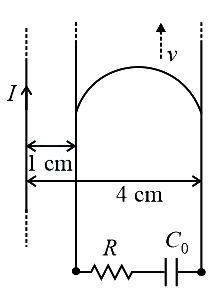
- A long straight wire carries a current, ampere. A semi-circular conducting rod is placed beside it on two conducting parallel rails of negligible resistance. Both the rails are parallel to the wire. The wire, the rod and the rails lie in the same horizontal plane, as shown in the figure. Two ends of the semi-circular rod are at distances and from the wire. At time , the rod starts moving on the rails with a speed (see the figure). A resistor and a capacitor are connected in series between the rails. At time , is uncharged. Which of the following statement(s) is (are) correct? [ SI units. Take ]
 JEE Advanced 2021 Medium
 - Paragraph :
A spray gun is shown in the figure where a piston pushes air out of a nozzle. A thin tube of uniform cross section is connected to the nozzle. The other end of the tube is in a small liquid container. As the piston pushes air through the nozzle, the liquid from the container rises into the nozzle and is sprayed out. For the spray gun shown, the radii of the piston and the nozzle are \(20 \mathrm{~mm}\) and \(1 \mathrm{~mm}\), respectively. The upper end of the container is open to the atmosphere.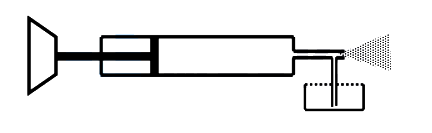
Question :
If the density of air is \(\rho_{a}\) and that of the liquid \(\rho_{\ell}\), then for a given piston speed the rate (volume per unit time) at which the liquid is sprayed will be proportional toJEE Advanced 2014 Easy - Match List I with List II and select the correct answer using the code given below the lists :
List - I List - II A.
P. B.
If cosx + cosy + cosz = 0 = sinx + siny + sinz then possible value of cosQ. C.
If cos cos2x + sinx sin 2x secx = cosx sin2x secx + cos cos2x then possible value of secx isR. D.
If cot then possible value of x isS. 1 JEE Advanced 2013 Medium - A tetrapeptide has -COOH group on alanine. This produces glycine (Gly), Valine (Val), Phenyl alanine (Phe) and Alanine (Ala) on complete hydrolysis. For this tetrapeptide, the number of possible sequences (primary structures) with -NH2 group attached to a chiral center isJEE Advanced 2013 Hard
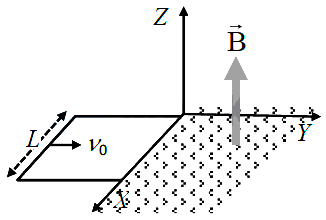
- A conducting square loop of side \(L\), mass \(M\) and resistance \(R\) is moving in the \(X Y\) plane with its edges parallel to the \(X\) and \(Y\) axes. The region \(y \geq 0\) has a uniform magnetic field, \(\vec{B}=B_0 k\). The magnetic field is zero everywhere else. At time \(t=0\), the loop starts to enter the magnetic field with an initial velocity \(v_0 \hat{\jmath} \mathrm{~m} / \mathrm{s}\), as shown in the figure. Considering the quantity \(K=\frac{B_0^2 L^2}{R M}\) in appropriate units, ignoring self-inductance of the loop and gravity, which of the following statements is/are correct:
 JEE Advanced 2025 Hard