


JEE Advanced · Mathematics · 8. Trigonometric Equations
Let \(\theta, \varphi \in[0,2 \pi]\) be such that \(2 \cos \theta(1-\sin \varphi)\) \(=\sin ^{2} \theta ~\times\) \(\left(\tan \frac{\theta}{2}+\cot \frac{\theta}{2}\right) \cos \varphi-1, \tan\) \((2 \pi-\theta)>0\) and \(-1 < \sin \theta < -\frac{\sqrt{3}}{2}\), then \(\varphi\) cannot satisfy
- A \(0 < \varphi < \frac{\pi}{2}\)
- B \(\frac{\pi}{2} < \varphi < \frac{4 \pi}{3}\)
- C \(\frac{4 \pi}{3} < \varphi < \frac{3 \pi}{2}\)
- D \(\frac{3 \pi}{2} < \varphi < 2 \pi\)
Answer & Solution
Correct Answer
(A) \(0 < \varphi < \frac{\pi}{2}\)
Step-by-step Solution
Detailed explanation
As \(\tan (2 \pi-\theta)>0\) and \(-1 < \sin \theta < -\frac{\sqrt{3}}{2}, \theta \in[0,2 \pi]\)
Hence \(\frac{3 \pi}{2} < \theta < \frac{5 \pi}{3}\)
Now \(2 \cos \theta(1-\sin \varphi)=\sin ^{2} \theta\left(\tan \frac{\theta}{2}+\cot \frac{\theta}{2}\right) \cos \varphi-1\)
\(\Rightarrow 2 \cos \theta(1-\sin \varphi)=2 \sin \theta \cos \varphi-1\)
\(\Rightarrow 2 \cos \theta+1=2 \sin (\theta+\varphi)\)
As \(\quad \theta \in\left(\frac{3 \pi}{2}, \frac{5 \pi}{3}\right), 1 < 2 \sin (\theta+\varphi) < 2\)
As \(\theta+\varphi \in\left(\frac{\pi}{6}, \frac{5 \pi}{6}\right)\) or \((\theta+\varphi) \in\left(\frac{13 \pi}{6}, \frac{17 \pi}{6}\right)\)
We have \(\varphi \in\left(-\frac{3 \pi}{2},-\frac{2 \pi}{3}\right) \cup\left(\frac{2 \pi}{3}, \frac{7 \pi}{6}\right)\)
Hence \(\frac{3 \pi}{2} < \theta < \frac{5 \pi}{3}\)
Now \(2 \cos \theta(1-\sin \varphi)=\sin ^{2} \theta\left(\tan \frac{\theta}{2}+\cot \frac{\theta}{2}\right) \cos \varphi-1\)
\(\Rightarrow 2 \cos \theta(1-\sin \varphi)=2 \sin \theta \cos \varphi-1\)
\(\Rightarrow 2 \cos \theta+1=2 \sin (\theta+\varphi)\)
As \(\quad \theta \in\left(\frac{3 \pi}{2}, \frac{5 \pi}{3}\right), 1 < 2 \sin (\theta+\varphi) < 2\)
As \(\theta+\varphi \in\left(\frac{\pi}{6}, \frac{5 \pi}{6}\right)\) or \((\theta+\varphi) \in\left(\frac{13 \pi}{6}, \frac{17 \pi}{6}\right)\)
We have \(\varphi \in\left(-\frac{3 \pi}{2},-\frac{2 \pi}{3}\right) \cup\left(\frac{2 \pi}{3}, \frac{7 \pi}{6}\right)\)
See the Complete Solution
Get step-by-step explanations for this and 2.5 Lakh+ more JEE, NEET & CET questions.
- Unlock all solutions
- Practice the full chapter
- Track accuracy across PYQs
4.8 rated on Google Play · 14,000+ reviews
More questions from Mathematics
- Three lines
and
are given. For which point(s) and can we find a point on and a point on so that and are collinear?JEE Advanced 2019 Medium - Let \(p\) and \(q\) be real numbers such that \(p \neq 0, p^3 \neq q\) and \(p^3 \neq-q\). If \(\alpha\) and \(\beta\) are non-zero complex numbers satisfying \(\alpha+\beta=-p\) and \(\alpha^3+\beta^3=q\), then \(a\) quadratic equation having \(\frac{\alpha}{\beta}\) and \(\frac{\beta}{\alpha}\) as its roots isJEE Advanced 2010 Medium
- Let
Column 1 contains information about zeros of , and
Column 2 contains information about the limiting behaviour of , and at infinity.
Column 3 contains information about increasing-decreasing nature of andColumn 1 Column 2 Column 3 (I) for some (i) (P) is increasing in (II) for some (ii) (Q) is decreasing in (III) for some (iii) (R) is increasing in (IV) for some (iv) (S) is decreasing in JEE Advanced 2017 Hard - Let be the greatest integer less than or equals to . Then, at which of the following point(s) the function is discontinuous?JEE Advanced 2017 Easy
- Let , where Suppose is a matrix such that, where and is the identity matrix of order 3. If and thenJEE Advanced 2016 Hard
- Let the circles and intersect at the points and Suppose that another circle satisfies the following conditions:
centre of is collinear with the centres of and
and both lie inside and
touches at and at
Let the line through and intersect at and and let a common tangent of and be a tangent to the parabola
There are some expression given in the List- whose values are given in List- below:
List- I List- II
Which of the following is the only INCORRECT combination?JEE Advanced 2019 Medium
More PYQs from JEE Advanced
- A cylindrical tube, with its base as shown in the figure., is filled with water. It is moving down with a constant acceleration along a fixed inclined plane with angle . and are pressures at point and , respectively, located at the base of the tube. Let , where is density of water, is the inner diameter of the tube and is the acceleration due to gravity. Which of the following statement(s) is (are) correct?
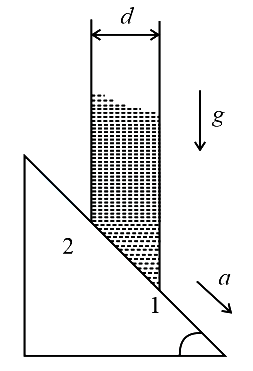 JEE Advanced 2021 Hard
 - A block \((B)\) is attached to two unstretched \(S_1\) and \(S_2\) with spring constants \(k\) and \(4 k\), respectively (see figure I). The other ends are attached to identical supports \(M_1\) and \(M_2\) not attached to the walls. The springs and supports have negligible mass. There is no friction anywhere. The block \(B\) is displaced towards wall 1 by a small distance \(x\) (figure II) and released. The block returns and moves a maximum distance \(y\) towards wall 2 . Displacements \(x\) and \(y\) are measured with respect to the equilibrium position of the block \(B\). The ratio \(\frac{y}{-1}\) is
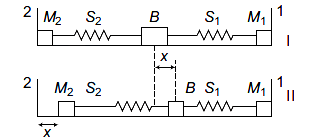 JEE Advanced 2008 Medium
 - The total number of compounds having at least one bridging oxo group among the molecules given below is
\(\text N _2\text O _5,\)\(\text P _4\text O _6,\)\(\text P _4\text O _8,\)\(\text H _4\text P _2\text O _5,\)\(\text H _5\text P _3\text O _{10},\) \(\text H _2\text S_2\text O _3,\text H _2\text S_2\text O _5\)JEE Advanced 2018 Medium - The correct option(s) to distinguish nitrate salts of taken separately is(are)JEE Advanced 2018 Easy
- Consider the square in the figure. Let be the points of intersections (dots in the picture) in some order. We say that and are friends if they are adjacent along a row or along a column. Assume that each point has an equal chance of being chosen.
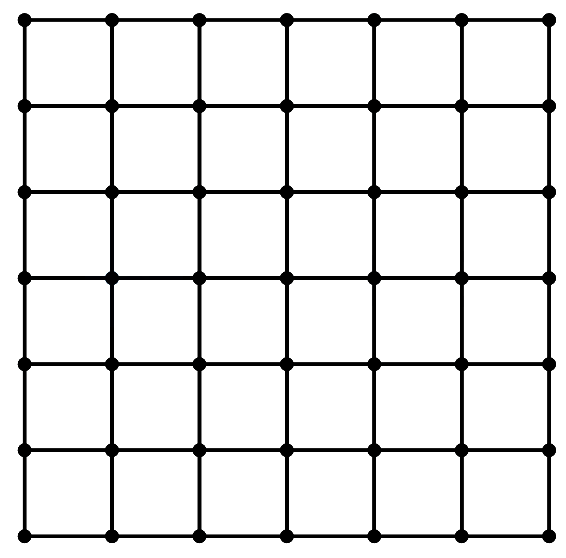
(There are two questions based on , the question given below is one of them)
Let be the probability that a randomly chosen point has many friends, . Let be a random variable such that for , the probability . Then the value of isJEE Advanced 2023 Hard - Paragraph:
Let \(U_1\) and \(U_2\) be two urns such that \(U_1\) contains 3 white and 2 red balls and \(U_2\) contains only 1 white ball. A fair coin is tossed. If head appears then 1 ball is drawn at random from \(U_1\) and put into \(U_2\). However, if tail appears then 2 balls are drawn at random from \(U_1\) and put into \(U_2\). Now, 1 ball is drawn at random from \(U_2\).Question:
The probability of the drawn ball from \(U_2\) being white isJEE Advanced 2011 Medium