


JEE Advanced · Chemistry · 21. p Block (G15-18)
The total number of compounds having at least one bridging oxo group among the molecules given below is
\(\text N _2\text O _5,\)\(\text P _4\text O _6,\)\(\text P _4\text O _8,\)\(\text H _4\text P _2\text O _5,\)\(\text H _5\text P _3\text O _{10},\) \(\text H _2\text S_2\text O _3,\text H _2\text S_2\text O _5\)
- A 5
- B 10
- C 15
- D 20
Answer & Solution
Correct Answer
(A) 5
Step-by-step Solution
Detailed explanation
See the Complete Solution
Get step-by-step explanations for this and 2.5 Lakh+ more JEE, NEET & CET questions.
- Unlock all solutions
- Practice the full chapter
- Track accuracy across PYQs
4.8 rated on Google Play · 14,000+ reviews
More questions from Chemistry
- A positron is emitted from \({ }_{11}^{23} \mathrm{Na}\). The ratio of the atomic mass and atomic number of the resulting nuclide isJEE Advanced 2007 Easy
- Consider an electrochemical cell: . The value of for the cell reaction is twice that of at If the emf of the cell is zero, the magnitude of of the cell reaction per mole of formed at is ____
(Given: R and are enthalpy, entropy and Gibbs energy, respectively.)JEE Advanced 2018 Medium - Paragraph:
A fixed mass of a gas is subjected to transformation of states from to to to and back to as shown in the figure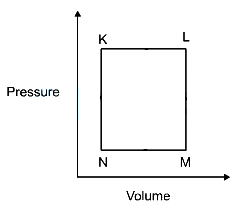
Question :
The pair of isochoric processes among the transformation of states isJEE Advanced 2013 Easy - Consider the kinetic data given in the following table for the reaction Product.
The rate of the reaction for and is found to be The value of is __________Ex
peri
ment No.\([\text A]\) \((\text{mol}\) \(\text{dm} ^{-3})\) \([\text B]\) \((\text{mol}\) \(\text{dm} ^{-3})\) \([\text C]\) \((\text{mol}\) \(\text{dm} ^{-3})\) Rate
of
reaction \((\text{mol}\) \(\text{dm} ^{-3}\) \(\text s^{-1})\)1 0.2 0.1 0.1 \(6.0 \times\) \(10^{-5}\) 2 0.2 0.2 0.1 \(6.0 \times \) \(10^{-5}\) 3 0.2 0.1 0.2 \(1.2 \times \) \(10^{-4}\) 4 0.3 0.1 0.1 \(9.0 \times \) \(10^{-5}\) JEE Advanced 2019 Medium - Paragraph:
When a metal rod \(M\) is dipped into an aqueous colourless concentrated solution of compound \(\mathrm{N}\), the solution turns light blue. Addition of aqueous \(\mathrm{NaCl}\) to the blue solution gives a white precipitate \(\mathrm{O}\). Addition of aqueous \(\mathrm{NH}_3\) dissolves \(\mathrm{O}\) and gives an intense blue solution.
Question:
The final solution containsJEE Advanced 2011 Hard - The given graph represent the variations of compressibility factor \((Z)=\frac{P V}{n R T}\) versus \(P\), for three real gases \(A, B\) and \(C\). Identify the only incorrect statement
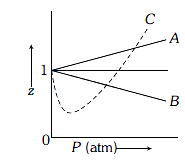
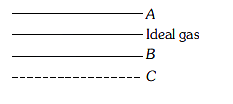 JEE Advanced 2006 Medium
More PYQs from JEE Advanced
- Axis of a parabola is \(y=x\) and vertex and focus are at a distance \(\sqrt{2}\) and \(2 \sqrt{2}\) respectively, from the origin. Then, equation of the parabola isJEE Advanced 2006 Medium
- In the complex acetylbromidodicarbonylbis(triethylphosphine)iron (II), the number of bond (s) isJEE Advanced 2015 Medium
- Paragraph:
A small block of mass \(1 \mathrm{~kg}\) is released from rest at the top of a rough track. The track is a circular arc of radius \(40 \mathrm{~m}\). The block slides along the track without toppling and a frictional force acts on it in the direction opposite to the instantaneous velocity. The work done in overcoming the friction up to the point \(Q\), as shown in the figure below, is \(150 \mathrm{~J}\). (Take the acceleration due to gravity, \(g=10 \mathrm{~m} \mathrm{~s}^{-2}\) ).
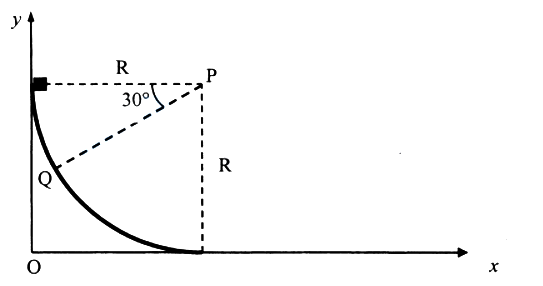
Question:
The speed of the block when it reaches the point \(Q\) isJEE Advanced 2013 Medium - Match the chemical conversions in List I with the appropriate reagents in List II and select the correct answer using the code given below the lists :
List - I List - II (A) 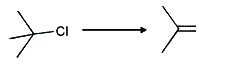
(P) (B) 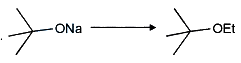
(Q) (C) 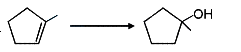
(R) (D) 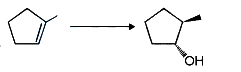
(S) JEE Advanced 2013 Hard - Let and be differentiable functions such that and , for all Then,
JEE Advanced 2016 Hard - Paragraph:
Scientists are working hard to develop nuclear fusion reactor. Nuclei of heavy hydrogen, \({ }_1^2 \mathrm{H}\) known as deuteron and denoted by \(D\) can be thought of as a candidate for fusion reactor. The \(D\) - \(D\) reaction is \({ }_1^2 \mathrm{H}+{ }_1^2 \mathrm{H} \rightarrow{ }_2^3 \mathrm{He}+n+\) energy. In the core of fusion reactor. A gas of heavy hydrogen is fully ionized into deuteron nuclei and electrons. This collection of \({ }_1^4 \mathrm{H}\) nuclei and electrons is known as plasma. The nuclei move randomly in the reactor core and occasionally come close enough for nuclear fusion to take place. Usually, the temperatures in the reactor core are too high and no material wall can be used to confine the plasma. Special techniques are used which confine the plasma for a time \(t_0\) before the particles fly away from the core. If n is the density (number/volume) of deutrons, the product t \(_0\) is called Lawson number. In one of the criteria, \(a\) reactor is termed successful if Lawson number is greater than \(5 \times 10^{14} \mathrm{scm}^{-3}\).
It may be helpful to use the following : Boltzmann constant \(k=8.6 \times 10^{-5} \mathrm{eV} / \mathrm{K}\); \(\frac{e^2}{4 \pi \varepsilon_0}=1.44 \times 10^{-9} \mathrm{eVm}\)
Question:
In the core of nuclear fusion reactor, the gas becomes plasma because ofJEE Advanced 2009 Medium