


JEE Advanced · Mathematics · 32. Probability
Paragraph:
Let \(U_1\) and \(U_2\) be two urns such that \(U_1\) contains 3 white and 2 red balls and \(U_2\) contains only 1 white ball. A fair coin is tossed. If head appears then 1 ball is drawn at random from \(U_1\) and put into \(U_2\). However, if tail appears then 2 balls are drawn at random from \(U_1\) and put into \(U_2\). Now, 1 ball is drawn at random from \(U_2\).Question:
The probability of the drawn ball from \(U_2\) being white is
- A
\(\frac{13}{30}\)
- B
\(\frac{23}{30}\)
- C
\(\frac{19}{30}\)
- D
\(\frac{11}{30}\)
Answer & Solution
Correct Answer
(B)
\(\frac{23}{30}\)
Step-by-step Solution
Detailed explanation
Now, probability of the drawn ball from \(\mathrm{V}_2\) being white is
\[
\Rightarrow P \text { (white/ } V_2 \text { ) }
\]
\[
\begin{aligned}
& \left.\Rightarrow P \text { (white/ } V_2\right) \\
& =P(H) \cdot\left\{\frac{{ }^3 C_1}{{ }^5 C_1} \times \frac{{ }^2 C_1}{{ }^2 C_1}+\frac{{ }^2 C_1}{{ }^5 C_1} \times \frac{{ }^1 C_1}{{ }^2 C_1}\right\} \\
& +P(T)\left\{\frac{{ }^3 C_2}{{ }^5 C_2} \times \frac{{ }^3 C_2}{{ }^3 C_2}+\frac{{ }^2 C_2}{{ }^5 C_2} \times \frac{{ }^1 C_1}{{ }^3 C_2}\right. \\
& \left.+\frac{{ }^3 C_1 \cdot{ }^2 C_1}{{ }^5 C_2} \times \frac{{ }^2 C_1}{{ }^3 C_2}\right\} \\
& \text { Now, } P\left(\text { white } / V_2\right)=\frac{1}{2}\left\{\frac{3}{5} \times 1+\frac{2}{5} \times \frac{1}{2}\right\} \\
& +\frac{1}{2}\left\{\frac{3}{10} \times 1+\frac{1}{10} \times \frac{1}{3}+\frac{6}{10} \times \frac{2}{3}\right\}=\frac{23}{30} \\
&
\end{aligned}
\]
\[
\Rightarrow P \text { (white/ } V_2 \text { ) }
\]
\[
\begin{aligned}
& \left.\Rightarrow P \text { (white/ } V_2\right) \\
& =P(H) \cdot\left\{\frac{{ }^3 C_1}{{ }^5 C_1} \times \frac{{ }^2 C_1}{{ }^2 C_1}+\frac{{ }^2 C_1}{{ }^5 C_1} \times \frac{{ }^1 C_1}{{ }^2 C_1}\right\} \\
& +P(T)\left\{\frac{{ }^3 C_2}{{ }^5 C_2} \times \frac{{ }^3 C_2}{{ }^3 C_2}+\frac{{ }^2 C_2}{{ }^5 C_2} \times \frac{{ }^1 C_1}{{ }^3 C_2}\right. \\
& \left.+\frac{{ }^3 C_1 \cdot{ }^2 C_1}{{ }^5 C_2} \times \frac{{ }^2 C_1}{{ }^3 C_2}\right\} \\
& \text { Now, } P\left(\text { white } / V_2\right)=\frac{1}{2}\left\{\frac{3}{5} \times 1+\frac{2}{5} \times \frac{1}{2}\right\} \\
& +\frac{1}{2}\left\{\frac{3}{10} \times 1+\frac{1}{10} \times \frac{1}{3}+\frac{6}{10} \times \frac{2}{3}\right\}=\frac{23}{30} \\
&
\end{aligned}
\]
See the Complete Solution
Get step-by-step explanations for this and 2.5 Lakh+ more JEE, NEET & CET questions.
- Unlock all solutions
- Practice the full chapter
- Track accuracy across PYQs
4.8 rated on Google Play · 14,000+ reviews
More questions from Mathematics
- Paragraph:
There are \(n\) urns each containing \((n+1)\) balls such that the ith urn contains \(i\) white balls and \((n+1-i)\) red balls. Let \(u_i\) be the event of selecting ith urn, \(i=1,2,3, \ldots, n\) and \(W\) denotes the event of getting a white balls.Question:
If \(P\left(u_i\right)=c\), where \(c\) is a constant, then \(P\left(u_i / W\right)\) is equal toJEE Advanced 2006 Medium - Equation of the plane containing the straight line \(\frac{x}{2}=\frac{y}{3}=\frac{z}{4}\) and perpendicular to the plane containing the straight lines \(\frac{x}{3}=\frac{y}{4}=\frac{z}{2}\) and \(\frac{x}{4}=\frac{y}{2}=\frac{z}{3}\) isJEE Advanced 2010 Medium
- Paragraph:
A circle \(C\) of radius 1 is inscribed in an equilateral \(\triangle P Q R\). The points of contact of \(C\) with the sides \(P Q, Q R, R P\) are \(D, E, F\) respectively. The line \(P Q\) is given by the equation
\(\sqrt{3} x+y-6=0\) and the point \(D\) is \(\left(\frac{3 \sqrt{3}}{2}, \frac{3}{2}\right)\). Further, it is given that the origin and the centre of \(C\) are on the same side of the line \(P Q\).Question:
Points \(E\) and \(F\) are given byJEE Advanced 2008 Medium - Paragraph:
Consider the lines: \(L_1: \frac{x+1}{3}=\frac{y+2}{1}=\frac{z+1}{2}, L_2: \frac{x-2}{1}=\frac{y+2}{2}=\frac{z-3}{3}\)Question:
The shortest distance between \(L_1\) and \(L_2\) isJEE Advanced 2008 Easy - Let the function \(f: \mathbb{R} \rightarrow \mathbb{R}\) be defined by
\(f(x)=\frac{\sin x}{e^{\pi x}} \frac{\left(x^{2023}+2024 x+2025\right)}{\left(x^2-x+3\right)}+\frac{2}{e^{\pi x}} \frac{\left(x^{2023}+2024 x+2025\right)}{\left(x^2-x+3\right)}\).
Then the number of solutions of \(f(x)=0\) in \(\mathbb{R}\) isJEE Advanced 2024 Medium - The value of the limit is _________JEE Advanced 2020 Medium
More PYQs from JEE Advanced
- Paragraph:
Chemical reactions involve interaction of atoms and molecules. A large number of atoms/molecules (approximately \(6.023 \times 10^{23}\) ) are present in a few grams of any chemical compound varying with their atomic/molecular masses. To handle such large numbers conveniently, the mole concept was introduced. This concept has implications in diverse areas such as analytical chemistry, biochemistry, electrochemistry and radiochemistry. The following example illustrates a typical case, involving chemical/electrochemical reaction, which requires a clear understanding of the mole concept.
A \(4.0\) molar aqueous solution of \(\mathrm{NaCl}\) is prepared and \(500 \mathrm{~mL}\) of this solution is electrolysed. This leads to the evolution of chlorine gas at one of electrodes (atomic mass: \(\mathrm{Na}=23, \mathrm{Hg}=200 ; 1\) faraday \(=96500\) coulombs).
Question:
The total charge (coulombs) required for complete electrolysis isJEE Advanced 2007 Medium - Let and be the roots of with For all positive integers define
and
Then which of the following options is/are correct?JEE Advanced 2019 Hard - and are two identical sound sources of frequency . The source is located at and moves anti-clockwise with a uniform speed on a circular path around , as shown in the figure. There are three points and on this path such that and are diametrically opposite while is equidistant from them. A sound detector is placed at point . The source can move along direction .
[Given: The speed of sound in air is ]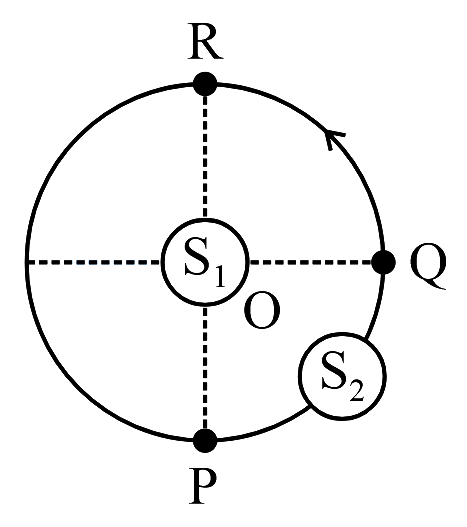
When only is emitting sound and it is at , the frequency of sound measured by the detector in is _____.JEE Advanced 2023 Easy - Let \(\alpha, \beta\) and \(\gamma\) be real numbers such that the system of linear equations
\[
\begin{array}{c}
x+2 y+3 z=\alpha \\
4 x+5 y+6 z=\beta \\
7 x+8 y+9 z=\gamma-1
\end{array}
\]
is consistent. Let \(|M|\) represent the determinant of the matrix
\[
M=\left[\begin{array}{ccc}
\alpha & 2 & \gamma \\
\beta & 1 & 0 \\
-1 & 0 & 1
\end{array}\right]
\]
Let \(P\) be the plane containing all those \((\alpha, \beta, \gamma)\) for which the above system of linear equations is consistent, and \(D\) be the square of the distance of the point \((0,1,0)\) from the plane \(P\).
The value of isJEE Advanced 2021 Medium - Paragraph:
When a particle is restricted to move along \(x\)-axis between \(x=0\) and \(x=a\), where \(a\) is of nanometer dimension, its energy can take only certain specific values. The allowed energies of the particle moving in such a restricted region, correspond to the formation of standing waves with nodes at its ends \(x=0\) and \(x=a\). The wavelength of this standing wave is related to the liner momentum \(p\) of the particle according to the de Broglie relation. The energy of the particle of mass \(m\) is related to its linear momentum as \(E=\frac{p^2}{2 m}\). Thus, the energy of the particle can be denoted by a quantum number \(n\) taking values \(1,2,3, \ldots(n=1\), called the ground state) corresponding to the number of loops in the standing wave.
Use the model described above to answer the following three questions for a particle moving in the line \(x=0\) to \(x=a\) [Take \(h=6.6 \times 10^{-34} \mathrm{Js}\) and \(e=1.6 \times 10^{-19} \mathrm{C}\) ]
Question:
The allowed energy for the particle for a particular value of \(n\) is proportional toJEE Advanced 2009 Medium - Let , be a continuous function then, which of the following function(s), has(have) the values zero at some point in the interval, (0,1)?JEE Advanced 2017 Hard