


JEE Advanced · Mathematics · 30. Vector Algebra
If \(\overrightarrow{\mathbf{a}}\) and \(\overrightarrow{\mathbf{b}}\) are vectors in space given by \(\overrightarrow{\mathbf{a}}=\frac{\hat{\mathbf{i}}-2 \hat{\mathbf{j}}}{\sqrt{5}}\) and \(\overrightarrow{\mathbf{b}}=\frac{2 \hat{\mathbf{i}}+\hat{\mathbf{j}}+3 \hat{\mathbf{k}}}{\sqrt{14}}\), then the value of \((2 \overrightarrow{\mathbf{a}}+\overrightarrow{\mathbf{b}}) \cdot[(\overrightarrow{\mathbf{a}} \times \overrightarrow{\mathbf{b}}) \times(\overrightarrow{\mathbf{a}}-2 \overrightarrow{\mathbf{b}})]\) is
- A 5
- B 10
- C 9
- D 2
Answer & Solution
Correct Answer
(A) 5
Step-by-step Solution
Detailed explanation
From the given information, it is clear that
\[
\begin{gathered}
\overrightarrow{\mathbf{a}}=\frac{\hat{\mathbf{i}}-2 \hat{\mathbf{j}}}{\sqrt{5}} \\
\Rightarrow \quad|\overrightarrow{\mathbf{a}}|=1,|\overrightarrow{\mathbf{b}}|=1, \overrightarrow{\mathbf{a}} \cdot \overrightarrow{\mathbf{b}}=0 \\
\text { Now, }(2 \overrightarrow{\mathbf{a}}+\overrightarrow{\mathbf{b}}) \cdot[(\overrightarrow{\mathbf{a}} \times \overrightarrow{\mathbf{b}}) \times(\overrightarrow{\mathbf{a}}-2 \overrightarrow{\mathbf{b}})]
\end{gathered}
\]
\[
\begin{aligned}
& =(2 \overrightarrow{\mathbf{a}}+\overrightarrow{\mathbf{b}}) \cdot\left[a^2 \overrightarrow{\mathbf{b}}-(\overrightarrow{\mathbf{a}} \cdot \overrightarrow{\mathbf{b}}) \cdot \overrightarrow{\mathbf{a}}+2 b^2 \cdot \overrightarrow{\mathbf{a}}\right. \\
& =[2 \overrightarrow{\mathbf{a}}+\overrightarrow{\mathbf{b}}] \cdot[\overrightarrow{\mathbf{b}}+2 \overrightarrow{\mathbf{a}}]=4 \overrightarrow{\mathbf{a}}^2+\overrightarrow{\mathbf{b}}^2 \\
& =4 \cdot 1+1=5 \quad \text { [as } a \cdot b=0]
\end{aligned}
\]
\[
\begin{gathered}
\overrightarrow{\mathbf{a}}=\frac{\hat{\mathbf{i}}-2 \hat{\mathbf{j}}}{\sqrt{5}} \\
\Rightarrow \quad|\overrightarrow{\mathbf{a}}|=1,|\overrightarrow{\mathbf{b}}|=1, \overrightarrow{\mathbf{a}} \cdot \overrightarrow{\mathbf{b}}=0 \\
\text { Now, }(2 \overrightarrow{\mathbf{a}}+\overrightarrow{\mathbf{b}}) \cdot[(\overrightarrow{\mathbf{a}} \times \overrightarrow{\mathbf{b}}) \times(\overrightarrow{\mathbf{a}}-2 \overrightarrow{\mathbf{b}})]
\end{gathered}
\]
\[
\begin{aligned}
& =(2 \overrightarrow{\mathbf{a}}+\overrightarrow{\mathbf{b}}) \cdot\left[a^2 \overrightarrow{\mathbf{b}}-(\overrightarrow{\mathbf{a}} \cdot \overrightarrow{\mathbf{b}}) \cdot \overrightarrow{\mathbf{a}}+2 b^2 \cdot \overrightarrow{\mathbf{a}}\right. \\
& =[2 \overrightarrow{\mathbf{a}}+\overrightarrow{\mathbf{b}}] \cdot[\overrightarrow{\mathbf{b}}+2 \overrightarrow{\mathbf{a}}]=4 \overrightarrow{\mathbf{a}}^2+\overrightarrow{\mathbf{b}}^2 \\
& =4 \cdot 1+1=5 \quad \text { [as } a \cdot b=0]
\end{aligned}
\]
See the Complete Solution
Get step-by-step explanations for this and 2.5 Lakh+ more JEE, NEET & CET questions.
- Unlock all solutions
- Practice the full chapter
- Track accuracy across PYQs
4.8 rated on Google Play · 14,000+ reviews
More questions from Mathematics
- Paragraph:
A fair die is tossed repeatedly until a six is obtained. Let \(X\) denotes the number of tosses required.Question:
The conditional probability that \(X \geq 6\) given \(X>3\) equalsJEE Advanced 2009 Medium - For a non-zero complex number \(z\), let \(\arg (z)\) denote the principal argument of \(z\), with \(-\pi <\arg (z) \leq \pi\). Let \(\omega\) be the cube root of unity for which \(0 <\arg (\omega) <\pi\). Let \(\alpha=\arg \left(\sum_{n=1}^{2025}(-\omega)^n\right)\).
Then the value of \(\frac{3 \alpha}{\pi}\) is ___________JEE Advanced 2025 Easy - The positive integer value of \(n>3\) satisfying the equation
\(\frac{1}{\sin \left(\frac{\pi}{n}\right)}=\frac{1}{\sin \left(\frac{2 \pi}{n}\right)}+\frac{1}{\sin \left(\frac{3 \pi}{n}\right)} \text { is }\)JEE Advanced 2011 Hard - Let be a complex cube root of unity with and be a n x n matrix with . Then , when n =JEE Advanced 2013 Hard
- Area of the region is equal toJEE Advanced 2016 Medium
- Let \(\alpha, \beta\) and \(\gamma\) be real numbers such that the system of linear equations
\[
\begin{array}{c}
x+2 y+3 z=\alpha \\
4 x+5 y+6 z=\beta \\
7 x+8 y+9 z=\gamma-1
\end{array}
\]
is consistent. Let \(|M|\) represent the determinant of the matrix
\[
M=\left[\begin{array}{ccc}
\alpha & 2 & \gamma \\
\beta & 1 & 0 \\
-1 & 0 & 1
\end{array}\right]
\]
Let \(P\) be the plane containing all those \((\alpha, \beta, \gamma)\) for which the above system of linear equations is consistent, and \(D\) be the square of the distance of the point \((0,1,0)\) from the plane \(P\).
The value of isJEE Advanced 2021 Easy
More PYQs from JEE Advanced
- Bombardment of aluminium by \(\alpha\)-particle leads to its artificial disintegration in two ways, (i) and (ii) as shown. Products \(X, Y\) and \(Z\) respectively are
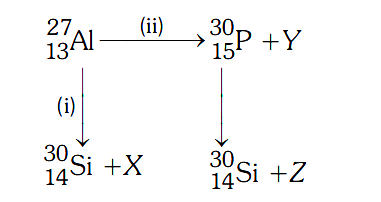 JEE Advanced 2011 Easy
 - The \(\beta\)-decay process, discovered around 1900 , is basically the decay of a neutron \((n)\). In the laboratory, a proton \((p)\) and an electron \(\left(e^{-}\right)\)are observed as the decay products of the neutron. Therefore, considering the decay of a neutron as a two-body decay process, it was predicted theoretically that the kinetic energy of the electron should be a constant. But experimentally, it was observed that the electron kinetic energy has continuous spectrum. Considering a three-body decay process, i.e.
\(n \rightarrow p+e^{-}+\bar{v}_{e}\), around 1930, Pauli explained the observed electron energy spectrum. Assuming the anti-neutrino \(\left(\bar{v}_{e}\right)\) to be massless and possessing negligible energy, and the neutron to be at rest, momentum and energy conservation principles are applied. From this calculation, the maximum kinetic energy of the electron is \(0.8 \times 10^{6} \mathrm{eV}\). The kinetic energy carried by the proton is only the recoil energy.
Question:
If the anti-neutrino had a mass of \(3 \mathrm{eV} / \mathrm{c}^{2}\) (where \(\mathrm{c}\) is the speed of light) instead of zero mass, what should be the range of the kinetic energy, \(K\), of the electron?JEE Advanced 2012 Hard - In a let , be the lengths of sides opposite to the angles, , respectively and If and area of incircle of the triangle XYZ is thenJEE Advanced 2016 Hard
- Monocyclic compounds \(\mathbf{P}, \mathbf{Q}, \mathbf{R}\) and \(\mathbf{S}\) are the major products formed in the reaction sequences given below.
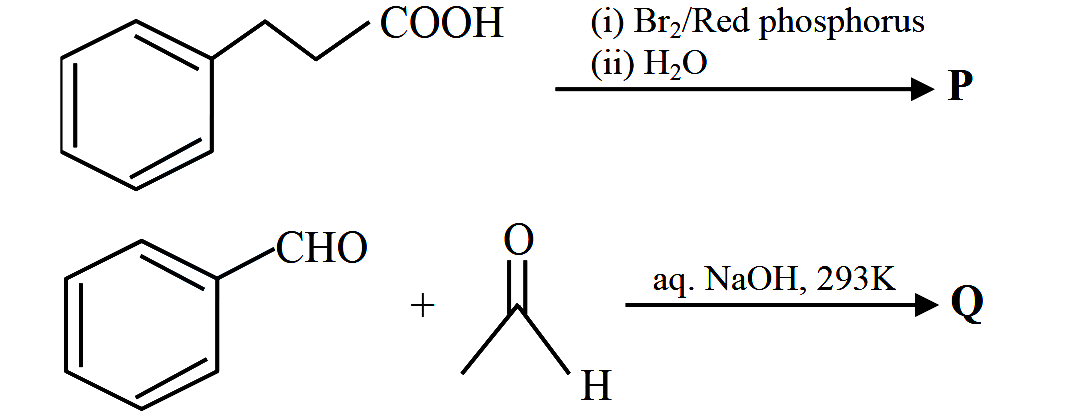
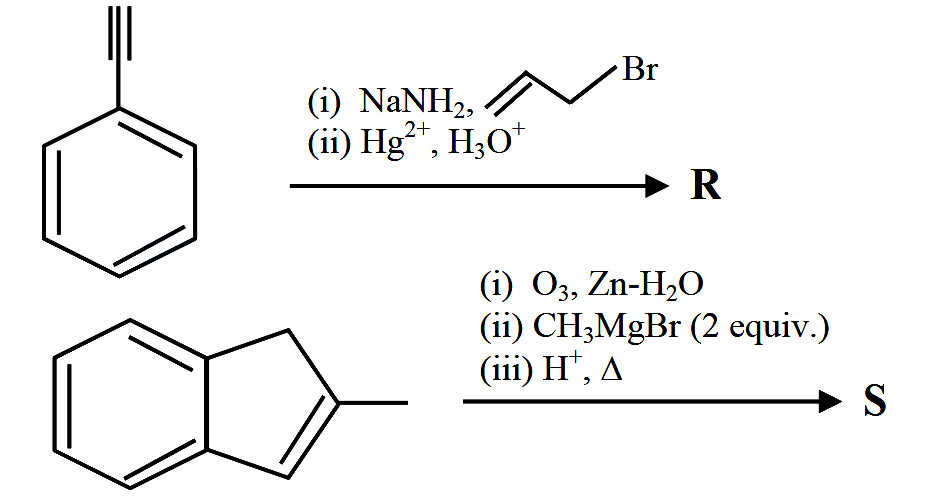
The product having the highest number of unsaturated carbon atom(s) is-JEE Advanced 2025 Hard - Paragraph:
The key feature of Bohr's theory of spectrum of hydrogen atom is the quantization of angular momentum when an electron is revolving around a proton. We will extend this to a general rotational motion to find quantized rotational energy of a diatomic molecule assuming it to be rigid. The rule to be applied is Bohr's quantization condition.
Question:
A diatomic molecule has moment of inertia I. By Bohr's quantization condition its rotational energy in the \(n\)th level ( \(n=0\) is not allowed) isJEE Advanced 2010 Medium - Paragraph:
Two trains \(A\) and \(B\) are moving with speeds \(20 \mathrm{~m} / \mathrm{s}\) and \(30 \mathrm{~m} / \mathrm{s}\), respectively in the same direction on the same straight track, with \(B\) ahead of \(A\). The engines are at the front ends. The engine of train \(A\) blows a long whistle.
Assume that the sound of the whistle is composed of components varying in frequency from \(f_1=800 \mathrm{~Hz}\) to \(f_2=1120 \mathrm{~Hz}\), as shown in the figure. The spread in the frequency (highest frequency - lowest frequency) is thus \(320 \mathrm{~Hz}\). The speed of sound in still air is \(340 \mathrm{~m} / \mathrm{s}\).
Question:
The speed of sound of the whistle isJEE Advanced 2007 Medium