


JEE Advanced · Chemistry · 18. Chemical Kinetics
Under the same reaction conditions, initial concentration of \(1.386 \mathrm{~mol} \mathrm{dm}^{-3}\) of a substance becomes half in 40 s and 20 s through first-order and zero-order kinetics, respectively. Ratio \(\left(\frac{k_1}{k_0}\right)\) of the rate constants for first order \(\left(k_1\right)\) and zero \(\operatorname{order}\left(k_0\right)\) of the reaction is
- A \(0.5 \mathrm{~mol}^{-1} \mathrm{dm}^3\)
- B \(1.0 \mathrm{~mol} \mathrm{dm}^3\)
- C \(1.5 \mathrm{~mol} \mathrm{dm}^3\)
- D \(2.0 \mathrm{~mol}^{-1} \mathrm{dm}^3\)
Answer & Solution
Correct Answer
(A) \(0.5 \mathrm{~mol}^{-1} \mathrm{dm}^3\)
Step-by-step Solution
Detailed explanation
First order kinetics, \(k_1=\frac{0.693}{t_{1 / 2}}=\frac{0.693}{40} \mathrm{~s}^{-1}\)
Zero order kinetics, \(k_1=\frac{C_0}{2 t_{1 / 2}}=\frac{1.386}{2 \times 20}\)
Hence, \(\frac{k_1}{k_0}=\frac{0.693}{1.386}=0.5\)
Zero order kinetics, \(k_1=\frac{C_0}{2 t_{1 / 2}}=\frac{1.386}{2 \times 20}\)
Hence, \(\frac{k_1}{k_0}=\frac{0.693}{1.386}=0.5\)
See the Complete Solution
Get step-by-step explanations for this and 2.5 Lakh+ more JEE, NEET & CET questions.
- Unlock all solutions
- Practice the full chapter
- Track accuracy across PYQs
4.8 rated on Google Play · 14,000+ reviews
More questions from Chemistry
- The work function ( \(\Phi\) ) of some metals is listed below. The number of metals which will show photoelectric effect when light of \(300 \mathrm{~nm}\) wavelength falls on the metal is
 JEE Advanced 2011 Easy
 - The number of stereoisomers obtained by bromination of trans-2-butene isJEE Advanced 2007 Medium
- With reference to aqua regia, choose the correct option(s).JEE Advanced 2019 Hard
- Match the compounds in Column I with their characteristic test(s)/reactions(s) given in Column II. Indicate your answer by darkening the appropriate bubbles of the \(4 \times 4\) matrix given in the ORS.
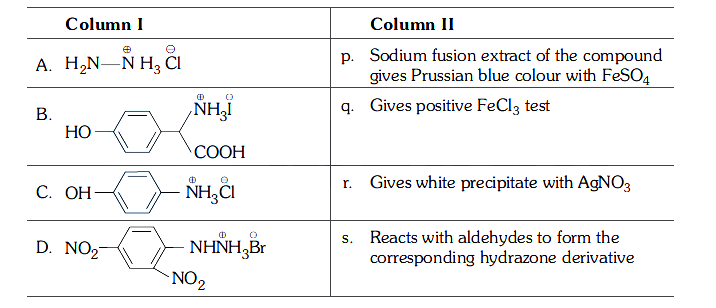 JEE Advanced 2008 Medium
 - Paragraph I: An organic compound \(\mathbf{P}\) with molecular formula \(\mathrm{C}_9 \mathrm{H}_{18} \mathrm{O}_2\) decolorizes bromine water and also shows positive iodoform test. \(\mathbf{P}\) on ozonolysis followed by treatment with \(\mathrm{H}_2 \mathrm{O}_2\) gives \(\mathbf{Q}\) and \(\mathbf{R}\). While compound \(\mathbf{Q}\) shows positive iodoform test, compound \(\mathbf{R}\) does not give positive iodoform test. \(\mathbf{Q}\) and \(\mathbf{R}\) on oxidation with pyridinium chlorochromate (PCC) followed by heating give \(\mathbf{S}\) and \(\mathbf{T}\), respectively. Both \(\mathbf{S}\) and \(\mathbf{T}\) show positive iodoform test.
Complete copolymerization of 500 moles of \(\mathbf{Q}\) and 500 moles of \(\mathbf{R}\) gives one mole of a single acyclic copolymer \(\mathbf{U}\).
[Given, atomic mass: \(\mathrm{H}=1, \mathrm{C}=12, \mathrm{O}=16\)]
Question: Sum of number of oxygen atoms in \(\mathbf{S}\) and \(\mathbf{T}\) isJEE Advanced 2024 Medium - Among \(\left[\mathrm{Co}(\mathrm{CN})_4\right]^{4-},\left[\mathrm{Co}(\mathrm{CO})_3(\mathrm{NO})\right], \mathrm{XeF}_4,\left[\mathrm{PCl}_4\right]^{+},\)\(\left[\mathrm{PdCl}_4\right]^{2-},\left[\mathrm{ICl}_4\right]^{-},\left[\mathrm{Cu}(\mathrm{CN})_4\right]^{3-}\) and \(\mathrm{P}_4\) the total number of species with tetrahedral geometry is _______JEE Advanced 2024 Easy
More PYQs from JEE Advanced
- Paragraph :
A uniform thin cylindrical disk of mass \(M\) and radius \(R\) is attached to two identical massless springs of spring constant \(k\) which are fixed to the wall as shown in the figure. The springs are attached to the axle of the disk symmetrically on either side at a distance \(d\) from its centre. The axle is massless and both the springs and the axle are in a horizontal plane. The unstretched length of each spring is \(L\). The disk is initially at its equilibrium position with its centre of mass \((C M)\) at a distance Lfrom the wall. The disk rolls without slipping with velocity \(\mathbf{v}_0=v_0 \hat{\mathbf{i}}\) The coefficient of friction is \(\mu\).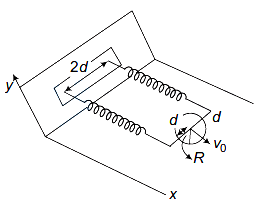
Question :
The maximum value of \(v_0\) for which the disk will roll without slipping isJEE Advanced 2008 Easy - Statement I p-hydroxybenzoic acid has a lower boiling point than o-hydroxybenzoic acid.
Statement II o-hydroxybenzoic acid has intramolecular hydrogen bonding.JEE Advanced 2007 Medium - A biconvex lens of focal length \(f\) forms a circular image of radius \(r\) of sun in focal plane. Then, which option is correct?JEE Advanced 2006 Medium
- Among the following complexes, the total number of diamagnetic species is_____
\(\left[\mathrm{Mn}\left(\mathrm{NH}_3\right)_6\right]^{3+},\left[\mathrm{MnCl}_6\right]^{3-},\left[\mathrm{FeF}_6\right]^{3-},\left[\mathrm{CoF}_6\right]^{3-},\)\(\left[\mathrm{Fe}\left(\mathrm{NH}_3\right)_6\right]^{3+}\), and \(\left[\mathrm{Co}(\mathrm{en})_3\right]^{3+}\)
[Given, atomic number: \(\mathrm{Mn}=25, \mathrm{Fe}=26, \mathrm{Co}=27\);
\(\text { en } \left.=\mathrm{H}_2 \mathrm{NCH}_2 \mathrm{CH}_2 \mathrm{NH}_2\right]\)JEE Advanced 2024 Easy - Paragraph:
A box \(B_{1}\) contains \(1\) white ball, \(3\) red balls and \(2\) black balls. Another box \(B_{2}\) contains \(2\) white balls, \(3\) red balls and \(4\) black balls. A third box \(B_{3}\) contains \(3\) white balls, \(4\) red balls and \(5\) black balls.
Question:
If \(1\) ball is drawn from each of the boxes \(B_{1}, B_{2}\) and \(B_{3}\), the probability that all \(3\) drawn balls are of the same colour isJEE Advanced 2013 Medium - The number of values of \(\theta\) in the interval \(\left(-\frac{\pi}{2}, \frac{\pi}{2}\right)\) such that \(\theta \neq \frac{n \pi}{5}\) for \(n=0, \pm 1, \pm 2\) and \(\tan \theta=\cot 5 \theta\) as well as \(\sin 2 \theta=\cos 4 \theta\) isJEE Advanced 2010 Easy