


JEE Advanced · Mathematics · 13. Parabola
Consider the region \(R=\left\{(x, y) \in \mathbb{R} \times \mathbb{R}: x \geq 0\right.\) and \(\left.y^{2} \leq 4-x\right\}\). Let \(\mathcal{F}\) be the family of all circles that are contained in \(R\) and have centers on the \(x\)-axis. Let \(C\) be the circle that has largest radius among the circles in \(\mathcal{F}\). Let \((\alpha, \beta)\) be a point where the circle \(C\) meets the curve \(y^{2}=4-x\).
The value of is _____.
- A 4
- B 5
- C 3
- D 2
Answer & Solution
Correct Answer
(D) 2
Step-by-step Solution
Detailed explanation
equation of normal at is Passing through
See the Complete Solution
Get step-by-step explanations for this and 2.5 Lakh+ more JEE, NEET & CET questions.
- Unlock all solutions
- Practice the full chapter
- Track accuracy across PYQs
4.8 rated on Google Play · 14,000+ reviews
More questions from Mathematics
- Paragraph:
Let \(a\), b and \(c\) be three real numbers satisfying \(\left[\begin{array}{lll}a & b & c\end{array}\right]\left[\begin{array}{lll}1 & 9 & 7 \\ 8 & 2 & 7 \\ 7 & 3 & 7\end{array}\right]=\left[\begin{array}{lll}0 & 0 & 0\end{array}\right]\)Question:
Let \(b=6\), with \(a\) and \(c\) satisfying Eq. (E). If \(\alpha\) and \(\beta\) are the roots of the quadratic equation \(a x^2+b x+c=0\), then \(\sum_{n=0}^{\infty}\left(\frac{1}{\alpha}+\frac{1}{\beta}\right)^n\) isJEE Advanced 2011 Easy - Let \(f:(-1,1) \rightarrow I R\) be such that \(f(\cos 4 \theta)=\frac{2}{2-\sec ^{2} \theta}\) for \(\theta \in\left(0, \frac{\pi}{4}\right) \cup\left(\frac{\pi}{4}, \frac{\pi}{2}\right)\). Then the value (s) of \(f\left(\frac{1}{3}\right)\) is (are)JEE Advanced 2012 Medium
- For all \(x>0\), let \(y_1(x), y_2(x)\), and \(y_3(x)\) be the functions satisfying
\(\begin{aligned} & \frac{d y_1}{d x}-(\sin x)^2 y_1=0, y_1(1)=5 \\ & \frac{d y_2}{d x}-(\cos x)^2 y_2=0, y_2(1)=\frac{1}{3} \\ & \frac{d y_3}{d x}-\left(\frac{2-x^3}{x^3}\right) y_3=0, y_3(1)=\frac{3}{5 e}\end{aligned}\)
respectively. Then \(\lim _{x \rightarrow 0^{+}} \frac{y_1(x) y_2(x) y_3(x)+2 x}{e^{3 x} \sin x}\) is equal to _____JEE Advanced 2025 Hard - Consider a triangle \(A B C\) and let \(a, b\) and \(c\) denote the lengths of the sides opposite to vertices \(A, B\) and \(C\) respectively. Suppose \(a=6, b=10\) and the area of the triangle is \(15 \sqrt{3}\). If \(\angle A C B\) is obtuse and if \(r\) denotes the radius of the incircle of the triangle, then \(r^2\) is equal toJEE Advanced 2010 Easy
- Let be two planes. Then, which of the following statement(s) is (are) TRUE?JEE Advanced 2018 Medium
- Let \(a\) and \(b\) be two nonzero real numbers. If the coefficient of \(x^5\) in the expansion of \(\left(a x^2+\frac{70}{27 b x}\right)^4\) is equal to the coefficient of \(x^{-5}\) in the expansion of \(\left(a x-\frac{1}{b x^2}\right)^7\), then the value of \(2 b\) isJEE Advanced 2023 Easy
More PYQs from JEE Advanced
- Paragraph:
Consider the functions defined implicitly by the equation \(y^3-3 y+x=0\) on various intervals in the real line. If \(x \in(-\infty,-2) \cup(2, \infty)\), the equation implicitly defines a unique real valued differentiable function \(y=f(x)\). If \(x \in(-2,2)\), the equation implicitly defines a unique real valued differentiable function \(y=g(x)\), satisfying \(g(0)=0\).Question:
\(\int_{-1}^1 g^{\prime}(x) d x\) is equal toJEE Advanced 2008 Medium - One mole of a monatomic ideal gas is taken through a cycle \(A B C D A\) as shown in the \(p\)-V diagram. Column II gives the characteristics involved in the cycle. Match them with each of the processes given in Column I.
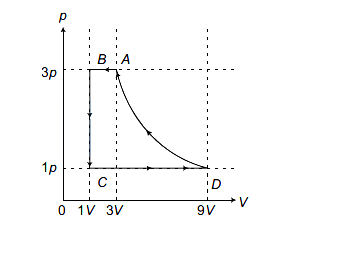
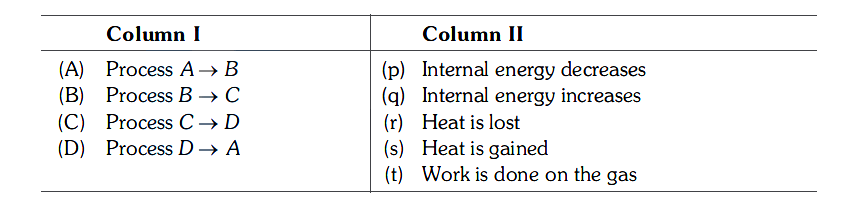 JEE Advanced 2011 Medium
 - Two capacitors with capacitance values and are connected in series. The voltage applied across this combination is . The percentage error in the calculation of the energy stored in this combination of capacitors is __________.JEE Advanced 2020 Medium
- Let and be positive real numbers. Suppose and are the lengths of the sides of a triangle opposite to its angles and respectively. If , then which of the following statements is/are TRUE?JEE Advanced 2020 Medium
- Let \(I=\int \frac{e^x}{e^{4 x}+e^{2 x}+1} d x, J=\int \frac{e^{-x}}{e^{-4 x}+e^{-2 x}+1} d x\).
Then, for an arbitrary constant \(C\), the value of \(J-I\) equalsJEE Advanced 2008 Easy - Words of length are formed using the letters A, B, C, D, E, F, G, H, I, J. Let be the number of such words where no letter is repeated; and let be the number of such words where exactly one letter is repeated twice and no other letter is repeated. The,JEE Advanced 2017 Medium