


JEE Advanced · Mathematics · 18. Matrices
Paragraph:
Let \(a\), b and \(c\) be three real numbers satisfying \(\left[\begin{array}{lll}a & b & c\end{array}\right]\left[\begin{array}{lll}1 & 9 & 7 \\ 8 & 2 & 7 \\ 7 & 3 & 7\end{array}\right]=\left[\begin{array}{lll}0 & 0 & 0\end{array}\right]\)Question:
Let \(b=6\), with \(a\) and \(c\) satisfying Eq. (E). If \(\alpha\) and \(\beta\) are the roots of the quadratic equation \(a x^2+b x+c=0\), then \(\sum_{n=0}^{\infty}\left(\frac{1}{\alpha}+\frac{1}{\beta}\right)^n\) is
- A
6
- B
7
- C
\(\frac{6}{7}\)
- D
\(\infty\)
Answer & Solution
Correct Answer
(B)
7
Step-by-step Solution
Detailed explanation
\[
\begin{aligned}
& \text { Given, }[a b c]_{1 \times 3}\left[\begin{array}{lll}
1 & 9 & 7 \\
8 & 2 & 7 \\
7 & 3 & 7
\end{array}\right]_{3 \times 3}=\left[\begin{array}{lll}
0 & 0 & 0
\end{array}\right] \\
& \Rightarrow \quad\left[\begin{array}{c}
a+8 b+7 c \\
9 a+2 b+3 c \\
7 a+7 b+7 c
\end{array}\right]=\left[\begin{array}{l}
0 \\
0 \\
0
\end{array}\right] \\
& \Rightarrow \quad a+8 b+7 c=0 \\
& \Rightarrow 9 a+2 b+3 c=0 \\
& \Rightarrow \quad a+b+c=0 \\
&
\end{aligned}
\]
On multiplying Eq. (iii) by 2 , then subtract from Eq. (ii), we get
\[
7 a+c=0
\]
Again multiplying Eq. (iii) by 3 , then subtract from Eq. (ii), we get
\[
\begin{array}{ll}
& 6 a-b=0 \\
\therefore \quad & b=6 a \text { and } c=-7 a
\end{array}
\]
If \(b=6, a=1\) and \(c=-7\)
\[
\begin{array}{ll}
\therefore & a x^2+b x+c=0 \\
\Rightarrow & x^2+6 x-7=0 \\
\Rightarrow & (x+7)(x-1)=0 \\
\therefore & x=1,-7 \\
\Rightarrow & \quad \sum_{n=0}^{\infty}\left(\frac{1}{1}-\frac{1}{7}\right)^n \Rightarrow \sum_{n=0}^{\infty}\left(\frac{6}{7}\right)^n \\
\Rightarrow & 1+\frac{6}{7}+\left(\frac{6}{7}\right)^n+\ldots \infty \\
& =\frac{1}{1-\frac{6}{7}}=\frac{1}{1 / 7}=7
\end{array}
\]
\begin{aligned}
& \text { Given, }[a b c]_{1 \times 3}\left[\begin{array}{lll}
1 & 9 & 7 \\
8 & 2 & 7 \\
7 & 3 & 7
\end{array}\right]_{3 \times 3}=\left[\begin{array}{lll}
0 & 0 & 0
\end{array}\right] \\
& \Rightarrow \quad\left[\begin{array}{c}
a+8 b+7 c \\
9 a+2 b+3 c \\
7 a+7 b+7 c
\end{array}\right]=\left[\begin{array}{l}
0 \\
0 \\
0
\end{array}\right] \\
& \Rightarrow \quad a+8 b+7 c=0 \\
& \Rightarrow 9 a+2 b+3 c=0 \\
& \Rightarrow \quad a+b+c=0 \\
&
\end{aligned}
\]
On multiplying Eq. (iii) by 2 , then subtract from Eq. (ii), we get
\[
7 a+c=0
\]
Again multiplying Eq. (iii) by 3 , then subtract from Eq. (ii), we get
\[
\begin{array}{ll}
& 6 a-b=0 \\
\therefore \quad & b=6 a \text { and } c=-7 a
\end{array}
\]
If \(b=6, a=1\) and \(c=-7\)
\[
\begin{array}{ll}
\therefore & a x^2+b x+c=0 \\
\Rightarrow & x^2+6 x-7=0 \\
\Rightarrow & (x+7)(x-1)=0 \\
\therefore & x=1,-7 \\
\Rightarrow & \quad \sum_{n=0}^{\infty}\left(\frac{1}{1}-\frac{1}{7}\right)^n \Rightarrow \sum_{n=0}^{\infty}\left(\frac{6}{7}\right)^n \\
\Rightarrow & 1+\frac{6}{7}+\left(\frac{6}{7}\right)^n+\ldots \infty \\
& =\frac{1}{1-\frac{6}{7}}=\frac{1}{1 / 7}=7
\end{array}
\]
See the Complete Solution
Get step-by-step explanations for this and 2.5 Lakh+ more JEE, NEET & CET questions.
- Unlock all solutions
- Practice the full chapter
- Track accuracy across PYQs
4.8 rated on Google Play · 14,000+ reviews
More questions from Mathematics
- Let and be distinct points on the parabola such that a circle with as diameter passes through the vertex of the parabola. If lies in the first quadrant and the area of the triangle is then which of the following is (are) the coordinates of ?JEE Advanced 2015 Medium
- Let be the origin and and for some If then which of the following statements is (are) TRUE?JEE Advanced 2021 Medium
- Paragraph:
Let \(A\) be the set of all \(3 \times 3\) symmetric matrices all of whose entries are either 0 or 1 . Five of these entries are 1 and four of them are 0 .Question:
The number of matrices \(A\) in \(A\) for which the system of linear equations \(A\left[\begin{array}{l}x \\ y \\ z\end{array}\right]=\left[\begin{array}{l}1 \\ 0 \\ 0\end{array}\right]\) has a unique solution, isJEE Advanced 2009 Easy - The locus of the orthocentre of the triangle formed by the lines \((1+p) x-p y+p(1+p)=0\), \((1+q) x-q y+q(1+q)=0\) and \(y=0\), where \(p \neq q\), isJEE Advanced 2009 Hard
- Let and be defined by . Then is -JEE Advanced 2016 Easy
- Let \(\omega=e^{i \pi / 3}\) and \(a, b, c, x, y, z\) be non-zero complex numbers such that \(a+b+c=x, a+b \omega+c \omega^2=y, a+b \omega^2+c \omega=z\).
Then, the value of \(\frac{|x|^2+|y|^2+|z|^2}{|a|^2+|b|^2+|c|^2}\) isJEE Advanced 2011 Hard
More PYQs from JEE Advanced
- For \(0 < \theta < \frac{\pi}{2}\), the solution(s) of \(\sum_{m=1}^6 \operatorname{cosec}\left[\theta+\frac{(m-1) \pi}{4}\right]\) \(\operatorname{cosec}\left(\theta+\frac{m \pi}{4}\right)=4 \sqrt{2}\) is/areJEE Advanced 2009 Hard
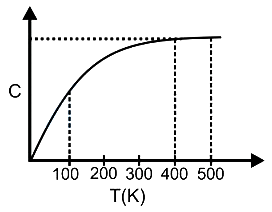
- The figure below shows the variation of specific heat capacity () of a solid as a function of temperature (). The temperature is increased continuously from to at a constant rate. Ignoring any volume change, the following statement (s) is (are) correct to a reasonable approximation.
 JEE Advanced 2013 Medium
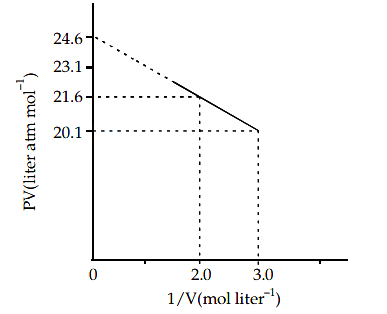
 - For one mole of a van der Waal's gas when \(b=0\) and \(\mathrm{T}=300 \mathrm{~K}\), the PV vs, \(1 / \mathrm{V}\) plot is shown below. The value of the van der Waal's constant \(a\) (atm. liter \({ }^{2} \mathrm{~mol}^{-2}\) ) is :
 JEE Advanced 2012 Easy
 - Paragraph:
Let \(a\), b and \(c\) be three real numbers satisfying \(\left[\begin{array}{lll}a & b & c\end{array}\right]\left[\begin{array}{lll}1 & 9 & 7 \\ 8 & 2 & 7 \\ 7 & 3 & 7\end{array}\right]=\left[\begin{array}{lll}0 & 0 & 0\end{array}\right]\)Question:
If the point \(P(a, b, c)\), with reference to Eq. (E), lies on the plane \(2 x+y+z=1\), then the value of \(7 a+b+c\) isJEE Advanced 2011 Easy - Paragraph:
Read the following passage and answer the questions.
Let \(A B C D\) be a square of side length 2 units. \(C_2\) is the circle through vertices \(A, B, C, D\) and \(C_1\) is the circle touching all the sides of square \(A B C D\). \(L\) is the line through \(A\).Question:
A circle touches the line \(L\) and the circle \(C_1\) externally such that both the circles are on the same side of the line, then the locus of centre of the circle isJEE Advanced 2006 Medium - The number of -digit integers in the closed interval formed by using the digits is ______.JEE Advanced 2022 Hard